
01 — Big Theme
Warmth & Emotional Comfort
The shift away from cold minimalism toward spaces that feel tactile, grounding, and genuinely restorative. Material first — the aesthetic follows.
02 — Big Theme
Nature as Design Philosophy
Nature has moved from trend to foundational principle. Organic form, material honesty, and connection to seasonal light treated as spatial decisions, not decorative additions.
03 — Big Theme
Quiet Luxury
Craftsmanship, material quality, and longevity over trend-driven decoration. Honed stone, aged brass, and furniture built to last decades rather than seasons.
04 — Big Theme
Personal Narrative & Nostalgia
The algorithm-curated interior is losing authority. People are decorating with objects that carry meaning — the brief is no longer “make it look like this” but “make it feel like us.”
05 — Big Theme
Sustainability as Standard
Natural fibres, reclaimed materials, and low-waste production specified as default. Surfaces that show how they were made and age in ways that improve rather than degrade.
06 — Big Theme
The Tech-Calm Retreat
Digital fatigue producing a clear design response — homes that actively counteract constant connectivity through warm lighting, tactile materials, and discreetly integrated technology.
01 — 2026 Trend Direction
Warm Minimalism
Minimalism without the chill. Restraint and negative space grounded in boucle, limewash, and honed travertine — the palette unified across every tactile surface simultaneously.
02 — 2026 Trend Direction
Modern Organic
The most commercially durable direction in contemporary residential design. Sculptural curved form, warm neutral palette, and materials that are natural or a credible expression of nature at its most tactile.
03 — 2026 Trend Direction
Japandi Evolution
No longer a trend — a settled design philosophy with a maturing tradition. The 2026 iteration is more rigorous: imperfection intentional, negative space actively designed, editing more absolute.
04 — 2026 Trend Direction
Mediterranean Soft Neutrals
The plaster-warm, sun-bleached quietness of a Provençal farmhouse — not saturated cobalt and terracotta. Warmth and airiness without the drama. The wall surface carries this aesthetic more than anything else.
05 — 2026 Trend Direction
Soft Industrial
Urban edge without harshness. Rounded silhouettes against raw structure, warm-toned metals replacing chrome, generous textiles absorbing concrete’s acoustic hardness. The rawness preserved; the coldness resolved.
06 — 2026 Trend Direction
Retro & Vintage Revival
Not recreating a specific decade — using the material intelligence of the past as counterweight to the flatness of contemporary production. One genuinely good vintage piece does more for a room’s character than an entire period recreation.
07 — 2026 Trend Direction
Color Drenching
A single hue applied to every surface — walls, trim, ceiling — without interruption. The room becomes an experience rather than a composition. Sheen level across surfaces is the most important technical variable.
08 — 2026 Trend Direction
Crafted Maximalism
The intelligent counter-movement to quiet minimalism. Every layer of pattern, object, and colour chosen with the same rigour a minimalist would apply to a single surface. The difference from chaos is always curation, never volume.
09 — 2026 Trend Direction
Neo Deco
Art Deco’s geometric precision and material richness, stripped of its period excess. Warm metals, deep immersive palettes, and edited glamour. The design language for clients who find restraint too passive and maximalism too demanding.
1. Why Are Interiors Moving Toward Warmth and Emotional Comfort?
Styles driving this: Japandi
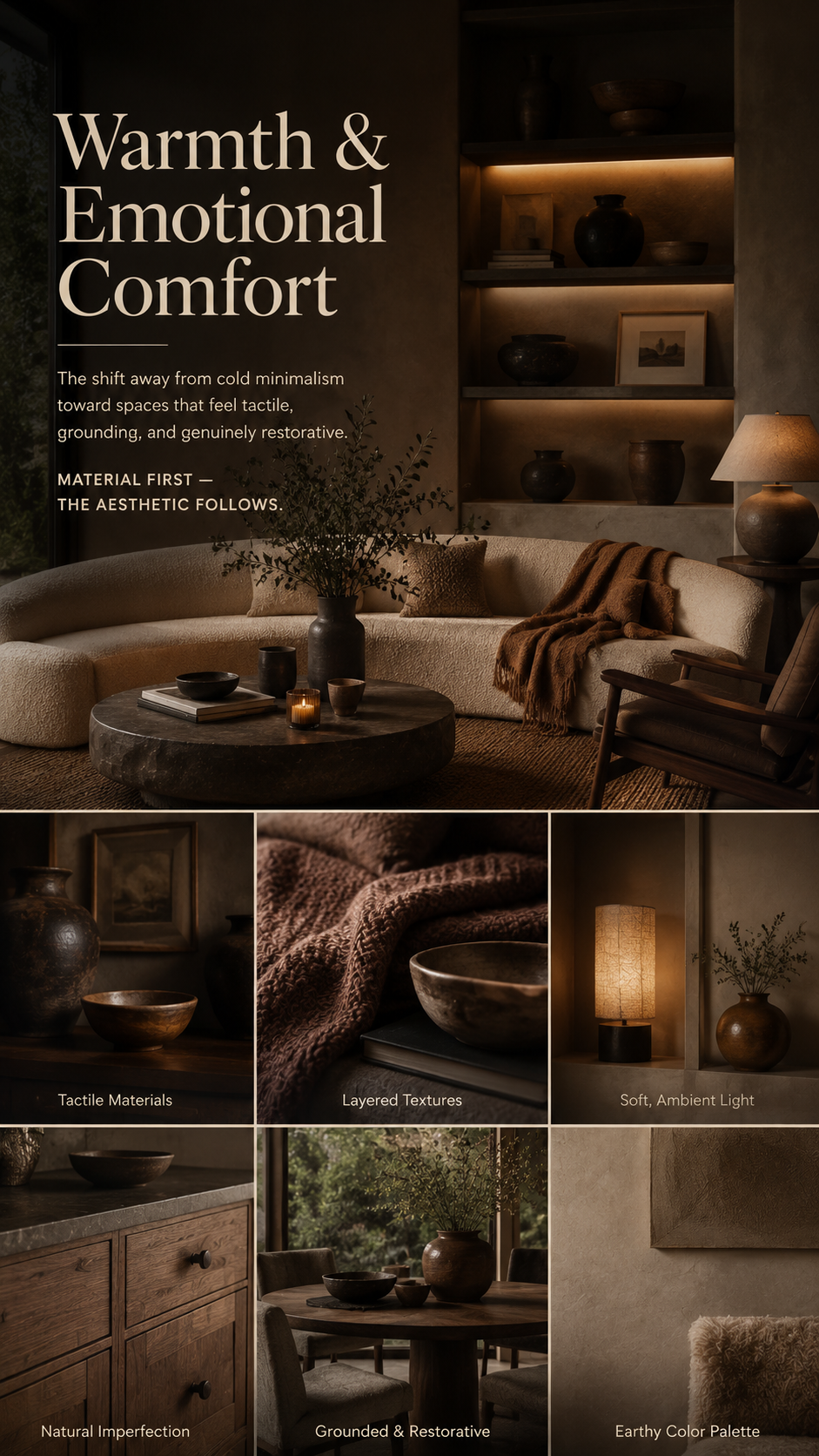
The shift away from cold minimalism is the defining movement in contemporary residential design. Post-pandemic living established a clear preference: homes should feel calm, grounding, and tactile.
The sterile all-white interior is being replaced by spaces that use texture, warm material, and softer form to create rooms that feel genuinely restorative rather than merely photogenic.
In practice this means boucle over linen-cotton, limewash over flat emulsion, walnut over pale oak. The shift is material first — the aesthetic follows from the choice to prioritise physical warmth over visual crispness.
2. How Is Nature Influencing Interior Design in 2026?
Styles driving this: Biophilic · Organic Modern · Wabi-Sabi | Color: Greens and botanicals →
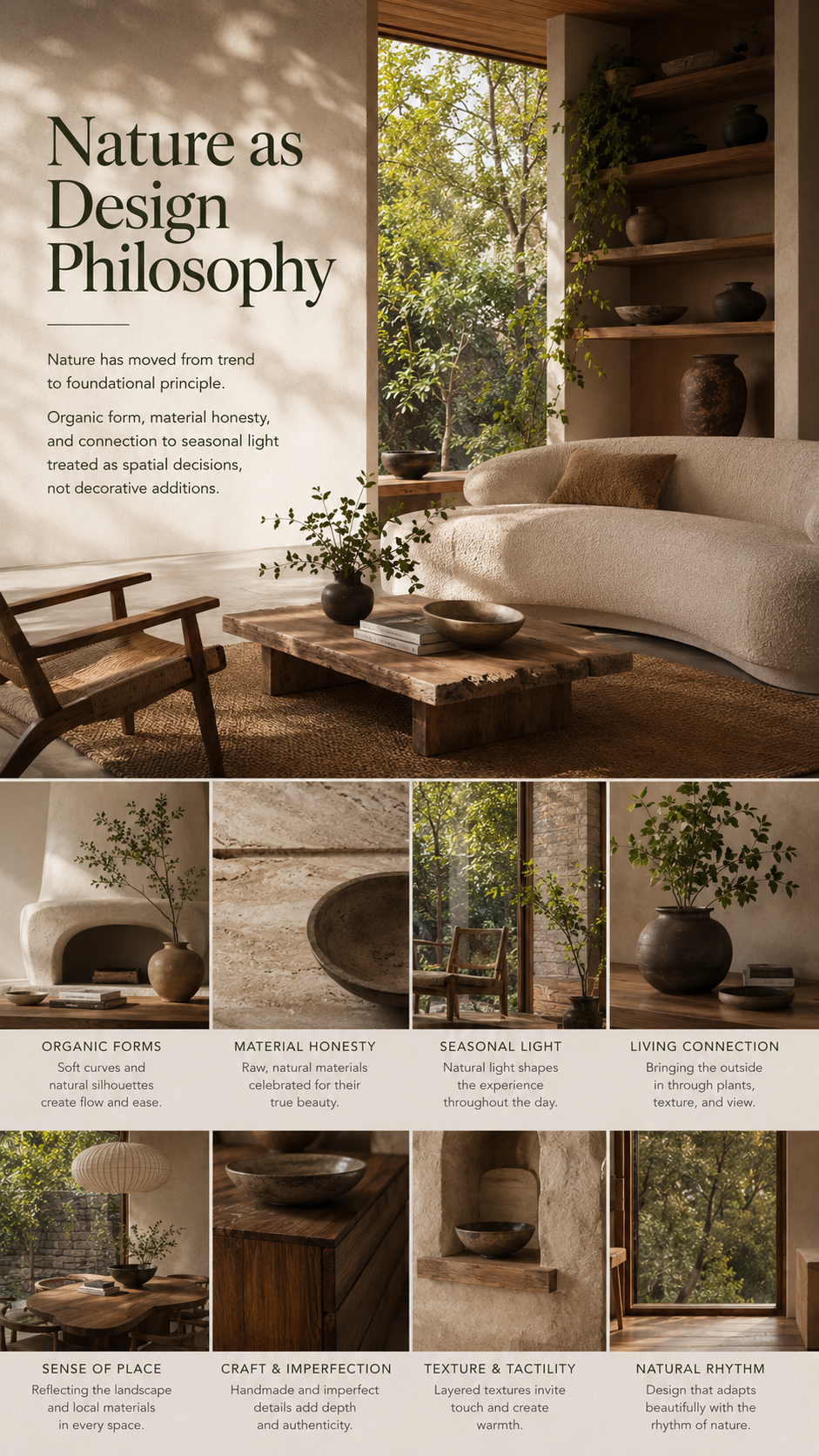
Nature has moved from trend to design philosophy.
It is no longer about adding houseplants to an otherwise conventional interior — it is about letting the logic of the natural world shape spatial decisions.
Organic form, material honesty, and connection to seasonal light are being treated as foundational principles, not decorative additions.
Biophilic design is the most rigorous expression of this shift. It requires decisions at the planning stage — orientation, material specification, ventilation — rather than at the styling stage.
The result is interiors that produce measurable wellbeing outcomes: lower cortisol, improved focus, and a genuine sense of being in a space that supports rather than exhausts.
3. What Is Quiet Luxury in Interior Design?
Styles driving this: Hollywood Glam · Art Deco · Contemporary | Color: Black and deep dramatic tones →
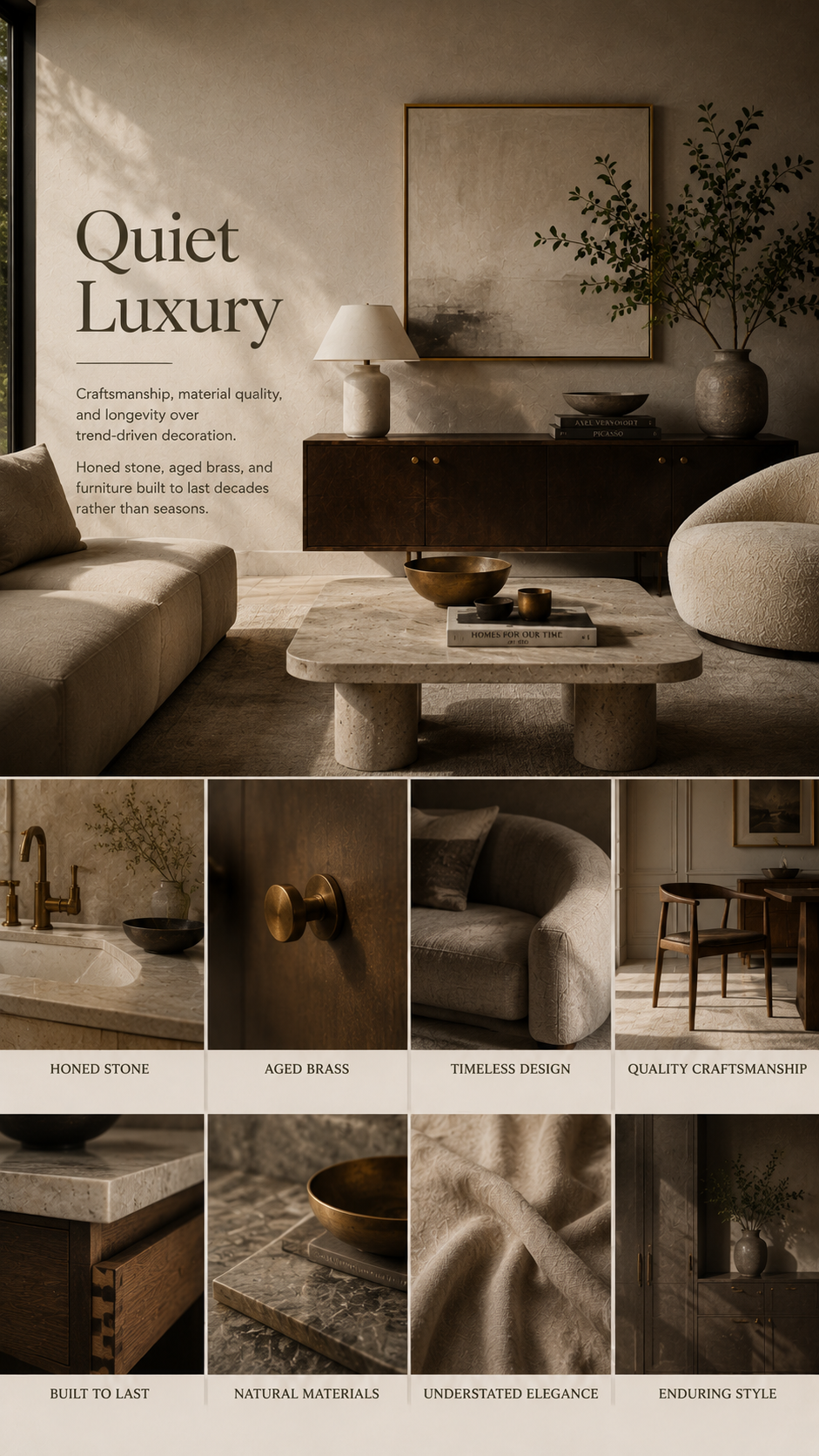
Quiet luxury is the rejection of conspicuous consumption in favour of materials, craftsmanship, and longevity.
In interior design terms it means honed stone over polished marble, aged brass over chrome, and furniture chosen to last decades rather than seasons.
The visual language is restrained: warm neutrals, considered proportion, and the absence of trend-dependent detail.
The rise of Neo Deco sits within this category — it brings geometric discipline and material richness without the theatrical excess of classic Art Deco. It is glamour edited for credibility.

4. Why Are Personal Narrative and Nostalgia Driving Interior Choices?
Styles driving this: Bohemian · Shabby Chic · Eclectic | Studio: LIV · ROSE
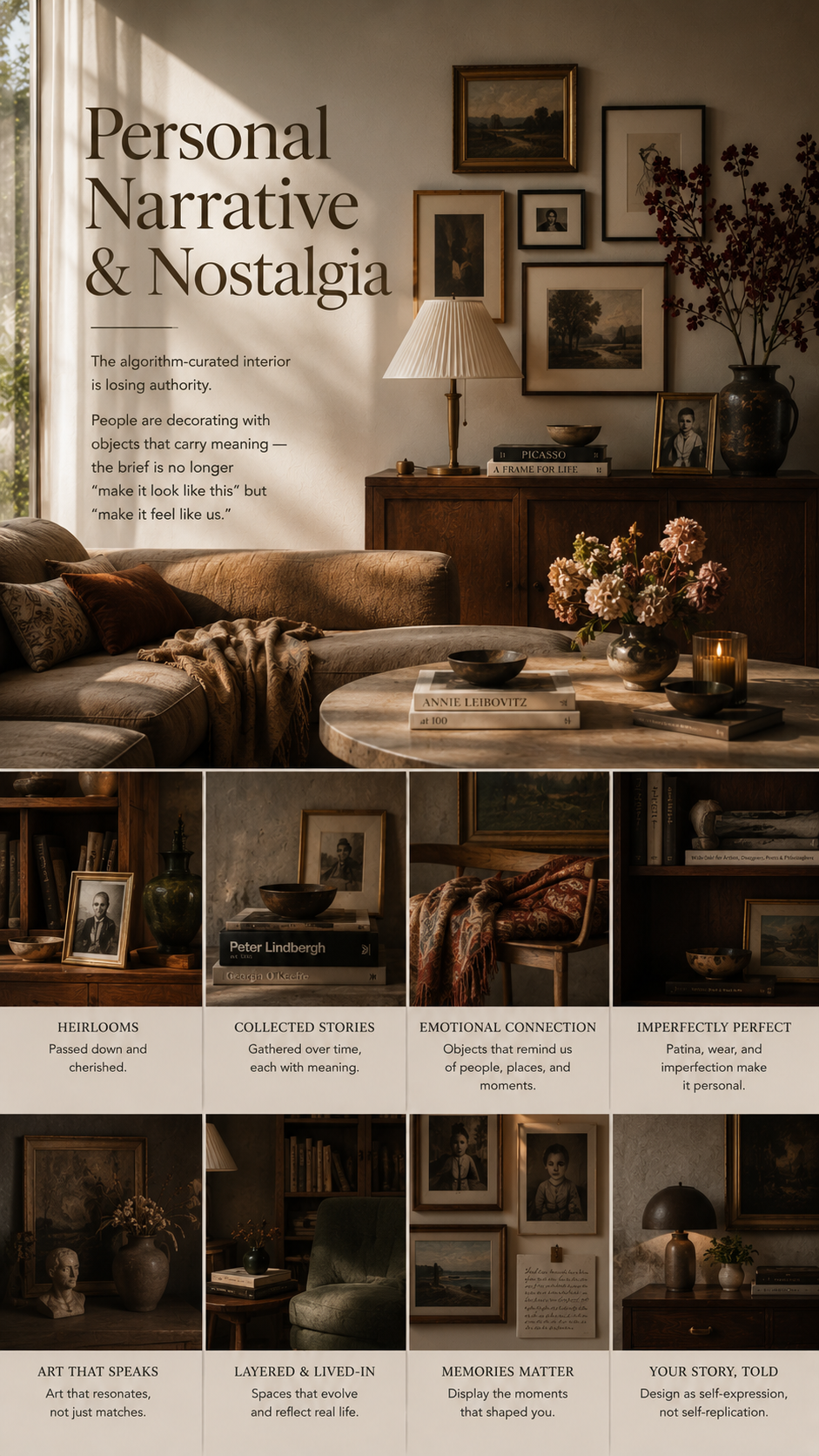
The algorithm-curated interior — assembled from a single Pinterest board — is losing cultural authority.
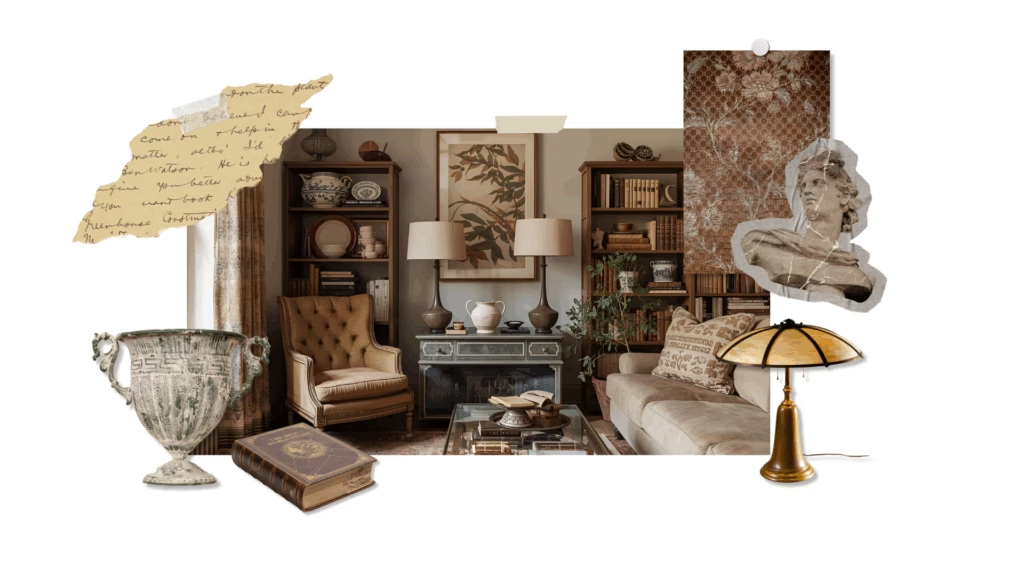
People are increasingly decorating with objects that carry meaning: heirlooms, secondhand finds, pieces made by hand, items that connect the space to a specific life.
The result is interiors that are harder to replicate and more genuinely personal. For designers, this is a shift from specifying to curating — and from presenting a style to building a story.
The brief is no longer “make it look like this” but “make it feel like us.”
5. How Has Sustainability Become a Design Standard Rather Than a Trend?
Styles driving this: Rustic · Modern Farmhouse · Wabi-Sabi
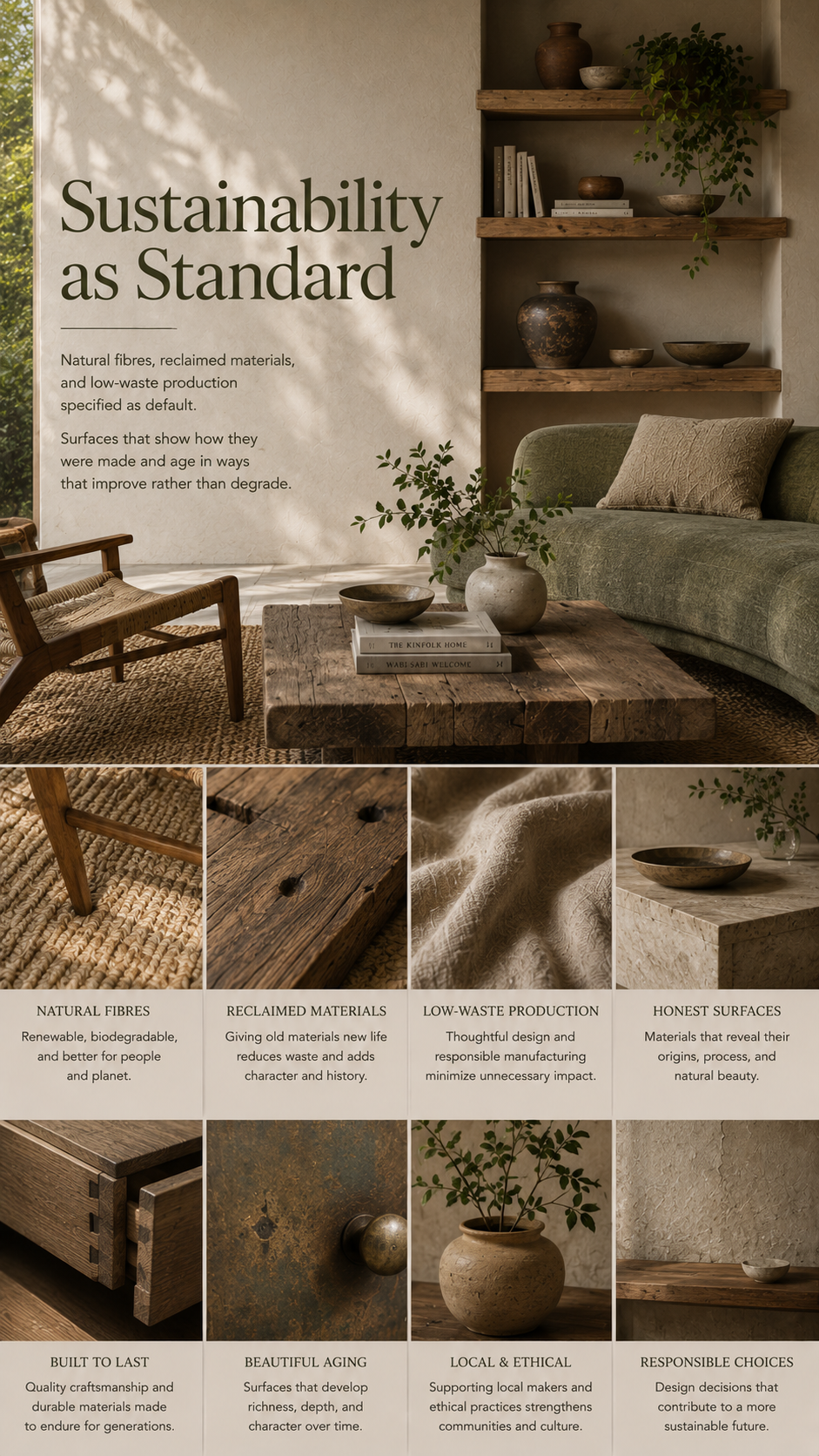
Sustainable design has crossed a threshold: it is no longer a niche position or a premium option.
Natural fibres, reclaimed materials, ethical sourcing, and low-waste production are being specified as default rather than exception.
The aesthetic that emerges from this shift is one of genuine material honesty — surfaces that show how they were made and age in ways that improve rather than degrade.
This makes Wabi-Sabi, Rustic, and Modern Farmhouse not just stylistic choices but ethically coherent positions.
The deliberate embrace of imperfection and the celebration of material that carries the evidence of its making is, in this context, a statement about values as much as aesthetics.

6. What Does It Mean to Design a Home as a Tech-Calm Retreat?
Styles driving this: Japandi · Asian Zen · Minimalist | Studio: JUNIPER · LILI
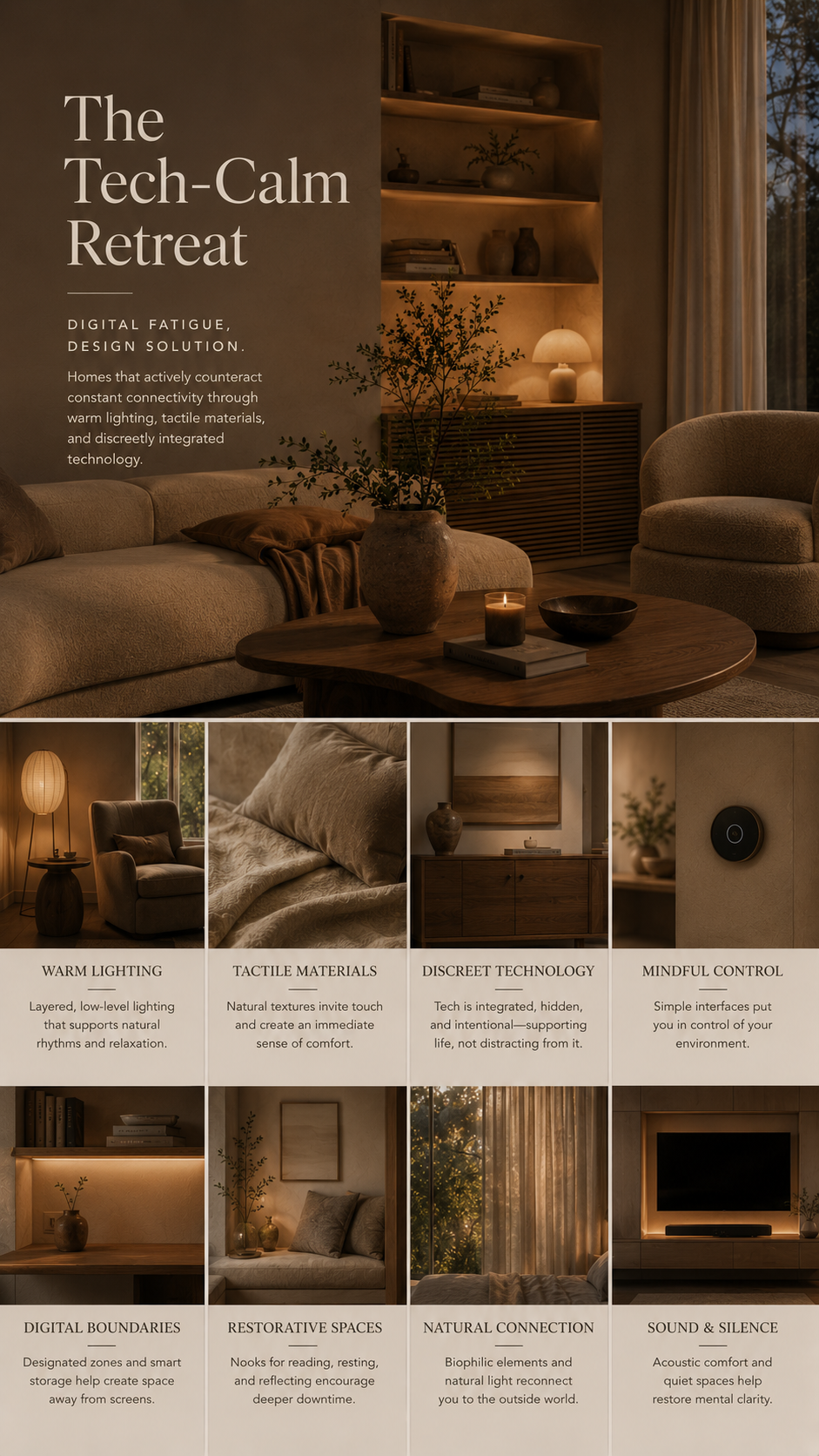
Digital fatigue is producing a clear design response: homes that actively counteract the experience of constant connectivity.
Warm lighting designed for mood rather than task, tactile materials that reward physical contact, soft acoustic environments, and technology integrated so discreetly that its presence is not felt.
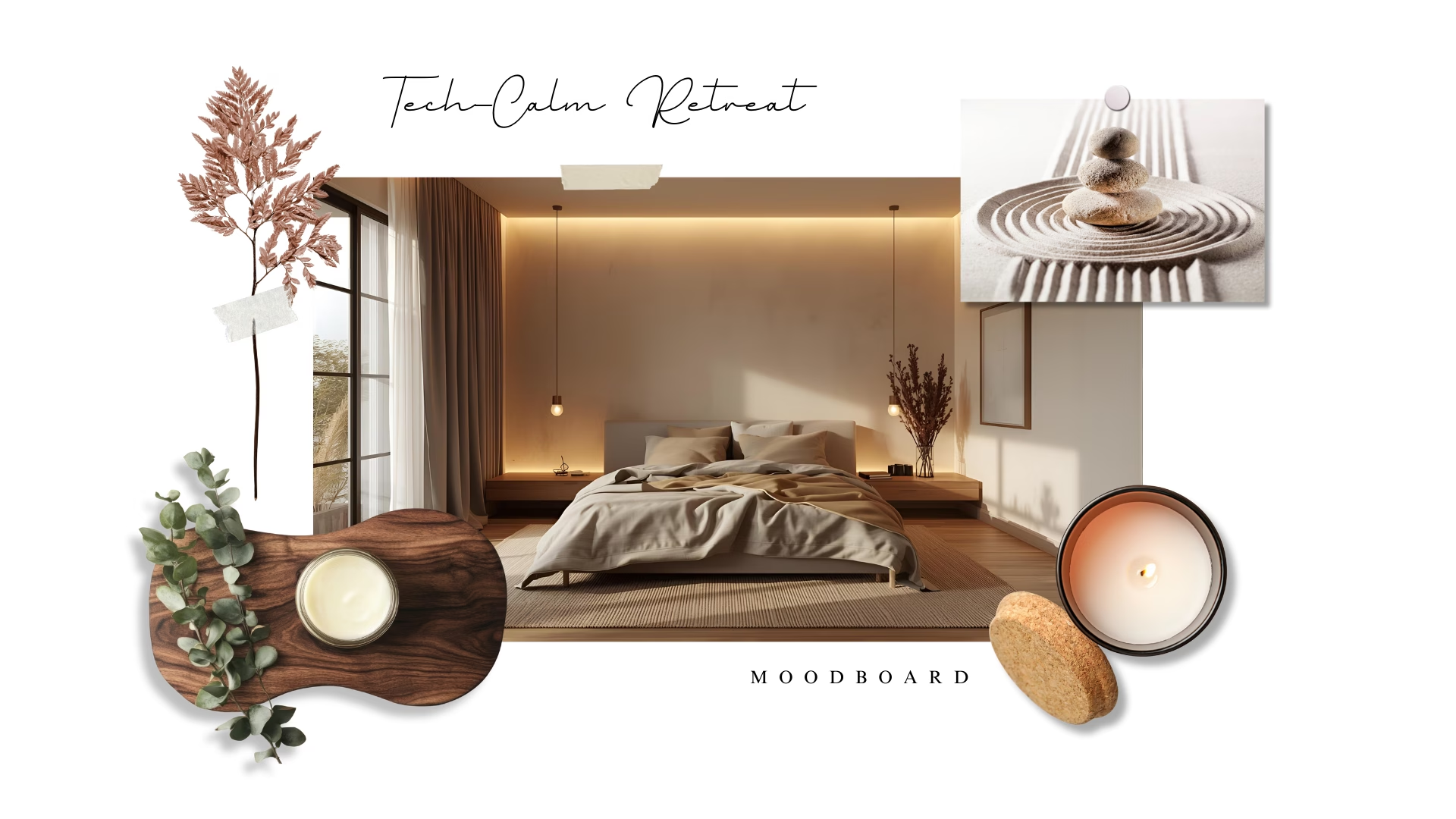
Japandi and Asian Zen are the style traditions most aligned with this direction. Both prioritise negative space, material silence, and environments that produce psychological calm.
The difference between a room that looks minimal and one that feels calm is a design education gap this trend is making commercially visible.
The 9 Key Interior Design Micro Trends for 2026
These are the specific style directions translating the six cultural themes above into tangible design choices.
Each trend has a defined aesthetic language, a material vocabulary, a direct connection to the foundational style it draws from, and a designer translation — the practical guidance for how to apply it in a professional context.
1. Warm Minimalism: What It Is and How to Apply It
Foundational style: Minimalist Interior Design → | Color direction: Emotional Neutrals →
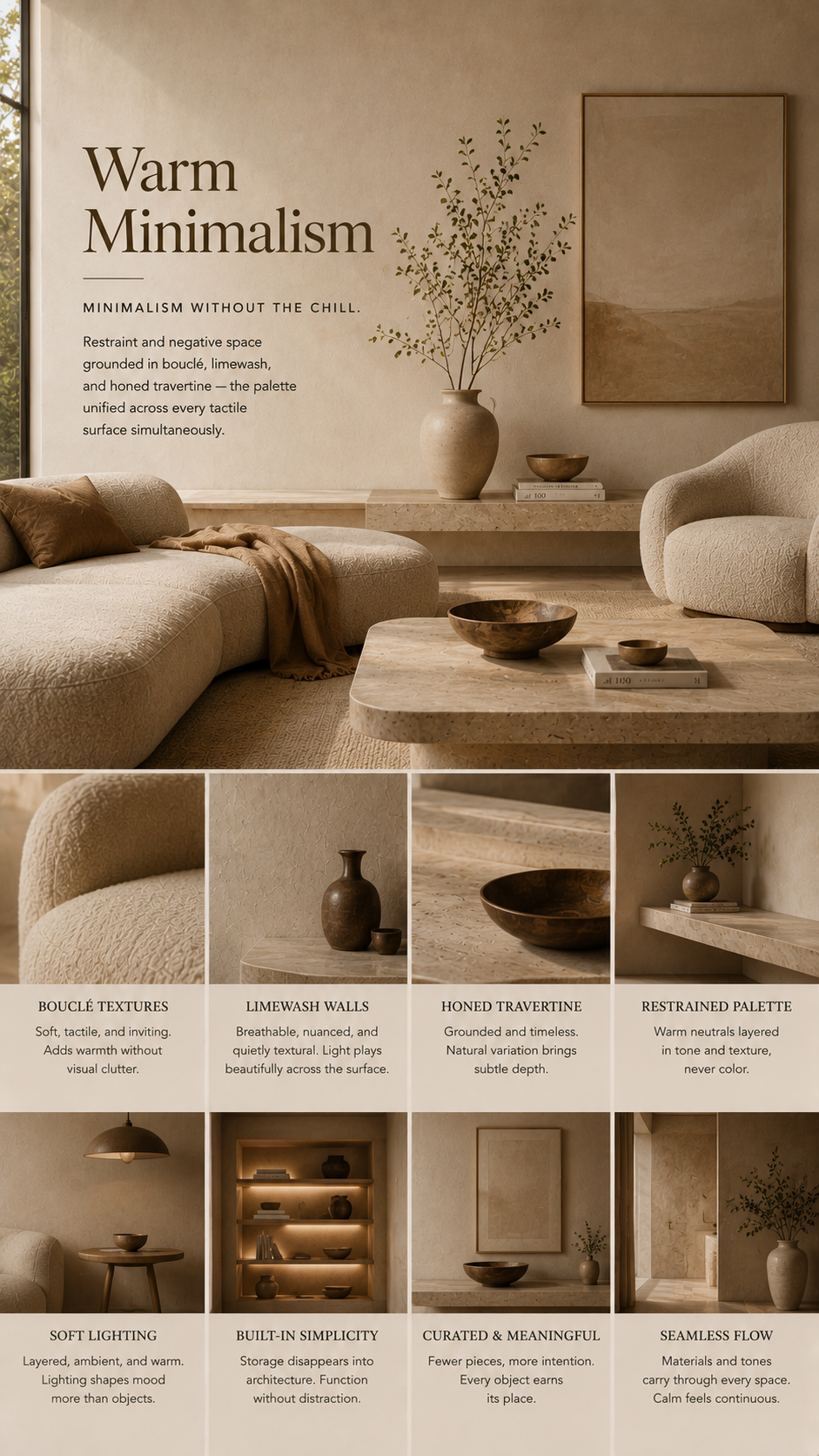
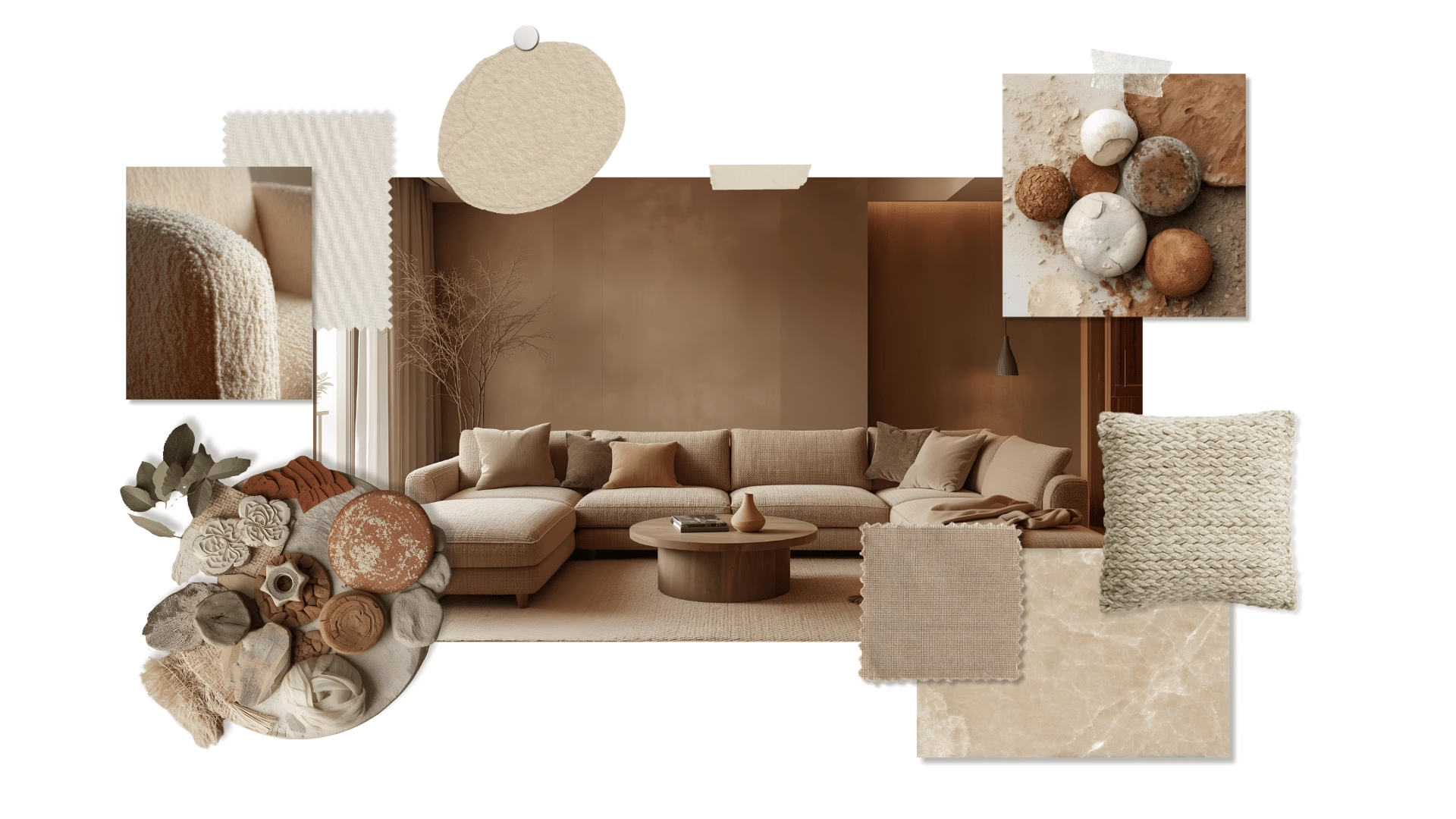
Warm Minimalism is minimalism without the chill. It keeps the discipline of restraint — limited objects, negative space, considered proportion — but grounds it in materials and tones that read as tactile and human.
Greige, warm white, mushroom, camel, and soft stone replace the stark whites and cold greys of clinical minimalism.
The furniture profile remains clean, but the surfaces are boucle rather than linen-cotton, limewash rather than flat paint, honed travertine rather than polished concrete.
What makes it work: The palette must feel unified across materials, not just paint. A warm white wall against cold grey upholstery breaks the cohesion.
The warmth needs to be present in every tactile surface simultaneously — wall, floor, upholstery, and accessory all reading from the same temperature register.
Who it suits: Smaller homes needing clarity and spatial calm; clients who want to feel organised and grounded without the austerity of strict minimalism; open-plan spaces that need a single coherent thread across all surfaces.
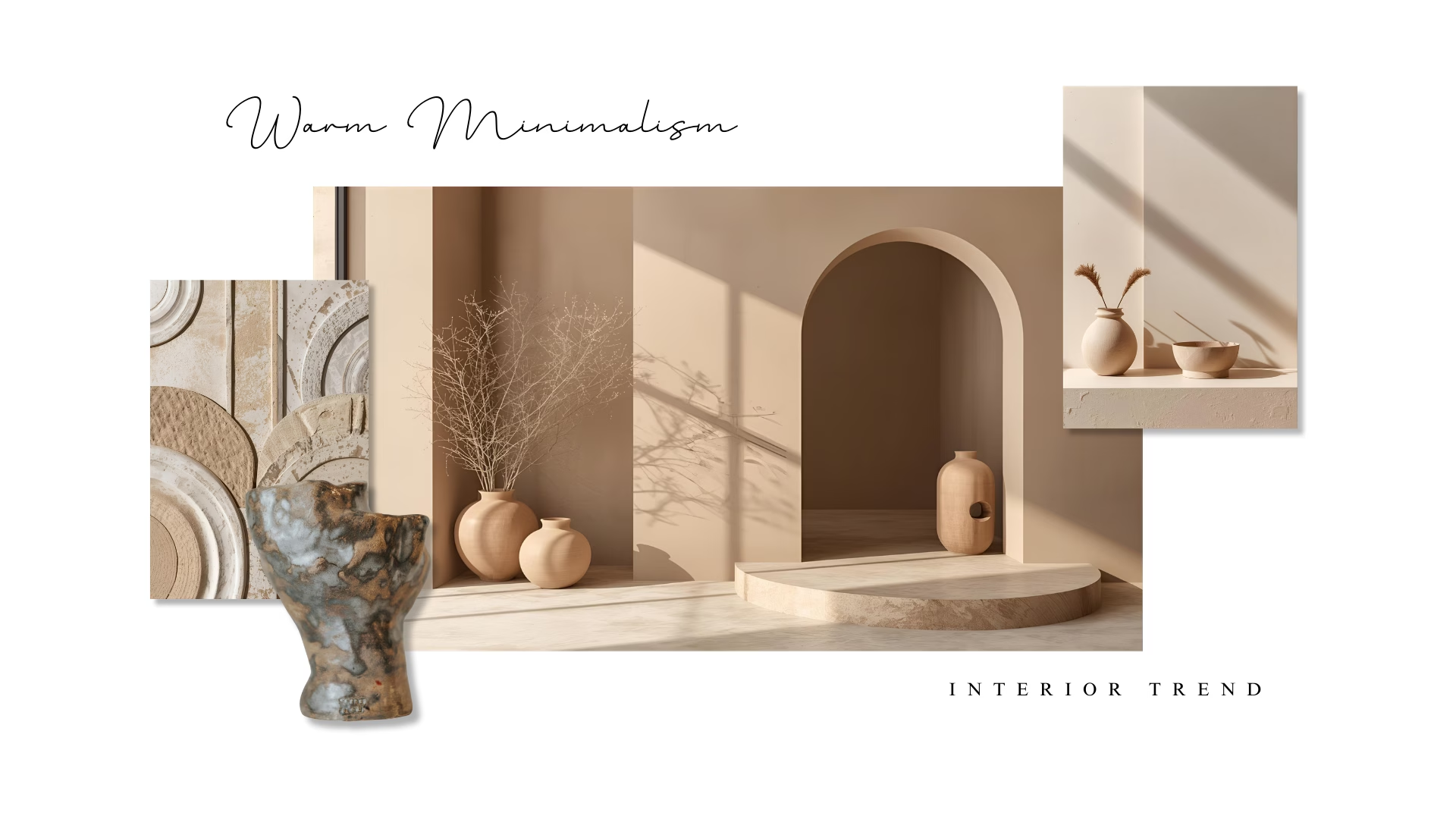
When a client says they want “minimalist but not cold,” this is the brief. Your first task is to establish material temperature before any other decision. Build a physical sample board — not a digital mood board — and check that every material reads warm when held together: the upholstery against the stone sample against the paint chip against the flooring. Cold materials that look warm on a screen will fail in the room.
Client conversation question: “Which matters more to you — the feeling of space, or the feeling of warmth?” If they say warmth, push the palette further toward biscuit and caramel. If they say space, keep it closer to pale stone and soft white. Warm Minimalism sits on a spectrum — knowing where your client sits on it is the brief.
2. Modern Organic: Where Sculptural Form Meets Natural Material
Foundational style: Organic Modern Interior Design → | Color: Warm Neutrals and Browns →
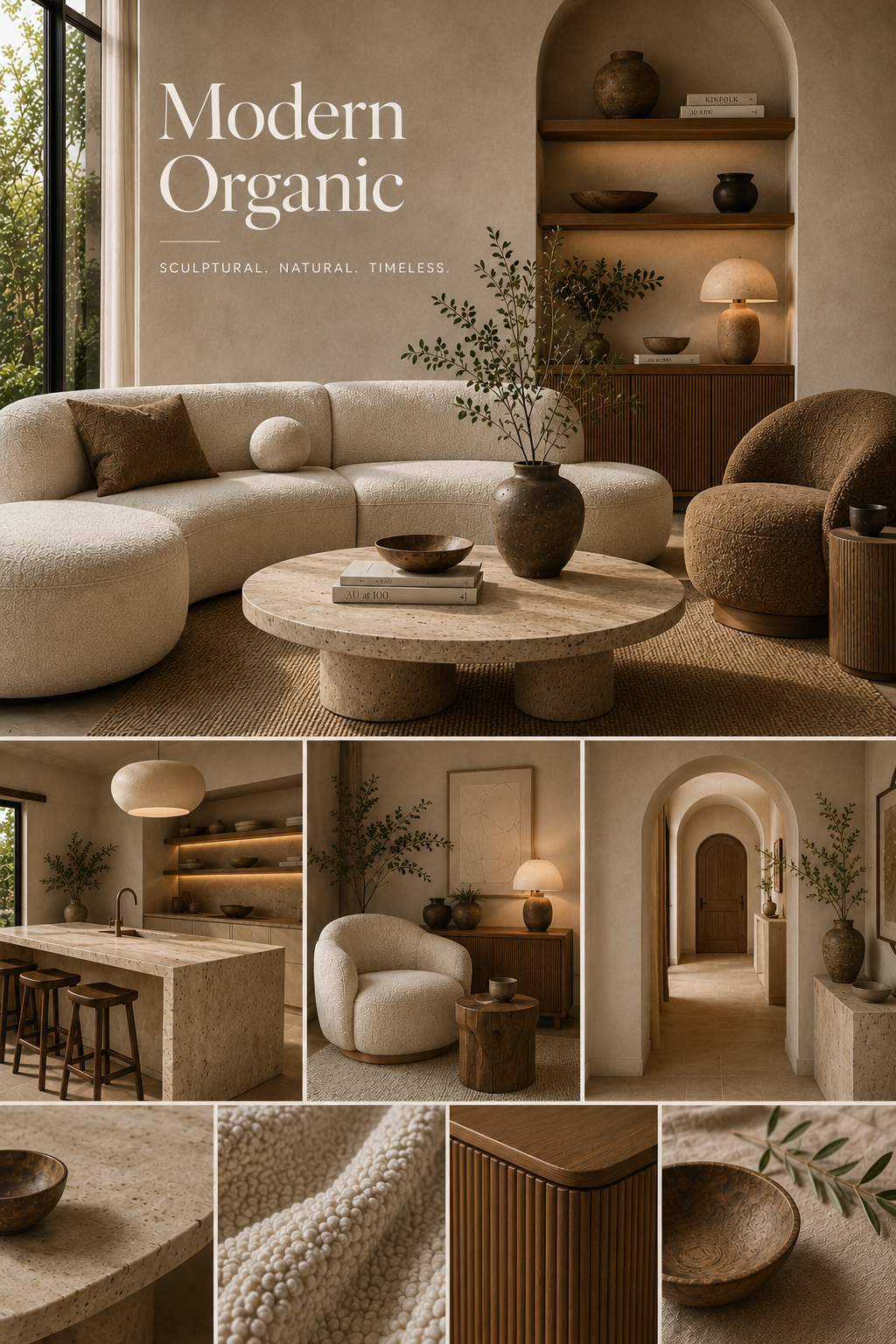
Modern Organic is the most commercially durable style direction in contemporary residential design.
It resolves the tension between spatial discipline and material warmth — producing interiors that feel both refined and genuinely grounded.
The furniture profile is sculptural and curved, the palette is warm neutral throughout, and every material is either natural or a credible expression of nature at its most tactile.
Key materials: Boucle, undyed linen, live-edge and solid timber, honed stone, hand-thrown ceramics, rattan, natural fibre rugs. Nothing synthetic, nothing high-gloss, nothing that reads as industrial-modern.
What makes it work: The risk in Modern Organic is generic beige. The differentiator is sculptural confidence — a curved sofa with genuine presence, a stone coffee table that anchors the room, a pendant that reads as an object not merely a light source.
Without strong form, the warmth becomes monotony. The material palette is the foundation; the form is what makes it memorable.
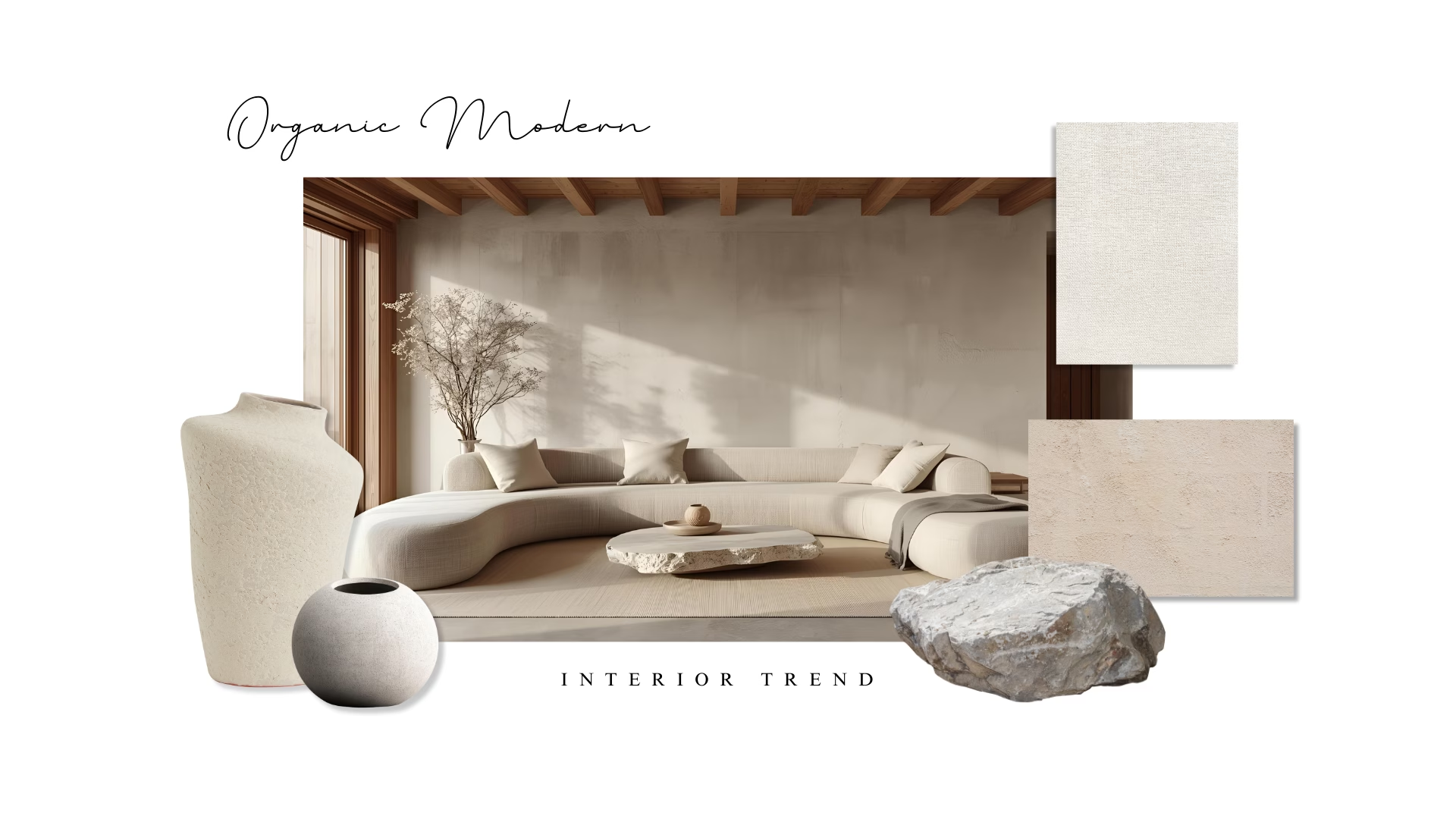
Modern Organic fails when it becomes a collection of warm-toned items without spatial hierarchy. Identify the one piece in the room that does the most formal work — usually the sofa or the coffee table — and make that your strongest form decision. Everything else is subordinate to it. If you cannot identify a hero form in your specification, the room will not read as designed; it will read as styled.
Palette rule: the warmth must come from the materials, not just the paint colour. A warm mushroom wall with cold upholstery will not read as Modern Organic — it will read as a neutral room with a styling problem.
Client conversation question: “Can you show me an object — not a room — that you find beautiful?” The answer tells you whether their instinct is toward natural texture (woven, thrown, rough) or toward sculptural form (curved, architectural, weighted). Knowing which matters most determines whether you lead with material or with silhouette.
3. Japandi Evolution: How the Style Has Deepened in 2026
Foundational style: Japandi Interior Design → | Color: Warm Neutrals and Browns →
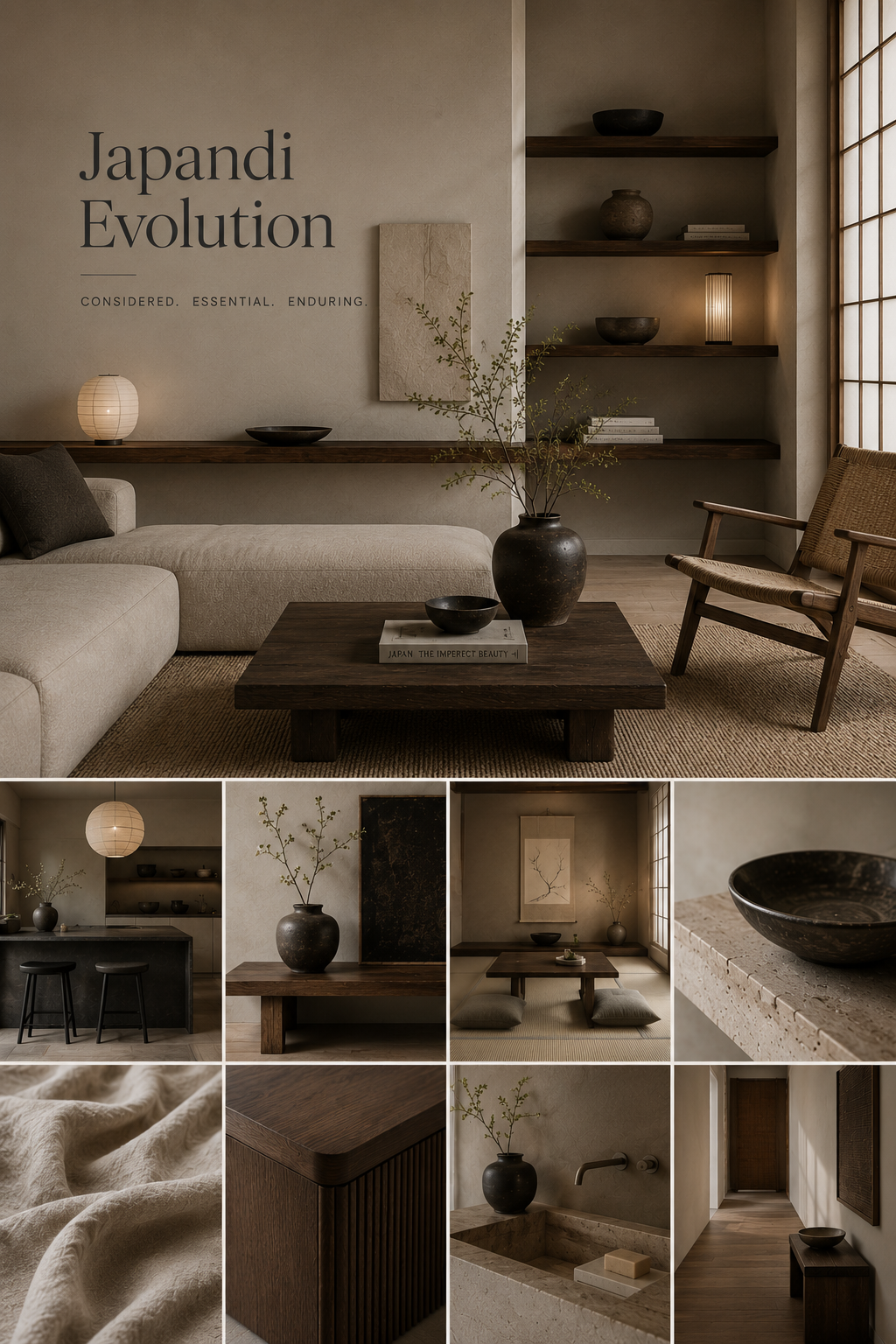
Japandi is no longer a trend in the sense of something new arriving — it has become a settled design philosophy with its own maturing tradition.
What is evolving in 2026 is the depth of its application. Early Japandi was often surface-level: low furniture, neutral tones, a few ceramics. The current iteration is more rigorous. Imperfection is intentional rather than accidental.
Negative space is actively designed rather than merely empty. The distinction between Japandi and generic Scandi-Minimal is the presence of genuine wabi-sabi sensibility.
What has changed in 2026: Warmer tones within the palette — aged white, soft clay, warm charcoal rather than cool grey. More texture: slubbed linen, uneven ceramics, timber with visible grain and knot.
Less furniture overall: the editing is more confident and the commitment to negative space is more absolute.
What makes it work: A hand-thrown bowl with an uneven rim, a timber knot left visible, a linen cushion slightly slubbed — these details give the space its soul. Without them, the style reads as a quiet room rather than a designed position.
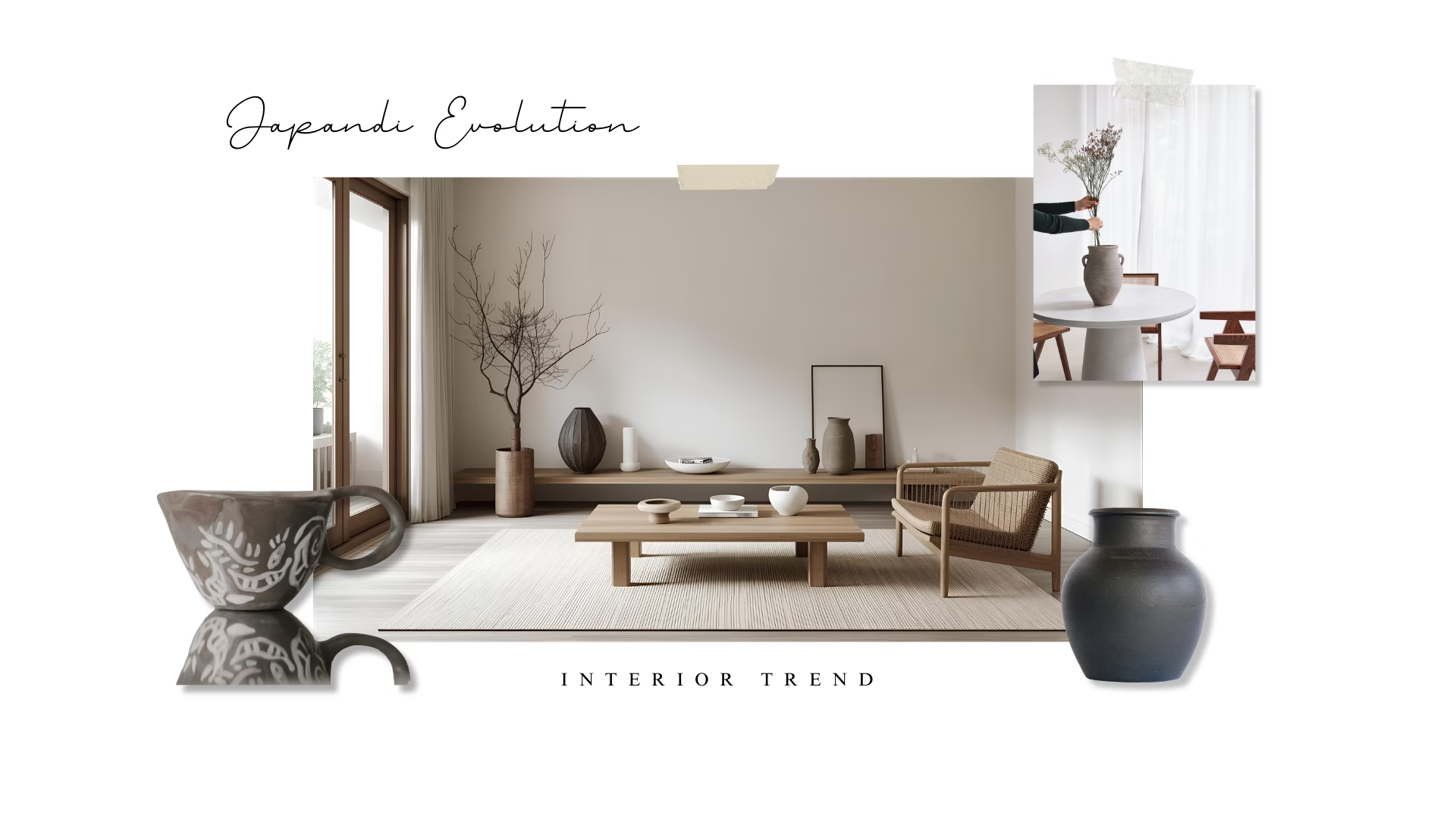
Japandi is one of the hardest styles to present to a client because its intelligence is expressed through what is absent. Your presentation should include a written rationale for what you chose not to include — this communicates the depth of the design thinking and gives the client a framework for understanding why empty space is a deliberate decision.
The sourcing decision that matters most: genuine handmade objects versus production objects that simulate handcraft. Japandi is built on the former. In a room with no other distraction, the difference is visible. Budget for this and brief the client on why it matters.
Client conversation question: “How do you feel about empty space — does it make you feel calm, or does it make you feel like something is missing?” Japandi requires a client who finds negative space restful rather than incomplete. If they say missing, redesign the brief before you specify anything.
4. Mediterranean Soft Neutrals: Sun-Warmed Interiors for Any Climate
Foundational style: Mediterranean Interior Design → | Color: Red and Earthy Warm Tones →
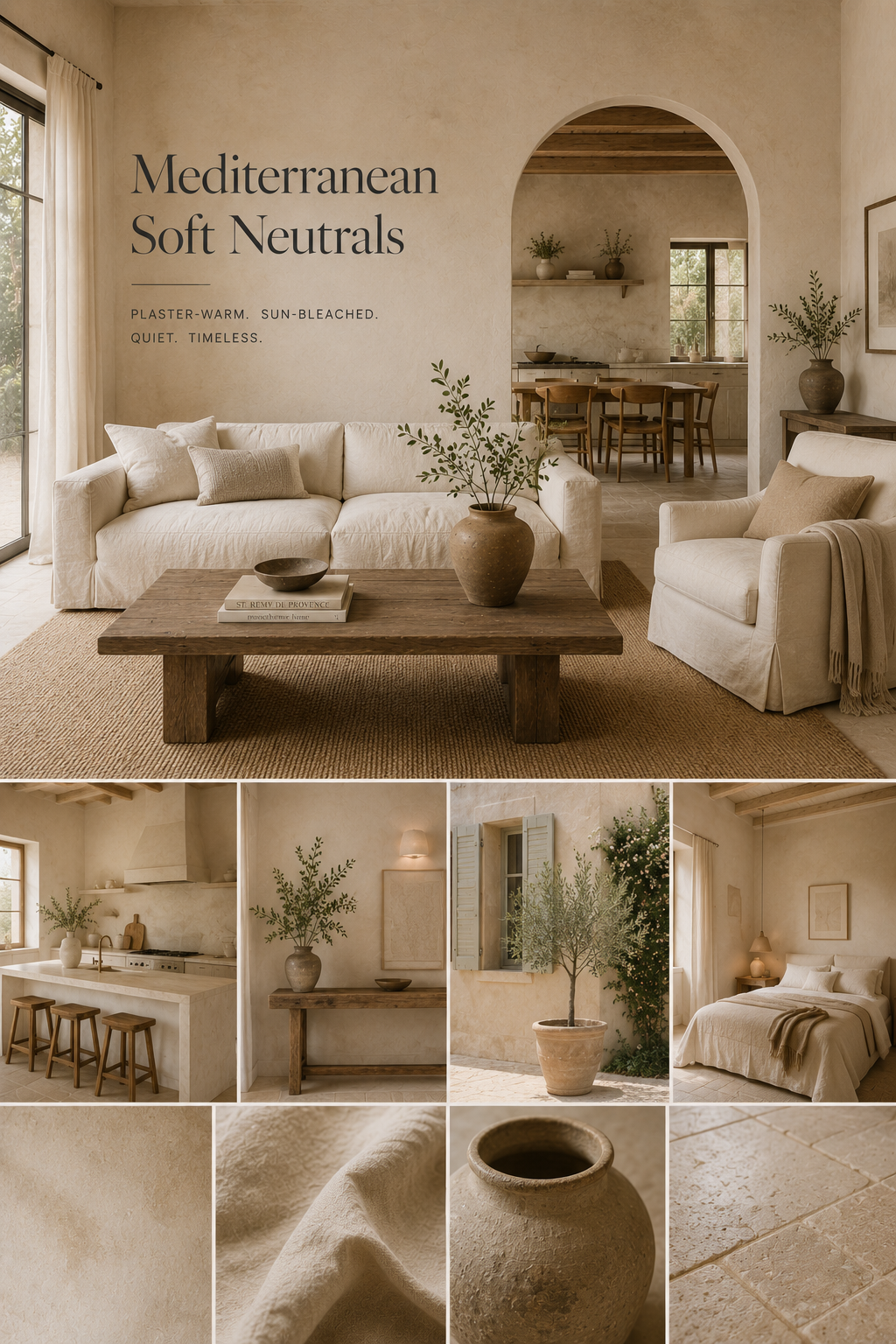
The Mediterranean aesthetic has found its 2026 expression in the soft neutral version of itself — not the saturated cobalt-and-terracotta of coastal Greece, but the plaster-warm, sun-bleached quietness of a Provençal farmhouse or a Moroccan riad in early morning light.
Soft white plaster, aged linen, gentle arches, rustic timber, and terracotta used at low saturation rather than as a bold accent.
What defines it in 2026: The restraint. Mediterranean design in its louder form is all patterned ceramic tile and deep cobalt.
The current direction takes its warmth and airiness without its drama — producing interiors that feel like the best version of somewhere sun-soaked regardless of the actual geography of the project.
What makes it work: The wall surface carries the aesthetic more than in most other styles. Plaster — true lime plaster or a high-quality limewash — reads entirely differently to flat emulsion paint in the same colour. The warmth of this trend is almost always material before it is colour.
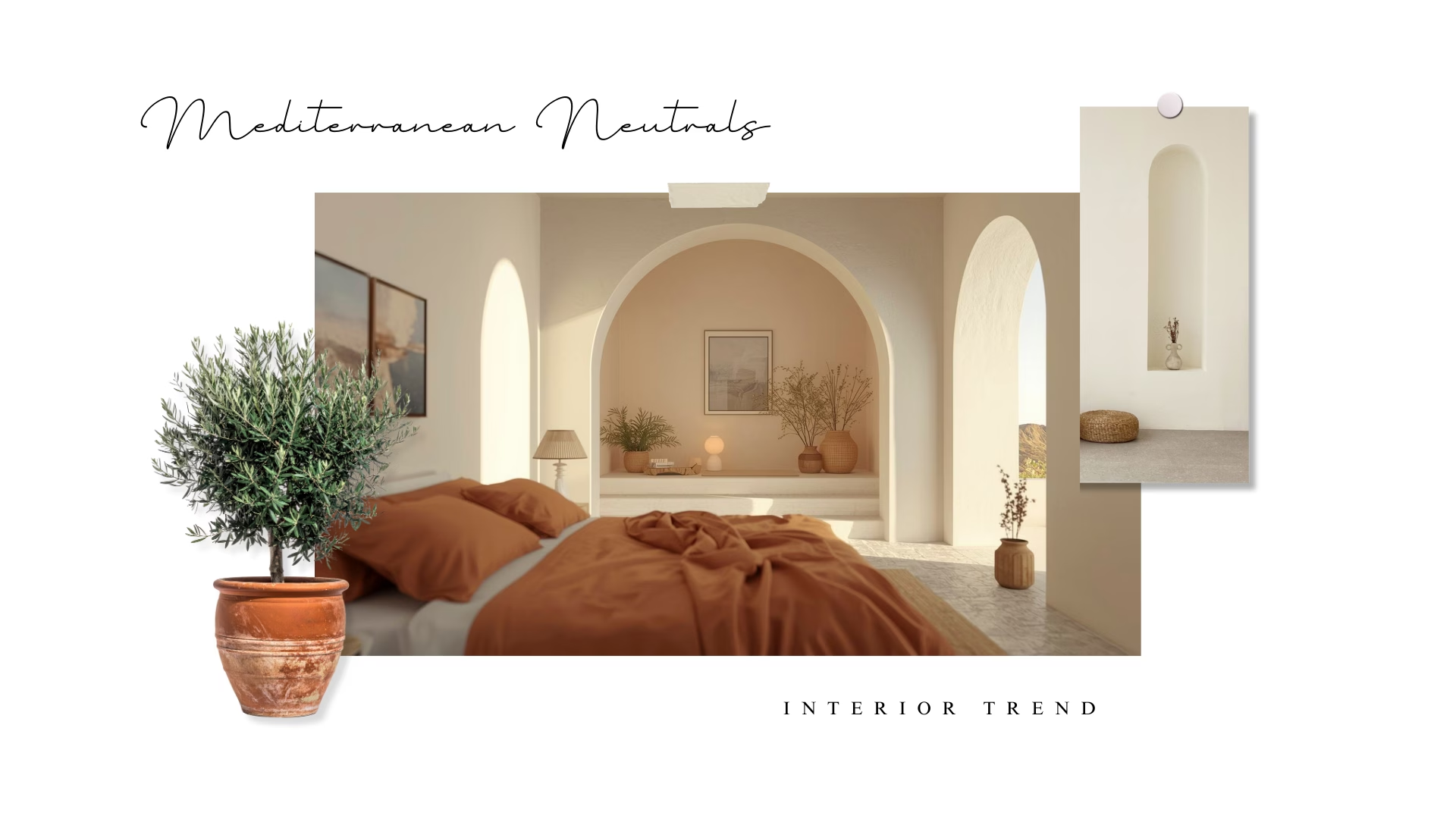
The Mediterranean Soft Neutrals brief most commonly arrives as “I want it to feel like a holiday home.” Translate that into specific material decisions rather than palette decisions. The holiday feeling comes from natural light hitting plaster, terracotta that stays cool underfoot, linen that moves in air — not from wall colour alone. Ask about natural light and spatial plan before selecting a single material.
Regional specificity matters: Provençal (dusty lavender, limestone, faded wood) reads differently to Greek island (whitewash, cobalt, bleached timber) and differently again to Moroccan (plaster, cedar, brass, jewel tones as accent). Identify which tradition you are drawing from — vague Mediterranean produces vague results.
Client conversation question: “Which specific place — a hotel, a house, a restaurant you have visited — felt exactly like what you want?” A specific place is worth a hundred adjectives. Get the name, look at the architecture, identify the material decisions that produced the feeling.
5. Soft Industrial: Urban Edge Without Harshness
Foundational style: Industrial Interior Design → | Color: Black and Deep Dramatic Tones →
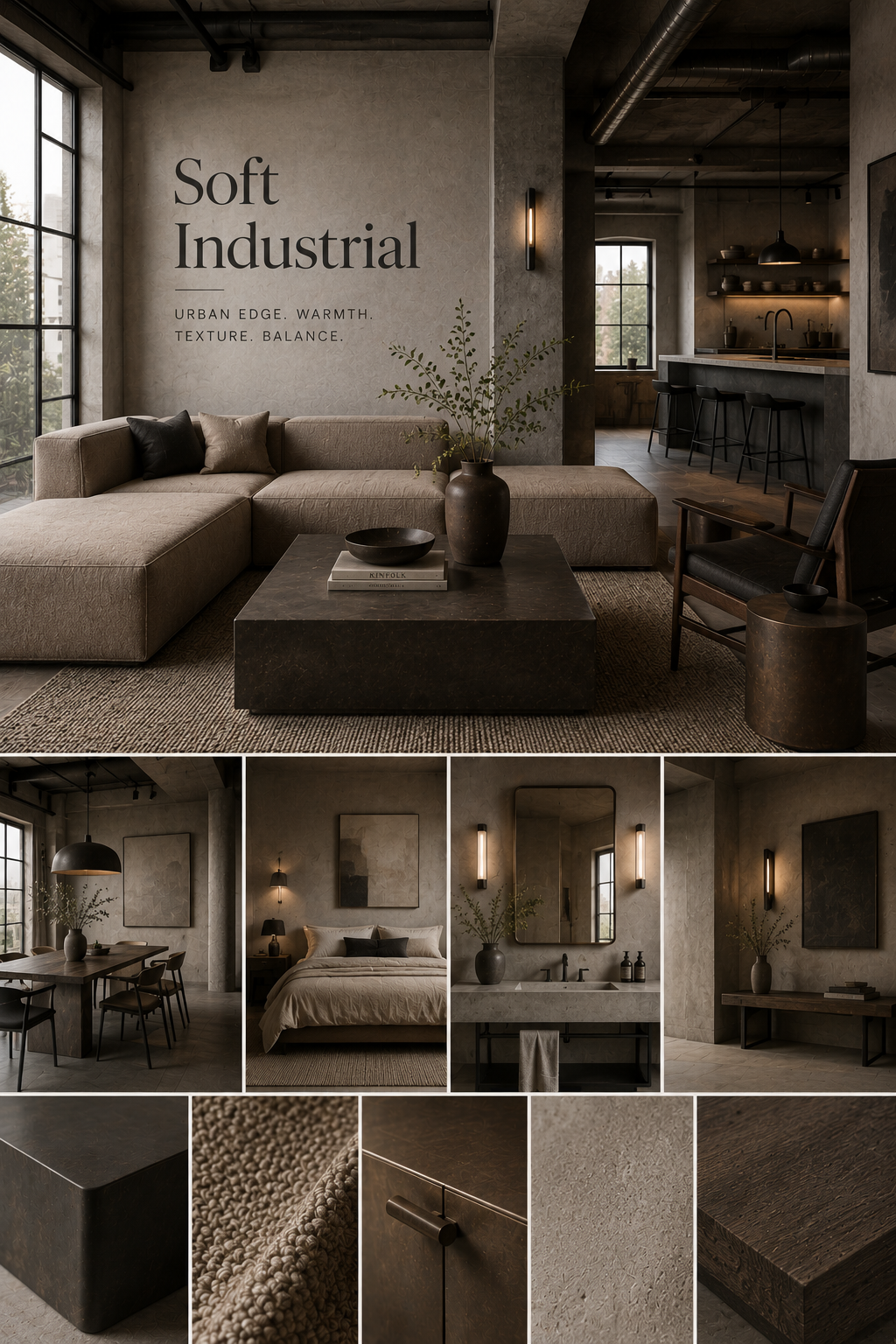
Industrial design began with an honest aesthetic problem: what do you do with a warehouse conversion when the beauty is already in the raw structure?
Exposed concrete, steel, brick, and ductwork are not problems to solve — they are the material given. Soft Industrial takes this logic and asks: how do we make a space with this material language feel genuinely liveable rather than atmospherically cold?
The 2026 answer is rounded silhouettes against raw structure, warm-toned metals replacing cold chrome, generous textiles that absorb the acoustic hardness of concrete, and a palette that shifts from battleship grey toward warm charcoal and aged steel.
The rawness is preserved; the coldness is resolved.
What makes it work: The warmth challenge must be addressed deliberately. Large-scale planters, generous leather or boucle upholstery, and layered wool textiles prevent the space from reading as a building site. The goal is not to soften the rawness — it is to balance it.
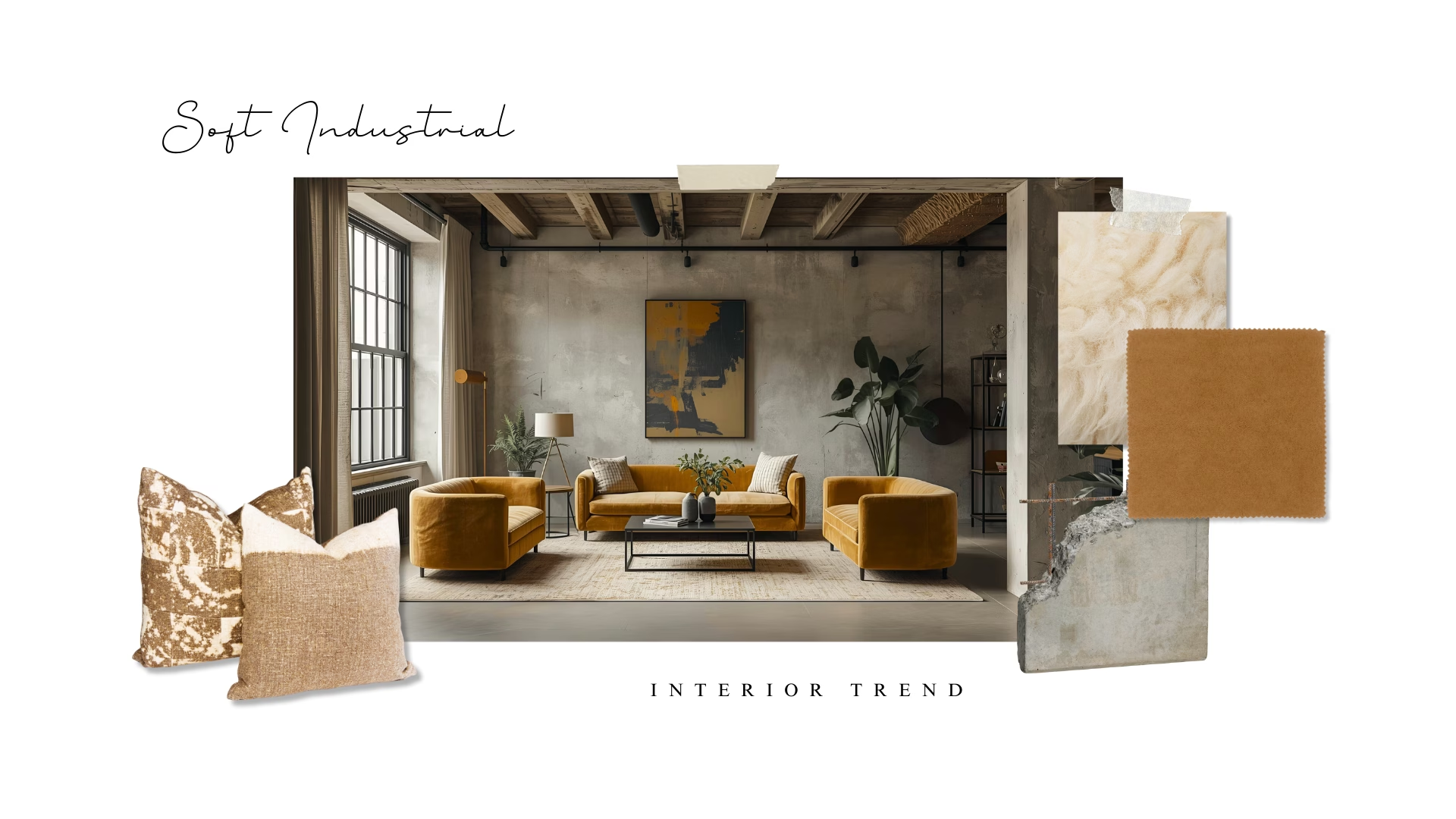
Soft Industrial only works when the raw material is treated as the asset rather than the problem. If the client wants to hide the concrete, you are in a different style entirely. Your first design conversation is about whether to celebrate the architectural constraint or work against it.
The acoustic problem is almost always underestimated. Hard parallel surfaces — concrete floor, concrete ceiling, brick walls — produce a reverb that makes the space uncomfortable for extended habitation. Build an acoustic strategy into the brief from the outset: rugs, acoustic panels (designed as art if the budget allows), heavy curtains, and upholstered surfaces.
Client conversation question: “Which aspect of this raw space do you most want to keep — the height, the texture, the light, or all of it?” The answer tells you how much industrial character is essential and how much softening is possible without losing what they came for.
6. Retro and Vintage Revival: How to Use the Past Without Theme-Park Design
Foundational styles: Bohemian · Shabby Chic · Retro | Color: Browns and Purple and Artistic Hues →
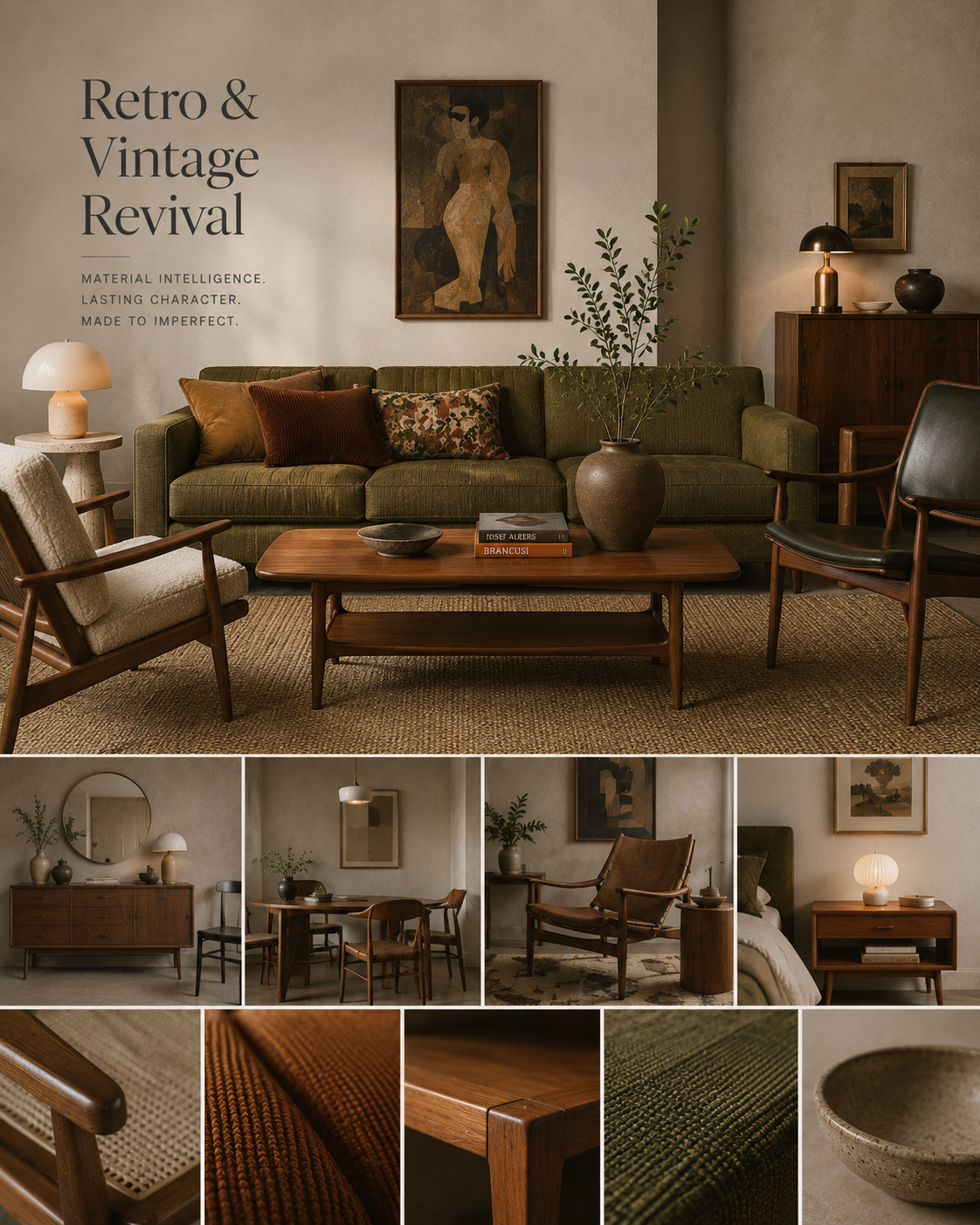
The current revival of retro and vintage design is not about recreating a specific decade.
It is about using the material and formal intelligence of the past — the warmth of teak, the organic optimism of 1950s chair design, the confident palette of 1970s upholstery — as a counterweight to the flatness of contemporary production.
One genuinely good vintage piece in a modern space does more for its character than an entire room of period recreation.
The distinction that matters: Retro recreates an aesthetic; vintage works with authentic objects. Both are valid but produce different results. Retro is designed, coordinated, deliberate.
Vintage is accumulated, found, layered over time. The most sophisticated expression combines both — a designed framework in which found objects sit with the same authority as specified ones.
What makes it work: The retro or vintage piece must be genuinely good, not merely old. Age alone does not produce character — quality does. The sourcing intelligence of the designer is what separates a successful Retro and Vintage Revival interior from a stylistically confused one.
The most important design decisions in Retro and Vintage Revival cannot be made at the specification stage — they emerge through sourcing. Your project timeline needs to account for the lead time of finding genuinely good vintage pieces. Brief the client early that some of the most character-giving elements will be found rather than ordered, and that the sourcing timeline is different from the production timeline.
Decade specificity matters: the 1950s, 1960s, and 1970s each have distinct visual logic. Mixing them without a clear editorial decision produces visual confusion. Identify your period anchor — which decade is doing the most work — and treat pieces from other eras as deliberate accent rather than equal voice.
Client conversation question: “Is there a specific object from your past — a piece of furniture, a lamp, something from a grandparent’s house — that you want to feel echoed in this space?” The answer tells you more about the emotional register they are looking for than any mood board will. Nostalgia in interiors is always personal before it is aesthetic.
7. Color Drenching and Tonal Rooms: The Technique Behind the Trend
Color direction: Color Drenching 101 → | All color application techniques →
Color drenching is a specific paint technique: apply a single hue or tonal family to every surface in a room — walls, trim, and ceiling — without interruption.
The result is a space without visual break, where the colour creates a cocoon-like enclosure that feels immersive rather than decorated. The room becomes an experience rather than a composition.
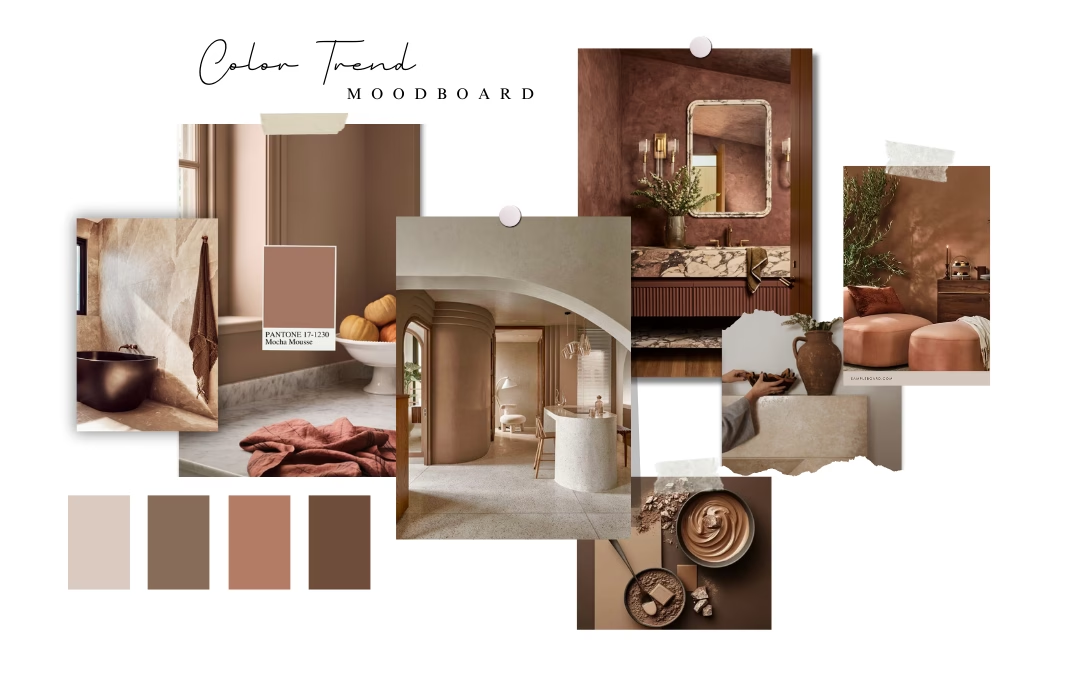
Why it works: When colour is used on every surface simultaneously rather than as an accent against white, it stops reading as a colour choice and starts reading as an atmosphere. This is a fundamentally different spatial proposition from conventional colour use.
Where it works best: Single-purpose rooms: dining rooms, reading corners, bedrooms. Spaces where intensity of atmosphere is an asset rather than a distraction. Rooms with sufficient natural light to prevent a dark drench from feeling oppressive.
What to avoid: High-traffic open-plan spaces; rooms without adequate daylight; applying the technique without managing sheen level (matte absorbs and deepens; eggshell and satin reflect and lighten — both work but produce entirely different spatial results).
Color drenching requires the most pre-commitment from the client — and the most precise briefing from you. The experience of a drenched room is extremely difficult to visualise from a paint chip. Before proceeding, paint a large sample (minimum A2 size) on every surface in the room — walls, ceiling, and trim — and photograph it at different times of day. Do not proceed without this step.
The sheen decision is the most technical element of a successful drench. Use the same colour in different sheens across surfaces — flat/matte on the ceiling (absorbs light, makes it recede), eggshell on walls (slight reflection, prevents heaviness), satin on woodwork (creates subtle hierarchy without a second colour). This graduated sheen approach is what separates a designer’s execution from a homeowner’s DIY attempt.
Client conversation question: “Which room in this project do you use most deliberately — where do you go to think, to eat, to retreat?” That is the drenching candidate. Color drenching rewards intention and single-purpose use.
8. Crafted Maximalism: The Art of Confident Abundance
Foundational styles: Maximalist · Eclectic · | Color: Purple and Artistic Hues · Black and Deep Dramatic Tones →
Crafted Maximalism is the intelligent counter-movement to quiet minimalism — and the most significant trend not yet named on this page.
Where Quiet Luxury subtracts, Crafted Maximalism accumulates. But the accumulation is disciplined: every layer of pattern, object, and colour is chosen with the same rigour that a minimalist would apply to a single surface.
The difference between Crafted Maximalism and visual chaos is always curation, never volume.
Pattern-on-pattern layering, deep immersive palettes, and objects chosen for story as much as beauty define the look. Night plum, antique gold, tapestry rust, and indigo are the dominant colour directions.
Richly textured surfaces — carved wood, glazed ceramic, embroidered textile, aged metal — create a space that rewards being looked at slowly, from every angle.
What makes it work: The structural principle behind successful maximalism is repetition: a colour, a material, or a motif that recurs throughout the space and gives the eye a thread to follow through the complexity.
Without that recurring element, the space reads as unstyled rather than maximalist. One through-line carries everything else.
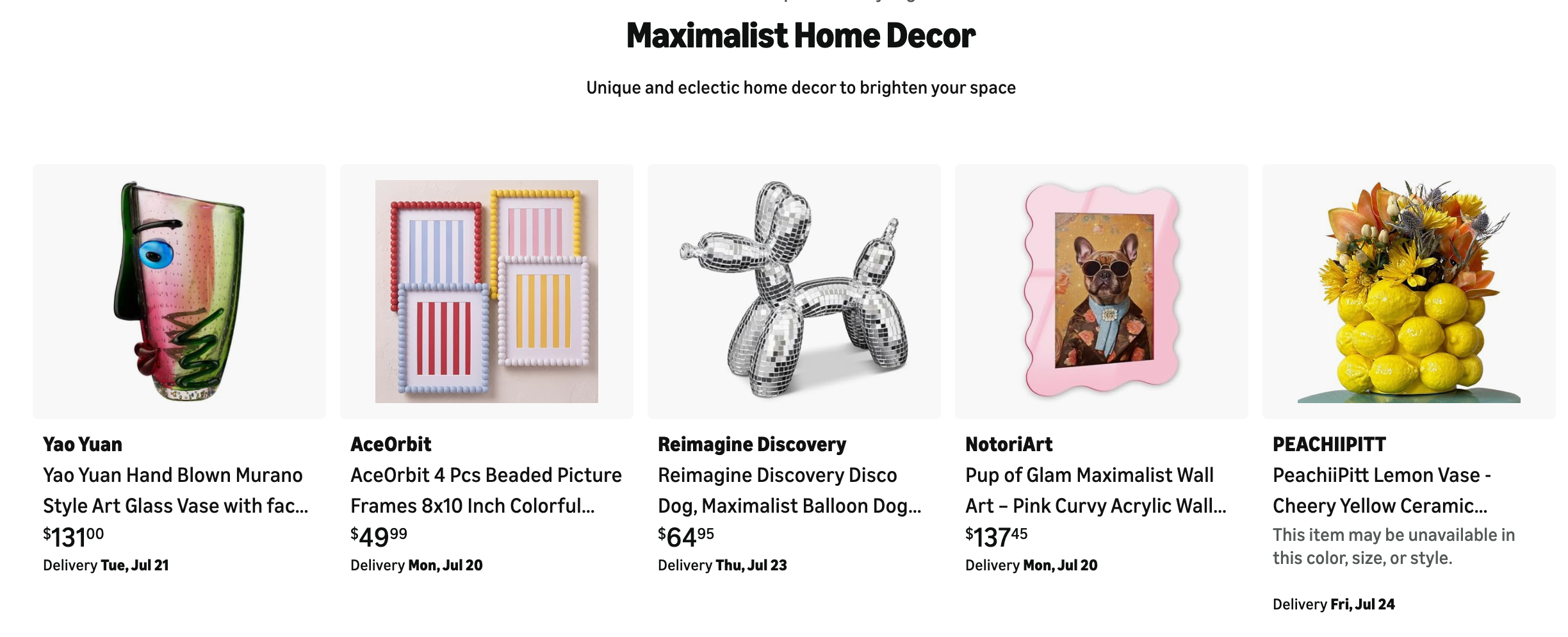
Before specifying any Crafted Maximalist interior, identify your three through-lines: one dominant colour that recurs across objects and surfaces; one material (brass, velvet, aged timber) that bridges different periods and origins; one motif or form (botanical, geometric, organic curve) that appears in different scales across the room. Without at least two of these three, the space will read as unstyled rather than intentionally layered.
Start the colour decision from the rug or the largest textile in the space. Build the palette from what already exists rather than designing from a mood board down. Maximalist spaces that feel curated are almost always built from the floor up — the rug sets the colour temperature, the upholstery responds, the walls anchor.
Client conversation question: “What is the one object in your current home that you love most — and what do you love about it?” That object’s qualities — its colour, texture, period, emotional register — should become the seed of the through-line. Crafted Maximalism is always anchored in something specific, never in a general desire for “more.”
9. Neo Deco: Geometric Glamour for the Contemporary Interior
Foundational styles: Art Deco · Hollywood Glam | Read: Neo Deco in depth → | Color: Black and Deep Dramatic Tones →
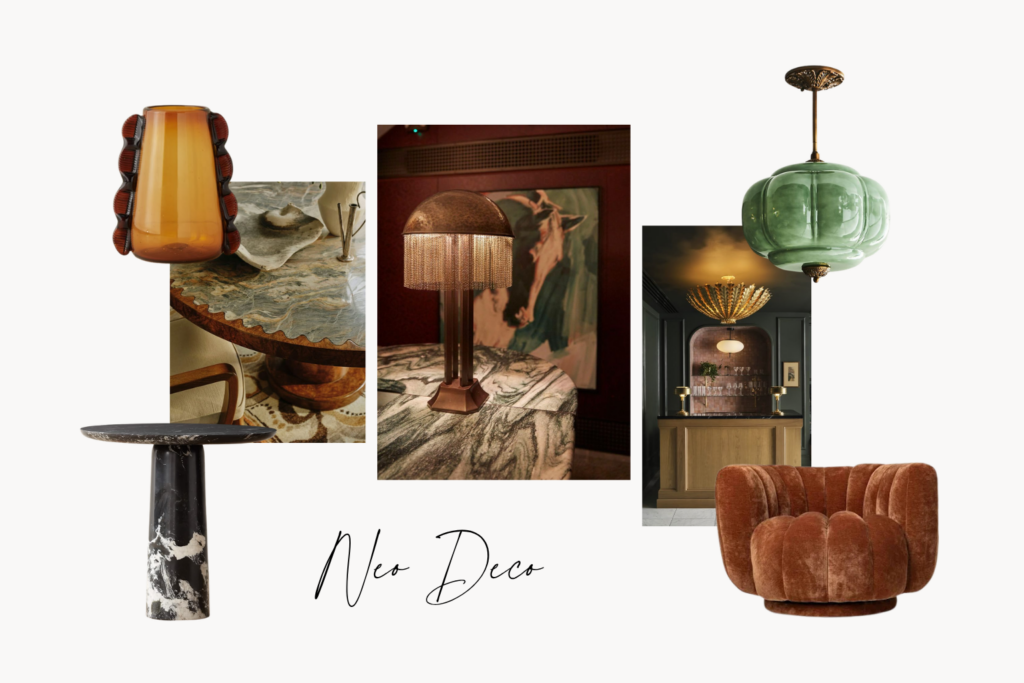
Neo Deco revives the formal intelligence of Art Deco — geometric precision, bold material contrast, and unapologetic glamour — and strips it of its period excess.
Where classic Art Deco was theatrical and accumulative, Neo Deco is edited and atmosphere-driven. The geometry is present but restrained. The metals are present but warm — aged brass and matte bronze rather than chrome.
The palette is deep and immersive — inky navy, forest green, warm black, burgundy — rather than the gold-and-black drama of the original.
Neo Deco is the 2026 expression of Quiet Luxury taken toward confidence. It is the design language for clients who find pure restraint too passive but find full maximalism too demanding. It sits precisely between those two positions — structured, atmospheric, and quietly theatrical.
What makes it work: Lighting is the single most important decision in a Neo Deco interior.
The style depends entirely on the interplay of surface and light — the way aged brass catches it, mirrored glass multiplies it, lacquer shimmers in it. Lighting specification that is too diffuse or too even will flatten the effect entirely. This is a style where the lighting plan and the material plan must be developed simultaneously.
Neo Deco requires commitment to its formal precision — the geometry must be exact, the materials must have quality, and the palette must be bold enough to hold the ornament. Timid Neo Deco reads as decorative pastiche. Your first material decision is always the metallic: choose one warm metal (aged brass, matte bronze, or antique gold) and use it consistently throughout — in hardware, lighting, and decorative objects. Mixed metallics dilute the cohesion.
The accessories in a Neo Deco interior are not afterthoughts — they are the punctuation of the design. A sculptural table lamp, a crystal decanter, a statement mirror. Source these with the same rigour as the furniture and they will elevate the space; treat them as secondary and the style reads as costume rather than design.
Client conversation question: “When you imagine a room that feels genuinely glamorous — not flashy, but confident — what is the first detail you see?” The specific detail they name tells you which material language to anchor the scheme in. A surface, a light, a piece of furniture — the answer reveals what their version of glamour looks like.
What Colors and Materials Are Defining 2026 Interiors?
The color story of 2026 is emotional before it is aesthetic. Designers are reaching for palettes that produce a specific psychological response — warmth, groundedness, calm, or confidence — rather than ones that are simply current.
The result is directions that read as nature-derived and human-scaled at the quiet end, and immersively atmospheric at the bold end.
Warm neutrals — greige, mushroom, warm stone, oatmeal — remain the dominant base palette across all major style directions. They are not a trend; they are a settled foundation.
Earthy warms — terracotta, clay red, burnt sienna, ochre — are the strongest accent direction. They bring heat without loudness and connect the interior to the natural material world.
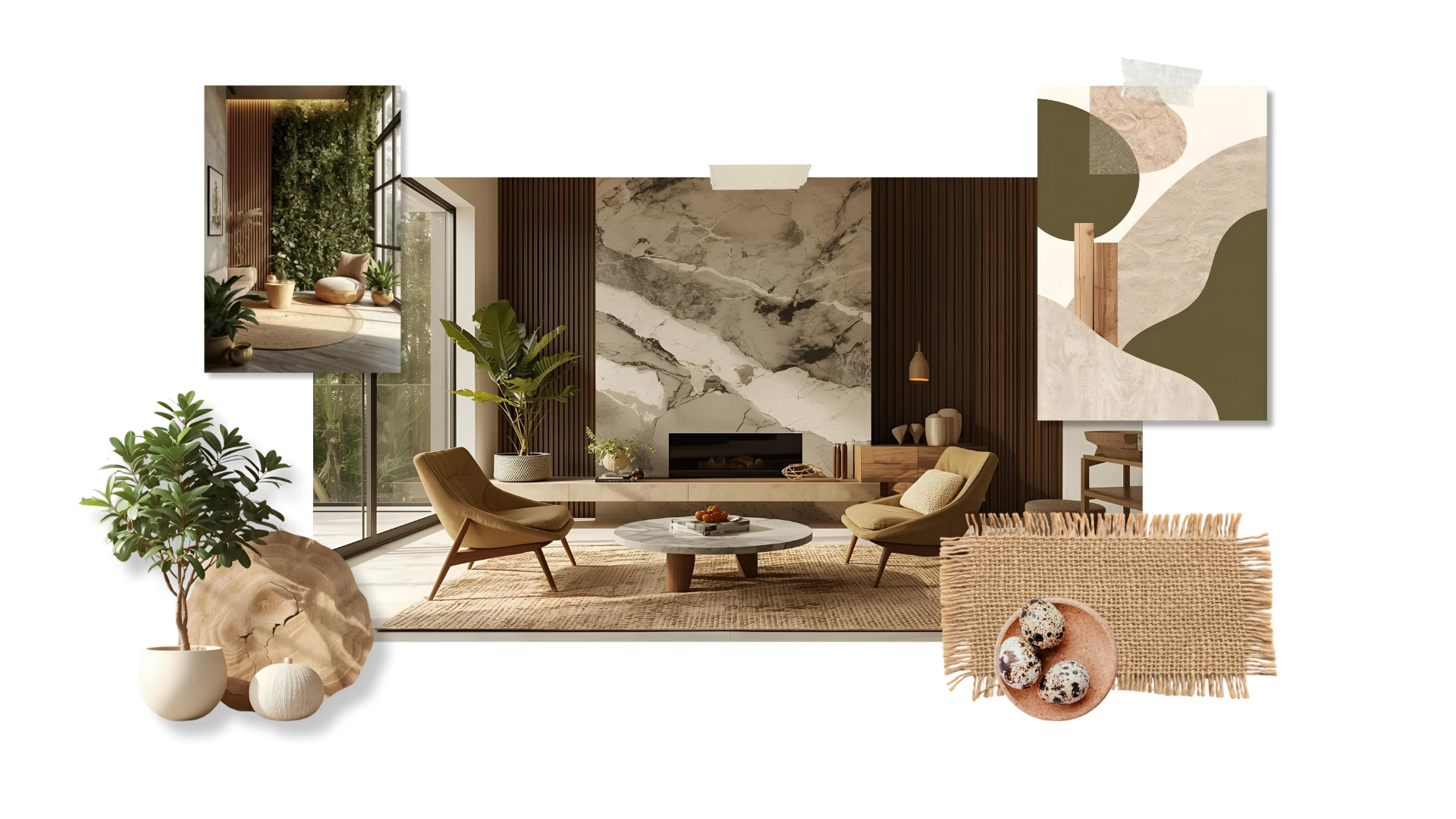
Deep botanicals — moss, sage, olive, forest green — have moved from accent to primary. Green is the most restful colour for the human eye and the most natural fit for interiors communicating wellbeing.
Dramatic grounds — charcoal, inky navy, warm black, deep plum — are anchoring the confident end of the market. Used as a whole-room ground (see Color Drenching and Neo Deco above), they create the intense atmospheric spaces defining high-end residential work in 2026.
Materials mirror these directions: plaster and limewash for walls, honed and aged stone for surfaces, mid-tone timber for furniture, boucle and wool for upholstery.
The common thread is tactility — surfaces that reward physical contact and age in ways that improve rather than degrade.
Take any trend from research to presentation.
Studio translates the trends on this page into structured execution tools — style guides, Canva mood board systems, and client-ready presentation frameworks. Seven styles are available now. A new style releases every month.
Explore Studio membership →How to Apply 2026 Interior Design Trends in Your Own Space
Translating trend intelligence into real spaces requires a specific sequence of decisions. These five principles apply regardless of which direction you are working with.
Start with feeling, not aesthetics. Decide how you want the room to feel — calm, energised, expressive, grounded, glamorous — before choosing a style or palette. The emotional brief precedes the visual one.
Build from texture, not colour. Lay your rug, choose your upholstery, select your wall finish. Colour should emerge from the material palette — not the other way around. A room built texture-first reads as coherent; a room built colour-first often reads as thin.
Invest in one sculptural hero piece. A standout table, chair, or light fitting anchors a room and gives everything else a reference point. Generic interiors lack this piece. Memorable ones are defined by it.
Mix old and new deliberately. One or two vintage or pre-loved pieces per space add character and depth that new production cannot replicate. The skill is in the proportion and placement.
Let the lighting do the emotional work. Overhead light is functional; lamps, sconces, and warm-toned bulbs create atmosphere. A room lit well outperforms a room styled well every time.
Frequently Asked Questions: Interior Design Trends 2026
What are the major interior design trends for 2026?
The nine key micro-trends for 2026 are Warm Minimalism, Modern Organic, Japandi Evolution, Mediterranean Soft Neutrals, Soft Industrial, Retro and Vintage Revival, Color Drenching and Tonal Rooms, Crafted Maximalism, and Neo Deco.
Each one expresses a broader cultural movement: the desire for emotional warmth, nature connection, understated luxury, personal narrative, sustainability, tech-calm retreats, immersive colour, confident abundance, and geometric glamour.
Which colors are trending in interior design in 2026?
The dominant colour directions in 2026 are warm neutrals (greige, mushroom, warm stone), earthy warms (terracotta, clay red, ochre), deep botanicals (olive, sage, forest green), and dramatic grounds (charcoal, warm black, inky navy, deep plum).
Cold greys and stark white-on-white interiors have faded. The shift is toward palettes that feel nature-derived, emotionally warm, or atmospherically confident.
What is the difference between an interior design trend and a style?
A trend is a cultural direction — a movement in how people want to feel and live at a particular moment.
A style is a permanent visual system with defined materials, proportions, and spatial logic that exists independently of any trend cycle.
Trends rise and fall; styles endure. Japandi is a style; Japandi Evolution is the 2026 trend expression of that style. Understanding styles gives designers tools that outlast the trend cycle.
Explore all 31 interior design styles →
Which 2026 trends work best for small spaces?
Warm Minimalism, Japandi Evolution, Scandinavian, and Modern Organic perform best in small spaces.
All four use light palettes, clean furniture profiles, and negative space to make compact rooms feel larger.
The most important principle in a small space is reducing visual complexity — fewer objects, a cohesive palette, and furniture chosen for precise scale rather than approximate size.
Are gray and white interiors outdated in 2026?
Cold grey and stark clinical white are fading, but warm grey, greige, and textured white are timeless.
The shift is not from neutral to colour — it is from cold neutral to warm neutral. A warm white limewashed wall is as contemporary as any other choice in 2026; a cool flat-painted grey is starting to read as the previous decade.
What is Crafted Maximalism?
Crafted Maximalism is the disciplined, intelligent version of maximalism — defined by pattern layering, deep immersive palettes, and curated objects chosen for story and craft as much as beauty.
The key distinction from visual chaos is the presence of a through-line: a recurring colour, material, or motif that runs throughout the space and gives the eye a thread to follow.
It draws from the Maximalist, Eclectic, and Bohemian style traditions.
What is Neo Deco interior design?
Neo Deco is a contemporary reinterpretation of Art Deco design — retaining its geometric precision, rich materiality, and atmospheric confidence while stripping away its period excess.
Where classic Art Deco is theatrical and accumulative, Neo Deco is edited and mood-driven.
Warm metals (aged brass, matte bronze), deep immersive palettes (inky navy, warm black, forest green), and confident geometric form define the look.
Read the full Neo Deco guide →
Where can I learn more about the styles behind each trend?
The Interior Design Styles pillar covers all 31 foundational styles in detail — including principles, materials, palette logic, and a Designer’s Note for each one.
Seven styles are available as complete execution systems in SampleBoard Studio, including style guides, mood board templates, and client presentation frameworks in Canva.
Glossary of Interior Design Trend Terms
What is Modern Organic interior design?
Modern Organic is a residential design direction balancing the spatial discipline of contemporary design with the material warmth of nature-forward interiors.
Defined by sculptural curved furniture, natural materials (boucle, timber, stone, linen), and a palette of warm neutrals. The most commercially prevalent direction in high-end residential design in 2026.
What is Quiet Luxury in interiors?
Quiet Luxury prioritises craftsmanship, material quality, and longevity over trend-driven decoration or conspicuous display. Honed stone over polished marble, aged brass over chrome, furniture built to last decades. The visual language is restrained, warm, and without obvious trend reference.
What is Warm Minimalism?
Warm Minimalism is minimalist design grounded in warm-toned surfaces, tactile fabrics, and a palette of greige, mushroom, and soft stone. It maintains minimalism’s spatial discipline while producing rooms that feel inviting rather than austere.
What is color drenching?
Color drenching applies a single hue or tonal family to every surface in a room — walls, trim, and ceiling — creating an immersive, cocoon-like atmosphere. Works best in single-purpose rooms with sufficient natural light. The sheen level across surfaces is the most important technical variable.
What is Crafted Maximalism?
Crafted Maximalism is disciplined maximalism defined by pattern layering, deep palettes, and curated objects chosen for story and craft. Distinguished from general maximalism by the presence of a through-line — a recurring colour, material, or motif — that creates coherence within the abundance.
What is Neo Deco?
Neo Deco is a contemporary interpretation of Art Deco design that retains geometric precision and rich materiality while removing period excess. Warm metals, deep immersive palettes, and edited glamour define it. The lighting specification is the single most important design decision in a Neo Deco interior.
What is Soft Industrial design?
Soft Industrial retains the raw material palette of industrial design — concrete, steel, exposed brick — while softening it with curved furniture, warm-toned metals, and generous textiles.
The design language of contemporary urban apartments that want atmospheric depth without sacrificing comfort. Acoustic planning is an essential part of the brief.
What is Japandi interior design?
Japandi merges Japanese design (imperfection, asymmetry, negative space) with Scandinavian design (warmth, domesticity, material honesty). Defined by wabi-sabi ceramics, solid timber furniture in low profiles, undyed textiles, and a palette of warm neutrals.
Available as a complete execution system in SampleBoard Studio as JUNIPER.
Browse by Topic
Interior design trends are not arbitrary. They emerge from how culture shifts — from how people want to feel inside their homes, what materials and technologies become available, and which ideas from fashion, architecture, and art reach the domestic interior.
SampleBoard has tracked interior design trends since 2010. Trends show where design is going.
Understanding why a trend rises is more useful than simply knowing that it exists.
This guide covers the nine interior design trends shaping 2026: the six macro cultural movements driving them, and the nine specific style directions they produce.
For each trend you will find what it looks like, why it is happening, how to apply it professionally, and which foundational style underpins it.
SampleBoard Studio shows you how to execute it — with structured style guides, mood board systems, and client-ready presentation frameworks built around each direction.
How this fits into the SampleBoard system
Stage 1 of 4 — understanding the cultural context that shapes design right now. From here: explore the styles behind each trend → understand the color direction driving them → then build and present your concept in SampleBoard Studio →