
01 — 2026 Direction
Earth-Based Warmth
Clay, terracotta, rust, canyon red, and sunbaked neutrals. The most direct expression of the shift away from clinical minimalism toward spaces that feel handmade, grounded, and materially rich.
02 — 2026 Direction
Softened Neutrals
Warm whites, chalk, oat, sand, and mushroom. Pure white is receding in favour of tones that carry just enough pigment to feel intentional. The key split: soft neutrals (cool-leaning, airy) vs warm neutrals (earth-anchored, layered).
03 — 2026 Direction
Nature-Led Greens
Olive, sage, moss, eucalyptus, forest, bamboo green. Green has moved from accent wall to base palette. The key distinction: botanical green (deep, saturated) vs muted green (sage, eucalyptus — functioning as a warm neutral alternative).
04 — 2026 Direction
Deep Blues & Ink Tones
Navy, indigo, slate, denim blue, Aegean sea-blue. The movement in 2026 is toward blues with warmth — denim over cobalt, indigo over navy. Cold-blue is receding; warmer, dustier, more material blues are ascending.
05 — 2026 Direction
Muted Pastels
Dusty blush, pale sage, powder blue, dusty rose, lilac grey. Emphatically muted — desaturated, aged, textile-soft. Not candy-bright but faded, considered, and worn-in. Always grounded with natural materials in matte finishes.
06 — 2026 Direction
Dark & Moody Tones
Charcoal, ink, espresso, anthracite, soft black. In 2026 these are material-first — chosen for what they do to surfaces rather than for drama alone. A soft black door frame. A charcoal island. These tones function architecturally, not decoratively.
Color Family 01
Red & Earthy Warm Tones
Clay · Terracotta · Paprika · Rust · Brick Red · Canyon Red · Burgundy · Sienna. The color family that most directly expresses the 2026 appetite for warmth, craft, and material honesty.
Color Family 02
Pink & Pastels
Blush · Rose Quartz · Dusty Mauve · Pale Blush · Dusty Rose · Peach Sorbet · Powder Blue · Lilac. The 2026 pastel direction is emphatically muted — aged, desaturated, and textile-soft.
Color Family 03
Blue & Cool Tones
Navy · Indigo · Slate · Teal · Denim Blue · Steel Blue · Aegean Sea-Blue · Sky Blue. The most versatile deep tone in residential interiors — the only family that works convincingly as base, feature surface, cabinetry, and textile accent.
Color Family 04
Green & Nature-Inspired Shades
Sage · Olive · Moss · Eucalyptus · Forest · Bamboo Green · Deep Jungle · Seafoam · Pistachio. The question is no longer whether to use green — it’s which green, at what coverage, with which materials.
Color Family 05
Soft Neutrals & Minimalist Palettes
White · Chalk · Cream · Pale Sand · Soft Greige · Oyster · Warm White · Off-White. Not the absence of color — a considered decision to let architecture, light, and material quality do the work that pigment does elsewhere.
Color Family 06
Warm Neutrals & Earthy Tones
Sand · Stone · Greige · Oatmeal · Mushroom · Camel · Taupe · Raw Umber · Warm Greige. The dominant palette of 2026 residential interiors globally — enough earth pigment to feel considered, without reading as a color commitment.
Color Family 07
Browns & Earthy Neutrals
Cocoa · Espresso · Walnut · Caramel · Mocha · Chestnut · Smoked Wood · Tobacco · Teak. The color the design world forgot for a decade and is now rediscovering — the logical extension of the warm-material movement.
Color Family 08
Purple & Artistic Hues
Lavender · Lilac · Dusty Mauve · Heather · Plum · Mulberry · Deep Amethyst · Digital Lavender · Dusk Violet. In 2026 purple has split: muted register functioning as sophisticated neutral, deep jewel register as bold architectural statement.
Color Family 09
Amber, Gold & Warm Accent Tones
Amber · Mustard · Harvest Gold · Antique Gold · Warm Bronze · Aged Brass · Beeswax · Ochre. Most powerful as a material tone — the most accessible entry point for clients nervous about color commitment.
Color Family 10
Black & Deep Dramatic Tones
Charcoal · Ink · Obsidian · Anthracite · Soot · Soft Black · Raw Concrete · Smoke. Black in 2026 is not dramatic for its own sake — it is architectural. The deliberate use of depth to add weight, definition, and permanence.
10 Color families shaping 2026 interiors
Each family is explored as a design system — not a list of colors, but a set of tonal relationships, material affinities, and spatial behaviors.
Read the family that interests you. Then follow the style link-backs to see how that palette functions within a specific design language.
Red & Earthy Warm Tones
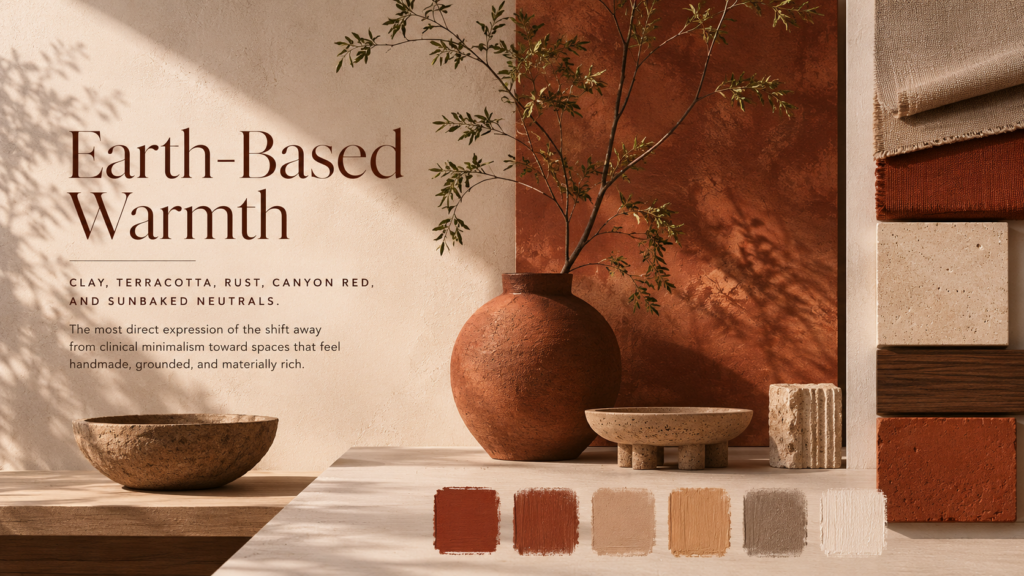
Red is the color family that most directly expresses the 2026 appetite for warmth, craft, and material honesty. This is not the red of accent walls and bold statements — though it can be that.
It is more fundamentally the red of earth: clay, terracotta, adobe, and fired pigment. These tones carry weight and intimacy in a way that cooler palettes cannot. They do not recede. They define a room’s temperature from the moment you enter.
The register spans from the dusty warmth of raw clay through the saturated depth of paprika and the dark richness of burgundy. What connects them is that all carry warmth as a structural quality — not applied on top of a neutral base, but embedded in the pigment itself.
Color psychology
Warm reds stimulate connection, conversation, and appetite — a long history in dining spaces.
In their earthier, more muted registers (clay, terracotta, burnt sienna), they produce something quieter: a sense of being settled and grounded. The difference is chroma. High-chroma red energises. Low-chroma, high-warmth red envelops.
For residential interiors in 2026, the demand is for the latter.
In a living room, a terracotta wall creates the sensation of warmth before any furniture is placed. In a kitchen, paprika on cabinetry reads as appetite-activating without being aggressive — particularly when balanced with natural stone countertops and aged brass hardware.
Key tones and how they behave
- Terracotta — the workhorse of the family. Warm, grounded, and forgiving in most light conditions. Shifts toward orange in direct sunlight; toward brown in low light. Always reads as handmade and Mediterranean-adjacent.
- Clay — more muted than terracotta, with a dustier, plaster-like quality. Sits closer to the neutral register and can function as a warm base tone rather than an accent.
- Paprika — saturated and specific. The most demanding tone in the family. Best on a single surface: a kitchen island, a feature wall, a large upholstered piece.
- Canyon red — deeper and more geological than terracotta. Carries the warmth of the desert landscape. Pairs with sand dune neutrals in Southwestern-informed spaces.
- Burgundy — the dark anchor of the family. Pulls toward plum in cool light, toward warm brown in incandescent. Best in rooms with natural light deficit where depth is an asset.
- Rust — the most material-specific tone. Reads as oxidised metal, aged textile, autumn leaf. Lower chroma than paprika, more character than terracotta.
Material pairings — how each surface changes the color
- Limewash plaster — the most sympathetic partner for terracotta and clay. The chalky quality prevents warm reds from becoming heavy. The surface shifts visually across the day as light direction changes, adding life that flat paint cannot.
- Boucle — softens warm reds significantly. The looped texture absorbs light, pulling high-chroma tones back toward warmth and intimacy. A paprika boucle sofa reads as considerably less saturated than the same color on a smooth surface.
- Aged brass — the natural metallic partner. Its warm, slightly oxidised tone shares the same yellow-red register as terracotta and rust. Chrome and nickel produce tension with this palette.
- Raw linen — acts as breathing space within a warm-red scheme. Its cool-adjacent, slightly grey-beige quality provides relief without introducing a different color temperature.
- Walnut timber — deepens the palette toward richness. Adds sophistication to terracotta-based schemes that might otherwise read as rustic.
Styling tip
The failure mode for this palette is heat accumulation — too much warmth across too many surfaces with nothing to breathe.
Balance deep red with soft texture — boucle, raw linen, or chalky plaster — to keep the palette modern and livable. The contrast should be textural, not tonal: introduce relief through surface quality rather than by adding a cool accent color that will fight the palette’s identity.
When presenting to a client who is nervous about “too much color,” show terracotta on a single feature wall or as a large textile sample first. The same palette at 20% coverage makes the case for what it would do at 60%.
Design styles this palette connects to
The red and earthy warm family operates differently depending on which design language it enters. In Mediterranean interiors, terracotta is structural — floors, walls, and exterior surfaces — grounded by aged white plaster and cobalt accents. It is the base, not the feature.
In Southwestern design, the palette deepens toward canyon red and adobe, anchored by turquoise and the specific quality of desert light.
In Organic Modern, terracotta appears as the warmest tone in an otherwise muted neutral palette — a single terracotta ceramic activates the whole scheme without dominating it.
In Bohemian interiors, rust and paprika layer with indigo, amber, and olive for saturated richness.
In Rustic spaces, the palette goes to its darkest register — deep burgundy, espresso, bark — where it reads as elemental and enduring.
→ Mediterranean Style Guide · Southwestern Style Guide · Organic Modern Style Guide · Bohemian Style Guide · Rustic Style Guide
Build a warm earth palette in SampleBoard Studio → Each palette in this family is fully translated into a structured style guide, mood board framework, and presentation-ready system.
Pink & Pastels
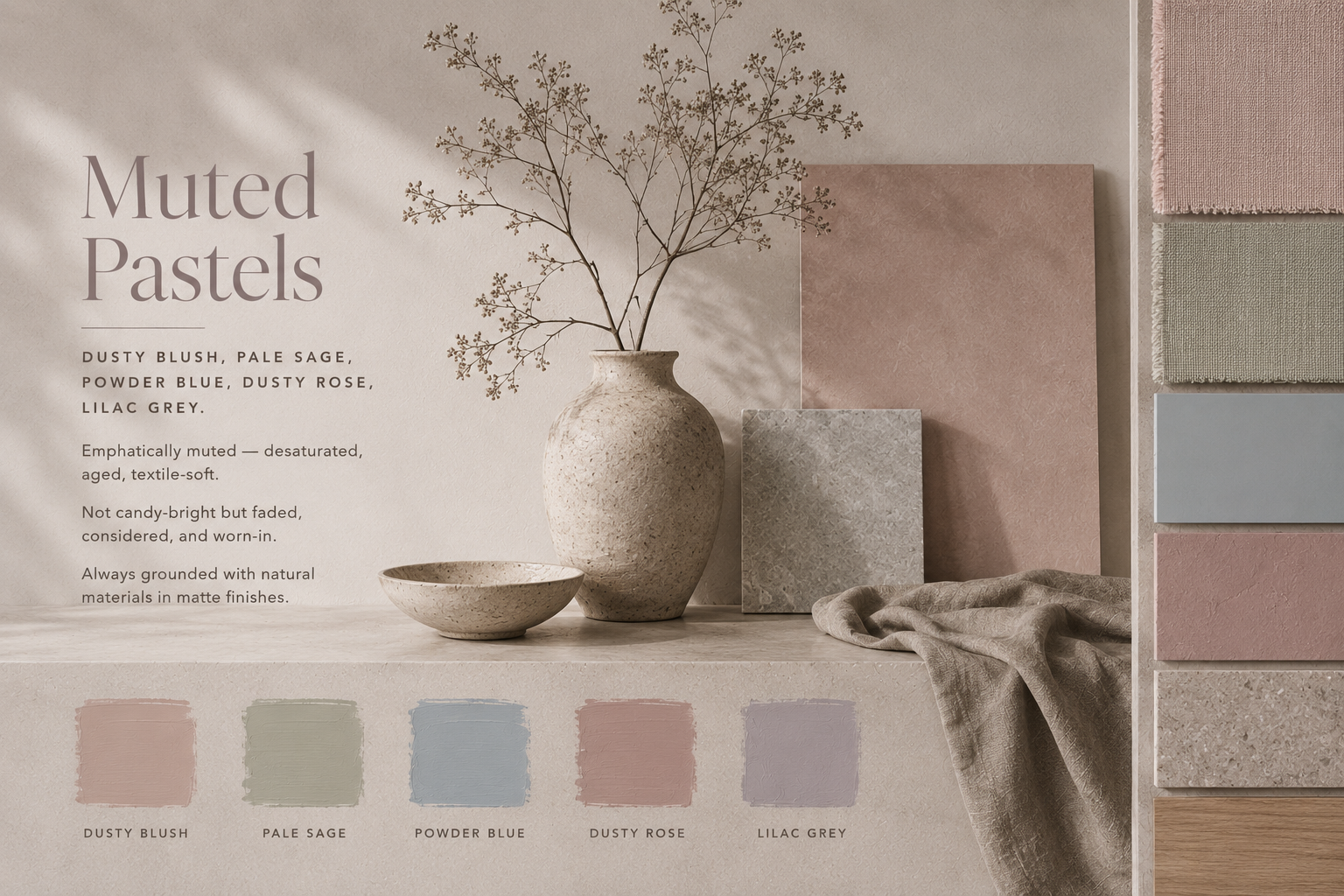
The pastel direction in 2026 is emphatically muted. These are not the bright, candy-saturated pastels of earlier cycles — they are aged, desaturated, and textile-soft.
Think of the color of faded linen left in southern light, of hand-thrown ceramics with an imperfect glaze. The sophistication of the 2026 pastel palette lies in its restraint: these tones never shout. They settle.
Color psychology
Pink reduces visual nervous system activation — it is measurably calming in a way that warm neutrals approximate through temperature but cannot replicate through hue.
For bedrooms and spaces designed for decompression, dusty pink and pale blush perform exceptionally well as base tones. They create a sense of being cocooned that no neutral can quite achieve.
The failure mode — the reason designers avoid pink — is when it reads as juvenile. This is invariably a problem of saturation and finish: high-saturation pink in a gloss finish looks like a children’s room.
Low-saturation pink in a matte or chalky finish looks like a sophisticated interior. The pigment itself is not the problem; the surface treatment always is.
Key tones and how they behave
- Dusty blush — the most livable tone in the family. Pale enough to function as a warm neutral alternative; warm enough to read as considered. Shifts toward beige in warm light; toward pale lavender in cool northern light.
- Dusty rose — a step deeper. Reads clearly as pink without intensity. Ideal for a feature wall or large upholstered piece where presence is wanted without dominance.
- Pale blush — almost a neutral. Often described by clients as “I didn’t notice it was pink until I felt how warm the room was.”
- Dusty mauve — moves toward purple. The most sophisticated tone in the family. Sits naturally in contemporary spaces where pink alone would feel too domestic.
- Peach sorbet — warmer, with more orange. The 2026 version of millennial pink: warmer, more material, less digital.
Material pairings — how each surface changes the color
- Light oak — the most natural partner for blush. Its warm honey tone reinforces the warmth without competing. Together they produce the Scandinavian-soft aesthetic defining 2026 Nordic residential interiors.
- Matte ceramics — amplify the artisanal quality of muted pastels. An unglazed or matte-glazed ceramic reads as handmade and intentional in a way that the same color in gloss would not.
- Brushed brass — warms the palette without adding saturation. Its muted gold tone sits sympathetically with the pink family.
- Rough linen — the most important textile for this palette. Its natural, slightly grey quality prevents the pastel scheme from becoming sweet. Every pink room needs something rough and natural in it.
- Marble with warm veining — introduces sophistication and cool relief simultaneously.
Styling tip
Always use pastels in matte or chalky finishes. Glossy pastel reads as retro at best.
The matte surface is what gives these tones their contemporary character — it is the finish, not the pigment, that makes the difference between a sophisticated and an unsophisticated pastel interior.
When presenting to a client who wants pink but isn’t sure, show them dusty blush first — it reads as a warm neutral to many eyes until they look closely. Once they see how it performs in the room, going deeper into the palette becomes much easier.
Design styles this palette connects to
In Scandinavian interiors, pale blush and dusty rose appear as accent tones within a predominantly white and warm timber scheme — providing the warmth that prevents the palette from becoming clinical.
In French Country, dusty rose and blush rose connect to the faded-floral tradition of Provençal textiles — the tone should feel sun-bleached, not freshly applied.
In Shabby Chic, blush and duck egg blue are the twin anchors — the distressed, faded quality of both tones gives the style its character.
In Vintage interiors, dusty mauve and peach sorbet carry genuine period resonance.
→ Scandinavian Style Guide · French Country Style Guide · Shabby Chic Style Guide · Vintage Style Guide

Build a pastel palette in SampleBoard Studio → Explore Studio membership →
Blue & Cool Tones
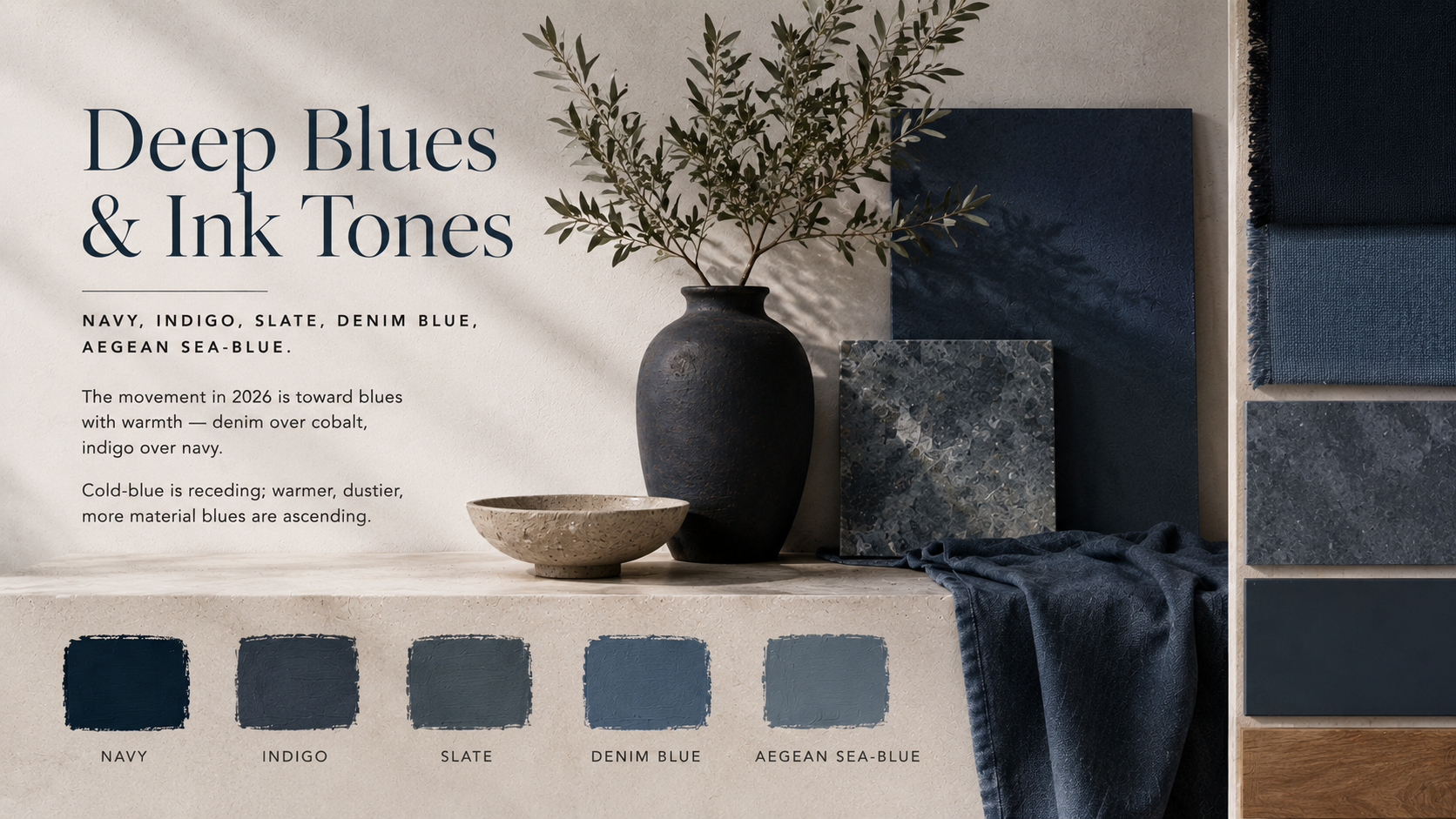
Blue is the most versatile deep tone in residential interiors — the only color family that works convincingly as a whole-room base, a single feature surface, a cabinetry color, and a textile accent.
In 2026, the movement within this family is toward blues with warmth in them. Denim blue over cobalt. Indigo over navy. Aegean sea-blue over electric. The cold-blue register is receding; warmer, dustier, more material blues are ascending.
Color psychology
Blue supports focus, clarity, and calm — the three qualities that the home-working context has made more commercially relevant than any other.
In a study or home office, deep blue creates the visual equivalent of a closed door: a space for concentrated work. In a bedroom, softer blues produce the lowest resting heart rate of any color family — a measurable physiological effect that matters when the brief is “somewhere I can actually sleep.”
Light, high-value blues (sky, powder, pale slate) open space and create airiness. Deep, low-value blues (navy, indigo, midnight) create enclosure and weight.
The same emotional register — calm, focused, composed — runs across the full range; only the spatial effect changes.
Key tones and how they behave
- Denim blue — the 2026 lead tone for this family. Warm enough to work with timber and natural materials; cool enough to read as blue rather than grey.
- Indigo — deep, slightly purple-inflected, and rich. Works best in spaces with good natural light where its depth reads as deliberate rather than dark.
- Slate — the blue that behaves most like a neutral. The most forgiving tone for designers uncertain about committing to blue at scale.
- Aegean sea-blue — carries green in it, connecting it to water rather than sky. Works in Mediterranean, Coastal, and Tropical spaces where cobalt would read as too formal.
- Steel blue — cool, precise, and architectural. The natural partner for Modern and Contemporary interiors where blue needs to contribute structure rather than softness.
- Teal — the blue-green crossover. Works where pure green would be too botanical and pure blue too cool.
Material pairings — how each surface changes the color
- Oak timber — the warm counterpart that prevents blue from going cold. The tension between warm natural material and cool considered color is what gives Scandinavian and Japandi spaces their character.
- Cane and rattan — introduce a natural, slightly informal quality that softens deep blues. Particularly effective with navy and indigo.
- Linen — its slightly grey-beige quality sits sympathetically with blue without competing. Acts as breathing space that reads as neutral while contributing warmth.
- Travertine — its warm, creamy tones produce a sophisticated contrast with deep blue that reads as more considered than white alone.
- Brushed chrome or nickel — the metallic that belongs to this family. Unlike brass, brushed chrome shares the cool-to-neutral register of blue.
Styling tip
Tonal layering is the most effective technique for blue interiors: move from light to medium to deep within the same family rather than introducing a contrasting accent color.
Blue has enough internal range to sustain a complete room without reaching outside itself. The exception is natural materials: always introduce at least one warm natural surface (oak, rattan, linen) to prevent the palette from reading as cold.
Design styles this palette connects to
In Coastal design, the specific tone matters enormously — Hampton’s uses navy and crisp white; Mediterranean Coastal uses Aegean sea-blue with aged white plaster and terracotta.
In Contemporary interiors, denim blue is replacing the cool greys of the previous decade as the defining neutral-adjacent tone.
In Japandi spaces, soft slate blue introduces the water and sky element that the philosophy depends on.
In Traditional interiors, navy and Prussian blue function as deep anchor tones.
In Modern design, steel blue is historically grounded — it appears in De Stijl and Bauhaus compositions as a structural accent.
→ Coastal Style Guide · Japandi Style Guide · Modern Style Guide · Traditional Style Guide · Contemporary Style Guide
Build a blue palette in SampleBoard Studio → Explore Studio membership →
Green & Nature-Inspired Shades
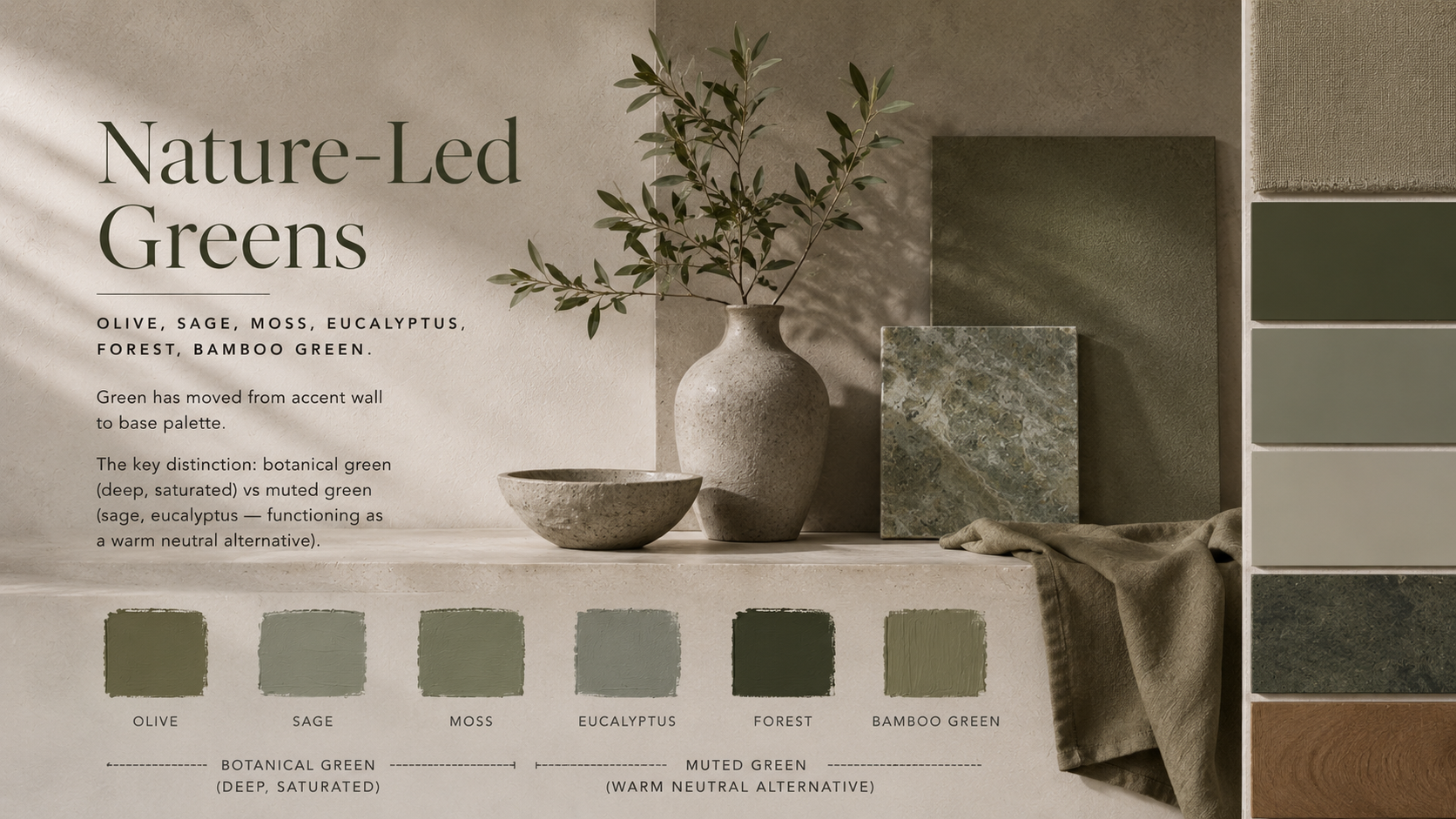
Green is the dominant color story of the decade, and in 2026 it is at the peak of that arc. The shift is complete: green has moved from accent to base, from botanical detail to architectural decision.
The question for designers is no longer “should I use green?” but “which green, at what coverage, with which materials?”
The family divides into two distinct registers. The muted register — sage, eucalyptus, soft olive — functions as a warm neutral alternative.
The saturated register — forest, moss, deep jungle — is fully committed and requires material confidence to execute well.
Color psychology
Green is the most restful color for the human eye — it requires the least muscular adjustment of the lens to bring into focus, which is why exposure to green environments reduces cortisol measurably.
This makes green the single most evidence-backed color choice for bedrooms, bathrooms, and any space where physical restoration is the brief. In saturated registers, forest green and deep jungle are among the few colors that read as simultaneously bold and calm.
Key tones and how they behave
- Sage — the muted register’s defining tone. Grey-green, dusty, and calm. Functions as a warm neutral alternative in any room that needs color without saturation. Shifts toward grey in cool northern light; toward olive in warm direct light.
- Eucalyptus — cooler and slightly more silvery than sage. Its botanical associations connect it to Organic Modern and Biophilic registers. The grey undertone makes it a natural partner for limewash plaster and raw linen.
- Olive — the warmest tone in the muted register. Its yellow-green undertone connects it to the earth palette. More culturally specific than sage — it carries Mediterranean and Bohemian associations.
- Moss — deep, slightly brown-green, and organic. Sits between the muted and saturated registers. Works best on walls where its depth creates atmosphere.
- Forest green — the saturated register’s benchmark tone. Deep, authoritative, and visually complete. Requires confident material partners — bare wood, aged leather, brushed brass — and is most effective in rooms with good natural light.
- Deep jungle — the most saturated and specific tone. Its tropical associations distinguish it from domestic greens. Only appropriate in Tropical, Bohemian, and Maximalist spaces.
- Bamboo green — light, warm, and specific to Asian Zen and Japandi registers.
Material pairings — how each surface changes the color
- Rattan — filters green into warm gold at midday, strengthening the botanical effect. Essential in Biophilic and Tropical spaces using saturated greens.
- Limewash plaster — the most sympathetic wall treatment for sage and eucalyptus. The surface shifts with light direction — toward grey in morning, toward olive in afternoon — adding movement the color alone cannot achieve.
- Glazed ceramic — intensifies and clarifies whatever green it carries. A moss green ceramic glaze reads as considerably more characterful than the same tone on a flat wall surface.
- Raw linen — softens green, pulling it toward grey-green. Sage wall and raw linen upholstery is one of the most reliably successful pairings in current residential design.
- Oak timber — the warm, honey-toned partner that prevents green from reading as cold or clinical.
- Jute and sisal — introduce the earth-ground layer that green needs to feel anchored. A green room with jute flooring reads as botanical and grounded.
Styling tip
Use green as a base tone, not an accent. The most common error with this family is introducing green as a single painted wall or a few cushions — the “pop of nature” approach that has been overdone.
The spaces where green works best are the ones where it commits: whole walls, large upholstered pieces, cabinetry. Combine soft sage walls with darker green accents — a deep olive timber frame, a forest green ceramic — for a layered, botanical composition that earns its depth.
Design styles this palette connects to
Green has the widest style reach of any family on this page.
In Biophilic design it is the primary palette — specified at every surface to reinforce the connection between interior and exterior.
In Japandi spaces, muted sage appears as the botanical note that bridges Japanese wabi with Scandinavian nature.
In Organic Modern, eucalyptus is the bridge between the warm neutral base and the botanical world.
In Scandinavian interiors, sage and dusty green function as the calm accent that provides color without disrupting the restrained palette.
In Tropical design, the palette goes to its deepest register — deep jungle, forest green.
In Wabi-Sabi spaces, moss and bamboo green appear as the living-matter tones that ground the philosophy of impermanence.
→ Biophilic Style Guide · Japandi Style Guide · Organic Modern Style Guide · Scandinavian Style Guide · Tropical Style Guide · Wabi-Sabi Style Guide
Build a nature-led palette in SampleBoard Studio → Explore Studio membership →
Soft Neutrals & Minimalist Palettes
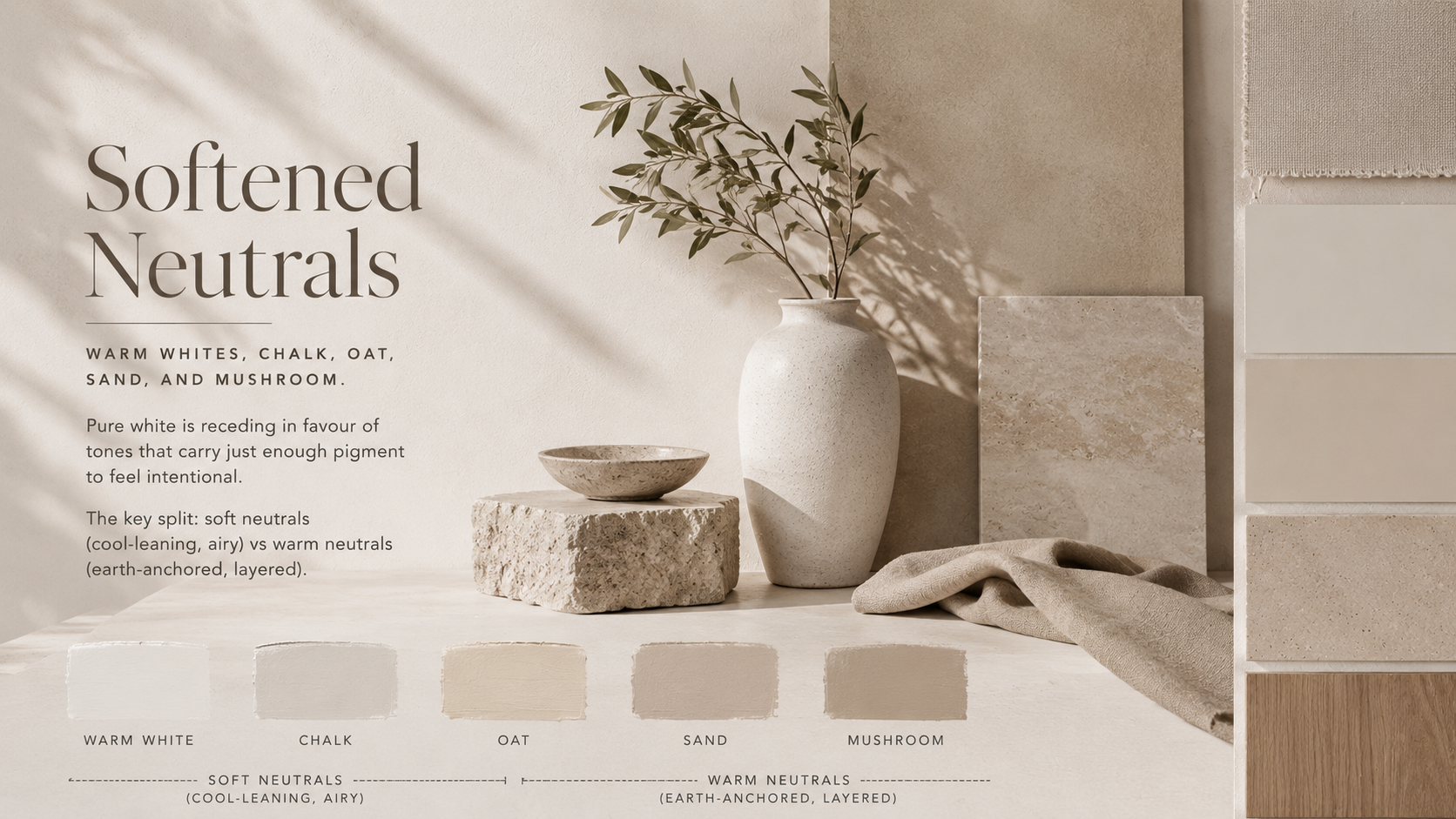
Soft neutrals are not the absence of color. They are a considered decision — the choice to create a space where architecture, light, and material quality do the work that pigment does elsewhere.
In 2026, pure white is receding in favor of tones that carry just enough warmth or coolness to feel intentional: chalk with a slight grey cast, cream with barely-perceptible warmth, oyster with a pearl-like quality that shifts under different light.
Understanding this family in depth — particularly the distinction between cool-leaning and warm-leaning soft neutrals — is one of the highest-value skills an emerging designer can develop.
The wrong soft neutral makes a room feel grey and flat. The right one makes a room feel as though it is glowing from the inside.
Color psychology
Soft neutrals produce stillness — the psychological experience of visual rest. In a world of increasing complexity, a room built on soft neutrals functions as a decompression chamber.
This is the color logic behind quiet luxury: not white as default, but white as a deliberate choice to make space for the experience of being in the room.
The psychological risk is sterility: soft neutrals without textural variation produce clinical rather than calm. The warmth must come from material layering — boucle, linen, limewash, warm timber — since it cannot come from pigment.
Key tones and how they behave
- Warm white — the most useful tone in this family. The slight warmth prevents it from reading as a clinical absence of color. Functions in every design style as a wall color.
- Chalk — has a slight grey-blue cast that makes it feel luminous. The most architectural of the soft neutrals — suits spaces where the structure itself is the feature.
- Cream — the warmest tone in the family. Can become golden in incandescent light. Best in rooms with cool natural light. Becomes too yellow in south-facing rooms with warm afternoon light.
- Pale sand — carries enough earth pigment to connect to the natural world. The soft neutral that functions most comfortably within an Organic Modern scheme.
- Oyster — a pearl-like quality with subtle blue-grey iridescence. Shifts visibly between light and shade — the most alive of the soft neutrals.
- Soft greige — the most commercially safe tone. Works everywhere but distinguishes itself nowhere without strong material layering.
Material pairings — how each surface changes the color
- Limewash plaster — the defining material for soft neutral walls in 2026. Its surface texture creates depth and movement that flat paint cannot achieve.
- Boucle — the textile that the soft neutral palette depends on for warmth. In a room of soft neutrals, boucle is the difference between a beautiful room and an interesting one.
- Linen — shares the slightly imperfect, natural-slub quality that keeps soft neutral palettes from going clinical.
- Warm timber (white oak, ash) — essential. Without the warmth of natural timber, soft neutral palettes become grey.
- Microcement — introduces a cool, architectural quality that suits chalk and oyster tones in Minimalist spaces.
- Wool — adds weight and warmth without introducing color. A chunky-knit wool throw is the most immediate way to prevent a soft neutral room from feeling cold.
Styling tip
Layer at least five textures when working within a fully neutral scheme.
The palette’s sophistication comes entirely from material variation — smooth plaster against rough linen, polished stone alongside raw timber, dense wool on bare microcement. Without the layering, the space reads as unfinished rather than considered. Five textures is the minimum. Seven is better.
When presenting to a client who worries it will look “boring,” show it in material samples rather than paint chips. The difference between a flat white and a limewash white in a material sample is immediately and viscerally apparent.
Design styles this palette connects to
Soft neutrals are the foundational palette of Minimalist design — where warm white and stone tones are chosen over pure white because they are more liveable.
In Scandinavian interiors, warm whites and pale greys are the base against which timber, wool, and ceramic introduce texture and life.
In Japandi spaces, aged white and oyster provide the light anchor that balances warm charcoals and smoked walnut.
In Transitional design, soft greige and warm white function as the neutral bridge between Traditional and Contemporary.
In Modern Farmhouse, warm linen and chalk white are the structural tones the black-and-white contrast builds on.
→ Minimalist Style Guide · Scandinavian Style Guide · Japandi Style Guide · Transitional Style Guide
Build a soft neutral palette in SampleBoard Studio → Explore Studio membership →
Warm Neutrals & Earthy Tones
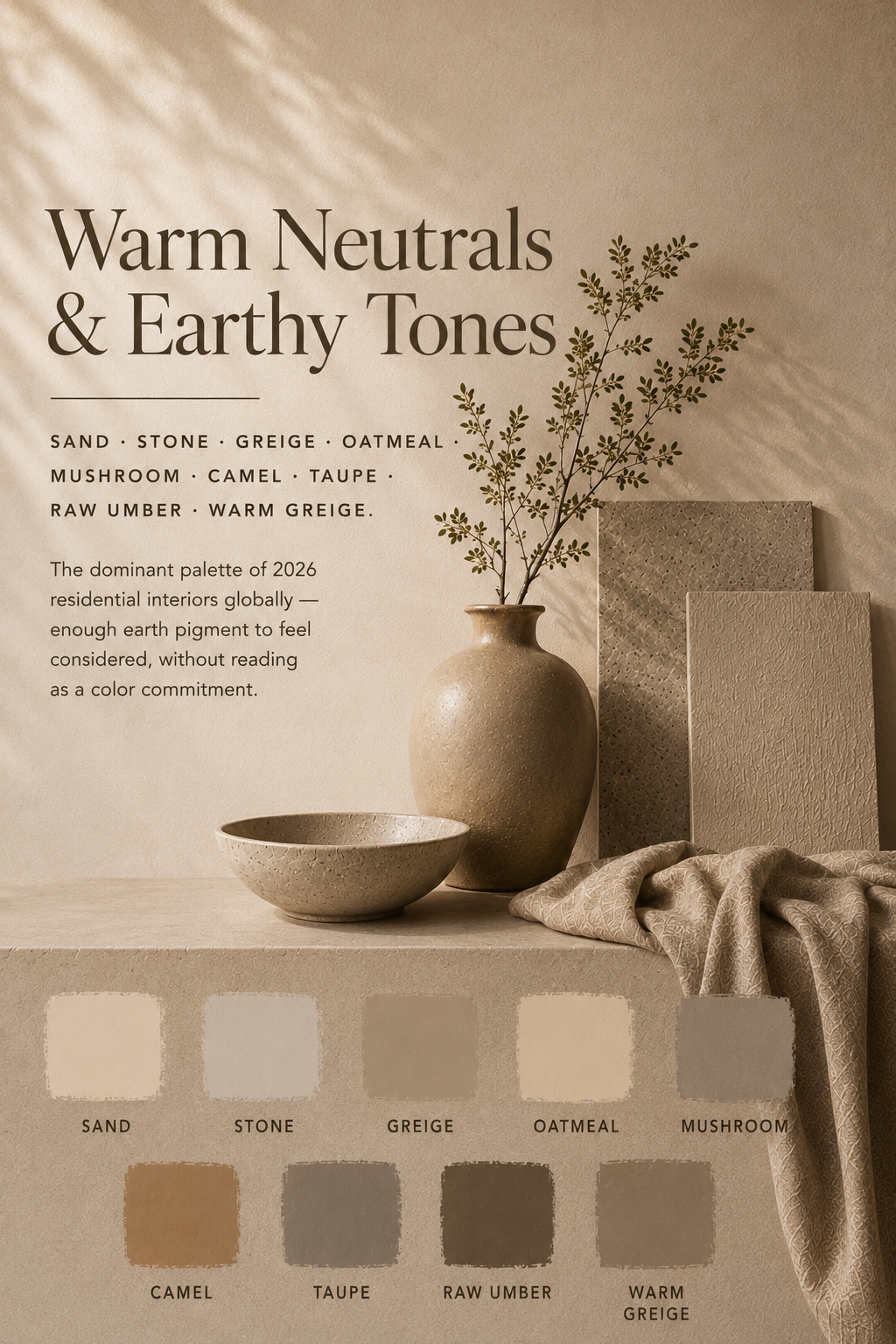
Warm neutrals are the dominant palette of 2026 residential interiors globally. They carry enough earth pigment to feel considered, but not enough to read as a color commitment.
They are the palette that sophisticated clients who “don’t want color” are almost always describing when they say they want to feel warm and settled.
The distinction between soft neutrals and warm neutrals is one of the most practically important decisions in palette-building. Soft neutrals (chalk, oyster) are light-anchored and airy.
Warm neutrals (sand, greige, mushroom, camel) are earth-anchored and grounding. The former opens space; the latter defines it. A north-facing bedroom needs warm neutrals. The light, not the preference, makes the determination.
Color psychology
Warm neutrals activate the restorative environment response — the physiological sense of safety and groundedness evolved from association with earth, shelter, and warmth.
These tones produce active comfort, not simply the absence of stimulation. For clients whose brief is “somewhere I can exhale,” warm neutrals are almost always the right answer.
Key tones and how they behave
- Sand — the most versatile tone in the family. Its warm beige quality reads consistently across different light conditions and connects easily to every natural material.
- Greige — the grey-beige blend that defined a generation of interior design. Requires strong material layering to feel current rather than default in 2026.
- Oatmeal — slightly cooler and more textural than sand, with a grain-like quality. The tone most naturally associated with boucle and linen textiles.
- Mushroom — the most sophisticated tone in the family. Its slight grey-purple cast gives it a quality that reads as pigmented neutral rather than beige. Works exceptionally well when the brief is “neutral but interesting.”
- Camel — the warmest tone in the family. Best used as a secondary tone or accent rather than as the base, where its warmth can accumulate to excess.
- Raw umber — the dark end of the warm neutral register. Best on architectural elements — beams, frames, cabinetry — rather than large wall areas.
Material pairings — how each surface changes the color
- Raw linen and rough-textured weaves — the most natural partners for warm neutrals. Their grey-beige quality shares the same temperature range without competing.
- Warm stone (limestone, sandstone) — reinforces the earth-anchor of the palette. Natural variation in tone prevents the warm neutral scheme from becoming monotonous.
- Beeswax-finished timber — the most sympathetic timber treatment. The wax finish gives wood a honey quality that sits harmoniously within the sand-to-camel register.
- Aged plaster — carries a sense of history and material depth that contemporary paints cannot replicate.
- Bronze and aged brass — the metals that belong to this family. Their warm oxidised tones share the yellow-brown register of camel and warm greige
Styling tip
The warm vs. cool neutral decision should be made before any other palette choice, based on the room’s light.
Hold a mushroom paint chip and a chalk paint chip in the room at different times of day: at noon, at 4pm, and under artificial light in the evening.
In a north-facing room, the chalk chip will go grey and flat by afternoon. The mushroom chip will hold its warmth. The room tells you which family it needs. Trust that reading over any color preference.
Design styles this palette connects to
Warm neutrals are the defining palette of Organic Modern design — oat, sand, and camel are the three tones most consistently found in rooms that define this style internationally.
In Wabi-Sabi interiors, worn ochre, pale ash, and raw umber connect the palette to the material philosophy of accepting imperfection.
In Transitional design, warm greige and taupe are the bridge tones that allow Traditional heritage and Contemporary restraint to coexist.
In Contemporary interiors, mushroom and warm greige are replacing the cool greys of the previous decade as the defining base palette.
→ Organic Modern Style Guide · Wabi-Sabi Style Guide · Transitional Style Guide · Contemporary Style Guide
Build a warm neutral palette in SampleBoard Studio → Explore Studio membership →
Browns & Earthy Neutrals
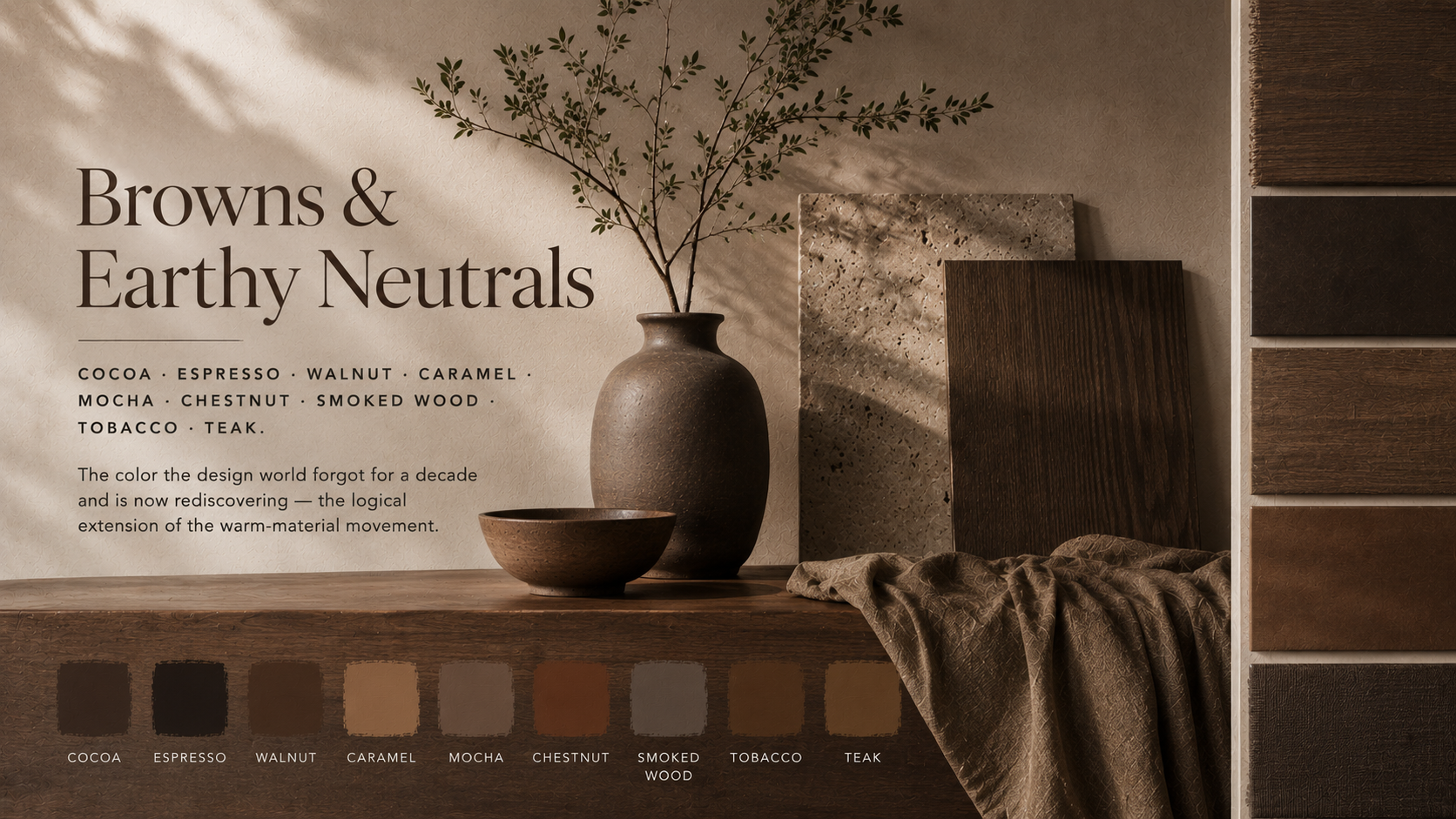
Brown is the color that the design world forgot for a decade and is now rediscovering with genuine enthusiasm.
Its return in 2026 is not retro — it is the logical extension of the warm-material movement building through biophilic design, Japandi aesthetics, and the broader shift away from cool minimalism.
Brown is the color of timber, leather, earth, and bark: the most fundamental palette of the natural world.
Color psychology
Brown creates feelings of safety, stability, and coziness at a fundamental level — it is the color most associated with shelter and physical protection.
In living rooms and studies, deep brown tones produce the sensation of being enclosed and protected, which reads as comfort in residential contexts and authority in professional ones.
The risk is heaviness: the material form of the color (timber grain, leather texture) prevents this by adding visual interest that flat paint cannot.
Key tones and how they behave
- Caramel — the warmest and most approachable. Its yellow-brown quality reads as golden in warm light. Functions as a warm accent that enriches neutral and earth-toned palettes.
- Mocha — mid-depth, warm brown with a slight red cast. Pantone’s Color of the Year 2025 (Mocha Mousse) brought this tone into mainstream residential awareness.
- Walnut — a material color as much as a paint color. Deep, slightly purple-brown. Reads as sophisticated and permanent. The anchor of Japandi and Mid-Century Modern interiors.
- Espresso — the darkest practical tone. Functions architecturally: on cabinetry and architectural frames it introduces weight and definition.
- Tobacco — warm, slightly smoky, with vintage associations. Works particularly well in Vintage and Retro interiors.
- Smoked wood — a grey-brown that reads as both material and color. Its cooler quality prevents the palette from accumulating excessive warmth. The most contemporary tone in the family.
Material pairings — how each surface changes the color
- Aged leather — leather’s own color shifts with age in the same direction as the brown palette. The combination of walnut timber and aged leather is the visual shorthand for Japandi and Mid-Century craft.
- Bronze hardware — shares the brown family’s warm undertone. Deep brown surfaces with bronze pulls reads as materially coherent in a way that chrome cannot achieve with this palette.
- Boucle in caramel or warm cream — introduces softness that prevents the brown palette from becoming too heavy.
- Linen — the light-anchor the brown family depends on. Without it, a deep brown scheme becomes cave-like.
- Travertine — the material that connects brown to the wider earth palette. Its cool-to-warm variation introduces material complexity.
Styling tip
Mix matte and gloss finishes within the brown palette to prevent the scheme from becoming visually flat.
Matte walnut cabinetry paired with a polished bronze handle, or a flat espresso wall against a leather sofa with natural sheen — these finish contrasts create visual movement.
A brown room with all matte finishes is a dark room; a brown room with considered finish variation is a sophisticated one.
Design styles this palette connects to
In Japandi design, smoked walnut, warm charcoal, and oyster form the tonal trio defining the style’s most executed contemporary spaces.
In Mid-Century Modern, caramel and warm walnut are structural — the palette of Eames, Wegner, and the teak-and-leather tradition.
In Industrial spaces, aged leather and tobacco brown connect the palette to the manufacturing heritage the style references.
In Bohemian interiors, amber and warm gold layer within the brown family to create accumulated richness.
In Rustic spaces, espresso and bark brown are elemental — connected directly to timber, stone, and material shelter.
→ Japandi Style Guide · Mid-Century Modern Style Guide · Rustic Style Guide · Industrial Style Guide · Bohemian Style Guide
Build a rich brown palette in SampleBoard Studio → Explore Studio membership →
Purple & Artistic Hues
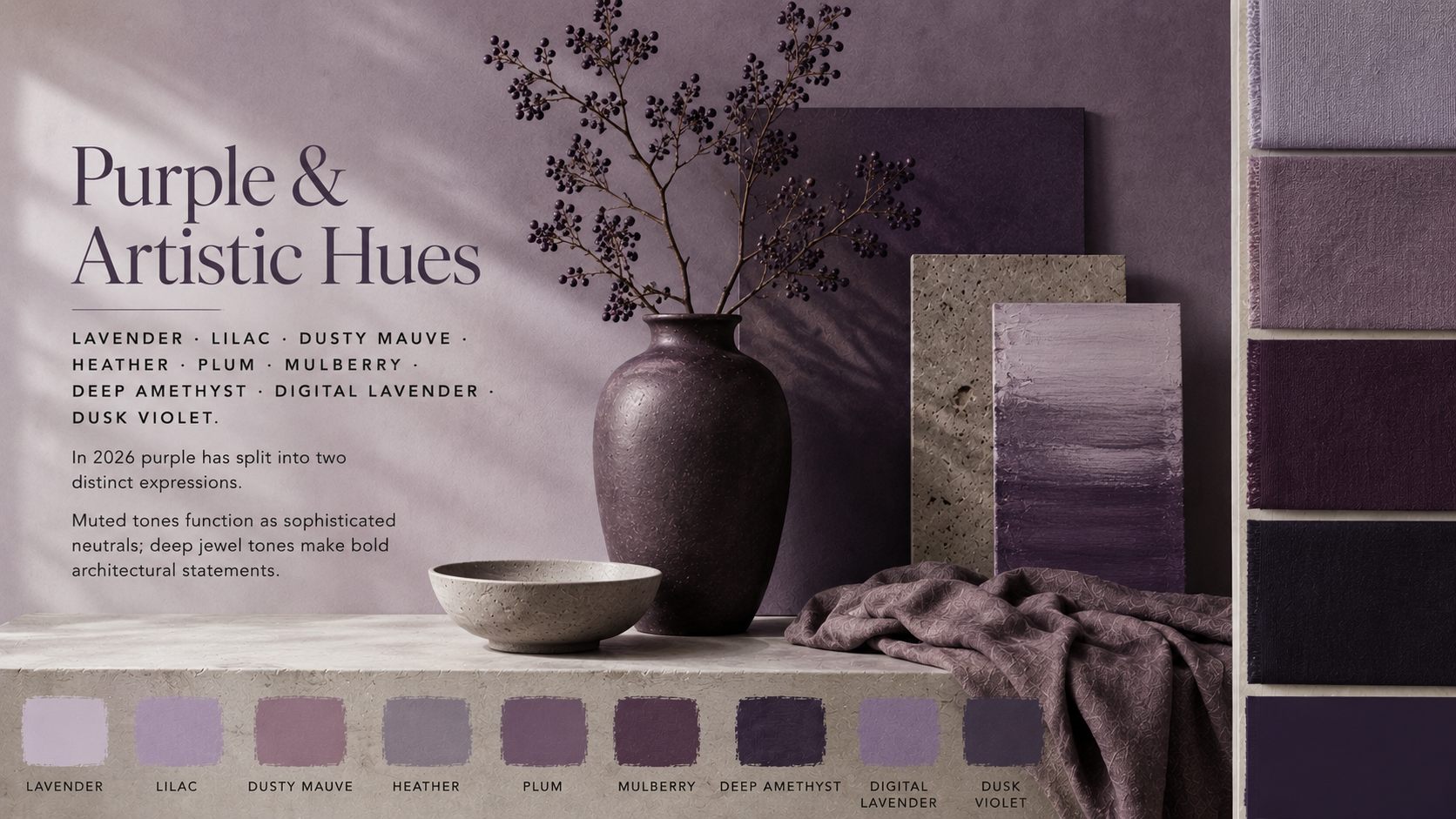
Lavender · Lilac · Dusty Mauve · Heather · Plum · Mulberry · Deep Amethyst · Digital Lavender · Dusk Violet
Purple is the color family most directly in transition right now.
In 2026 it has split into two distinct registers: the muted register (lavender, lilac grey, heather, dusty mauve) which functions as a sophisticated neutral alternative, and the deep jewel register (plum, amethyst, deep violet) which operates as a bold architectural statement.
Understanding which register a client is asking for is the fundamental design decision with this family.
Color psychology
Purple sits at the boundary between warm and cool — it shares red’s warmth and blue’s calm. This gives it a specific psychological effect: creative contemplation.
It is the color most associated with introspection and imaginative thought, making it exceptionally well-suited to bedrooms, reading rooms, and private creative spaces.
In the muted register, the effect is closer to blue: calm and sophisticated. In the deep jewel register, it approaches red: luxurious and immersive.
Key tones and how they behave
- Digital lavender — the 2026 signature tone. Its slightly tech-adjacent quality sits naturally in contemporary and Avant-Garde spaces. Reads as both futuristic and nostalgic simultaneously.
- Lilac grey — the most neutral tone in the family. Purple so muted it reads as a sophisticated grey with warmth. Functions as a neutral base in Scandinavian and Japandi spaces.
- Heather — dusty, outdoor-botanical. Works in Shabby Chic and Vintage registers. Its grey-purple quality prevents it from reading as vivid.
- Dusty mauve — the elegant connector between the pink and purple families. Particularly effective in bathrooms and bedrooms where sophistication without drama is the brief.
- Deep amethyst — the jewel-register anchor for Hollywood Glam and Art Deco interiors. Requires confident material partners — velvet, marble, brass — and significant natural light.
- Dusk violet — the specific purple of transitional light: the sky between sunset and dark. Carries warm and cool simultaneously. The Southwestern-specific purple most palettes miss.
Material pairings — how each surface changes the color
- Velvet — the definitive textile for deep purple. Its pile absorbs light at the surface and reflects it from depth, creating richness that makes jewel-register purples perform at their best.
- Marble (grey-veined) — introduces a cool material complexity that keeps purple from reading as purely warm.
- Brushed brass — works across the full purple register. Prevents lavender from going cool; prevents deep amethyst from becoming garish.
- Smoked glass — introduces light and mystery simultaneously, reinforcing the dramatic quality of the jewel register.
- Raw linen in cream or warm white — the essential relief material. Prevents muted purples from going cold and grey.
Styling tip
Use muted purple tones — heather, lilac grey, dusty mauve — as neutrals rather than accent colors.
The most effective purple interiors are rooms where purple is the base and the eye slowly realises it is not looking at grey.
At low chroma and muted saturation, purple performs beautifully in Scandinavian, Japandi, and contemporary spaces without triggering the “is this too bold?” response that saturated purple always provokes
Design styles this palette connects to
In Hollywood Glam interiors, deep amethyst and sapphire provide the jewel-tone backdrops for velvet upholstery — the most distinctive element of the style.
In Art Deco, amethyst is a period-specific jewel tone with genuine historical resonance.
In Bohemian spaces, plum and dusty mauve layer within the warm-jewel accumulation.
In Southwestern design, dusk violet is the specific landscape color most palettes miss — the tone of the desert at golden hour.
In Avant-Garde interiors, digital lavender is the 2026 signature.
→ Hollywood Glam Style Guide · Art Deco Style Guide · Bohemian Style Guide · Southwestern Style Guide
Build an artistic purple palette in SampleBoard Studio → Explore Studio membership →
Amber, Gold & Warm Accent Tones
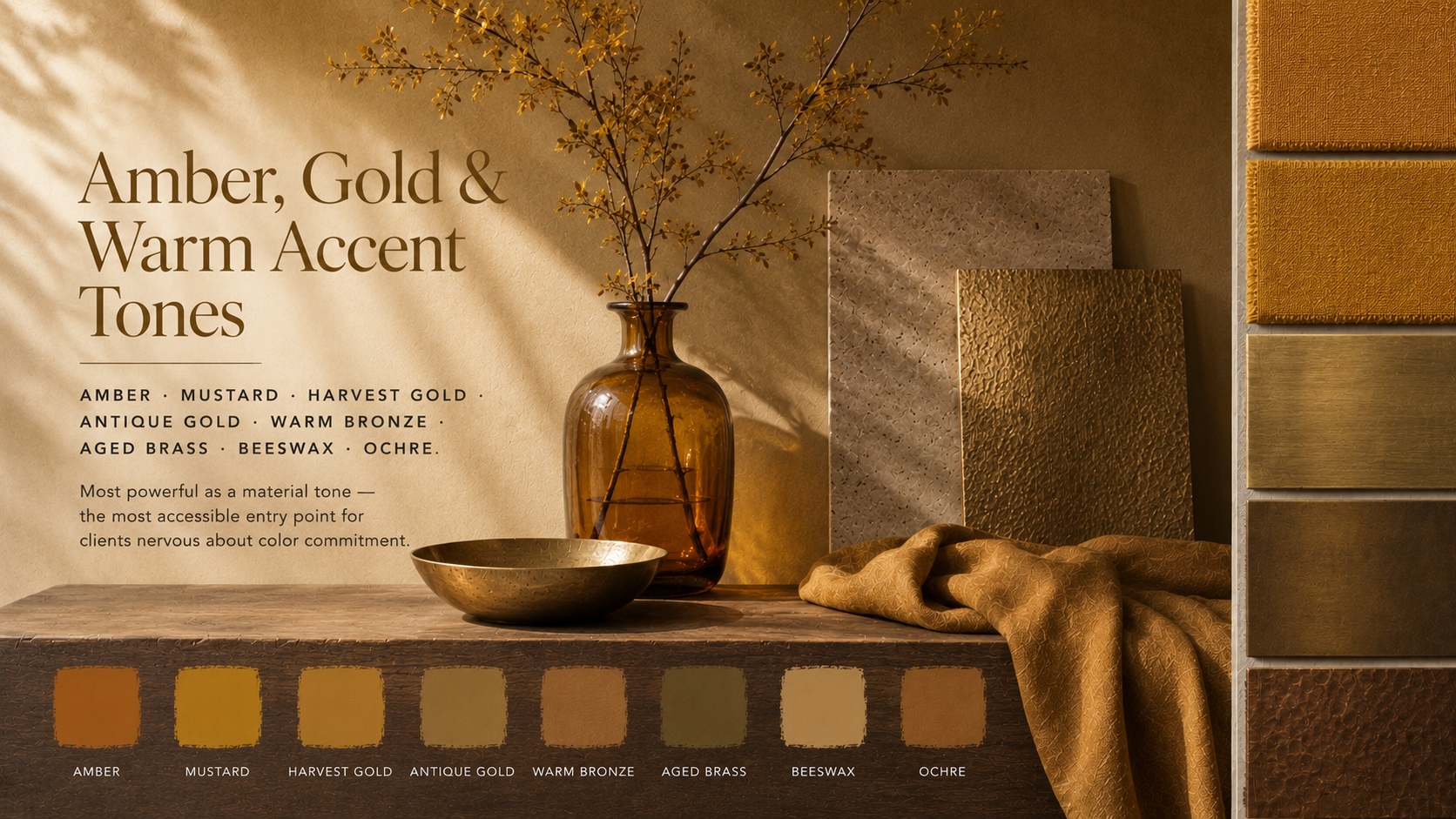
Amber and gold occupy a unique position in interior design color — they exist simultaneously as paint colors, material tones, and light qualities.
The warm brass of a door handle, the honey of an aged oak floor, the amber cast of late afternoon sun through linen curtains: these are all expressions of the same color family.
Understanding this is the key to using the amber-gold family well: it is often most powerful as a material tone rather than a paint color.
Color psychology
Amber and gold are the colors most associated with light itself — with candlelight, firelight, and the warm quality of late afternoon sun.
This gives them a specific psychological warmth that colors in the red or brown family cannot quite replicate: they read as illuminated rather than as pigmented.
A single amber-toned material — a brass lamp, an ochre ceramic, a mustard textile — can change the entire perceived temperature of a space.
Key tones and how they behave
- Ochre — the most earth-connected. Its yellow-brown quality connects it to clay and terracotta, making it the natural bridge between the amber-gold family and the earth-warm palette.
- Mustard — the most characterful tone. Its strong yellow-green-brown quality divides opinions — which is exactly what makes it useful as a signature accent. Best at low coverage rather than at scale.
- Harvest gold — the 1970s register. Saturated and specific. Works in Mid-Century Modern and Retro spaces. Requires careful material grounding.
- Antique gold — the most historically resonant tone. Its slightly green-brown cast connects it to Art Deco, Hollywood Glam, and Victorian contexts.
- Beeswax — the most material-specific tone. Reads as a finish rather than a color — the specific warm yellow of timber treated with natural wax.
- Warm bronze — the metallic extension of this family. In hardware and lighting, warm bronze introduces the amber-gold register without requiring any wall or textile commitment.
Material pairings — how each surface changes the color
- Aged brass — the material expression of this palette in metal form. Its slightly oxidised, matte-warm quality shifts the color temperature of every room it appears in toward amber.
- Lacquered timber — amplifies warm gold tones. A lacquered honey oak floor reads considerably warmer than an oiled equivalent.
- Warm-toned stone (honey onyx, amber travertine) — the most powerful material carrier of the gold family. The translucency of backlit onyx creates an amber glow no paint color can replicate.
- Deep walnut — the dark counterpart that gives amber and gold their depth. The combination of warm gold with dark walnut is one of the most historically enduring interior color relationships.
Styling tip
The most effective way to introduce the amber-gold family is through hardware and lighting rather than wall color.
Replacing chrome door hardware with aged brass, swapping a white pendant for an amber glass shade, or adding a beeswax-finished side table will shift the color temperature of a room more dramatically and more reversibly than any paint color.
This makes the amber-gold family the most accessible entry point for clients who want warmth but are nervous about color commitment.
Design styles this palette connects to
In Mid-Century Modern interiors, mustard and harvest gold are period-specific — they belong to the authentic MCM register alongside walnut and teak.
In Retro design, the amber-gold family is structural: harvest gold, avocado, and burnt orange define the 1970s aesthetic.
In Bohemian spaces, amber reads as candlelight — the atmospheric tone that distinguishes a Boho interior from a merely eclectic one.
In Moroccan design, warm gold and ochre carry genuine cultural and historical depth.
In Art Deco spaces, antique gold is structural — it appears in gilded frames and metallic details that define the style’s visual language.
→ Mid-Century Modern Style Guide · Bohemian Style Guide · Art Deco Style Guide · Moroccan Style Guide · Retro Style Guide
Build a warm gold palette in SampleBoard Studio → Explore Studio membership →
Black & Deep Dramatic Tones
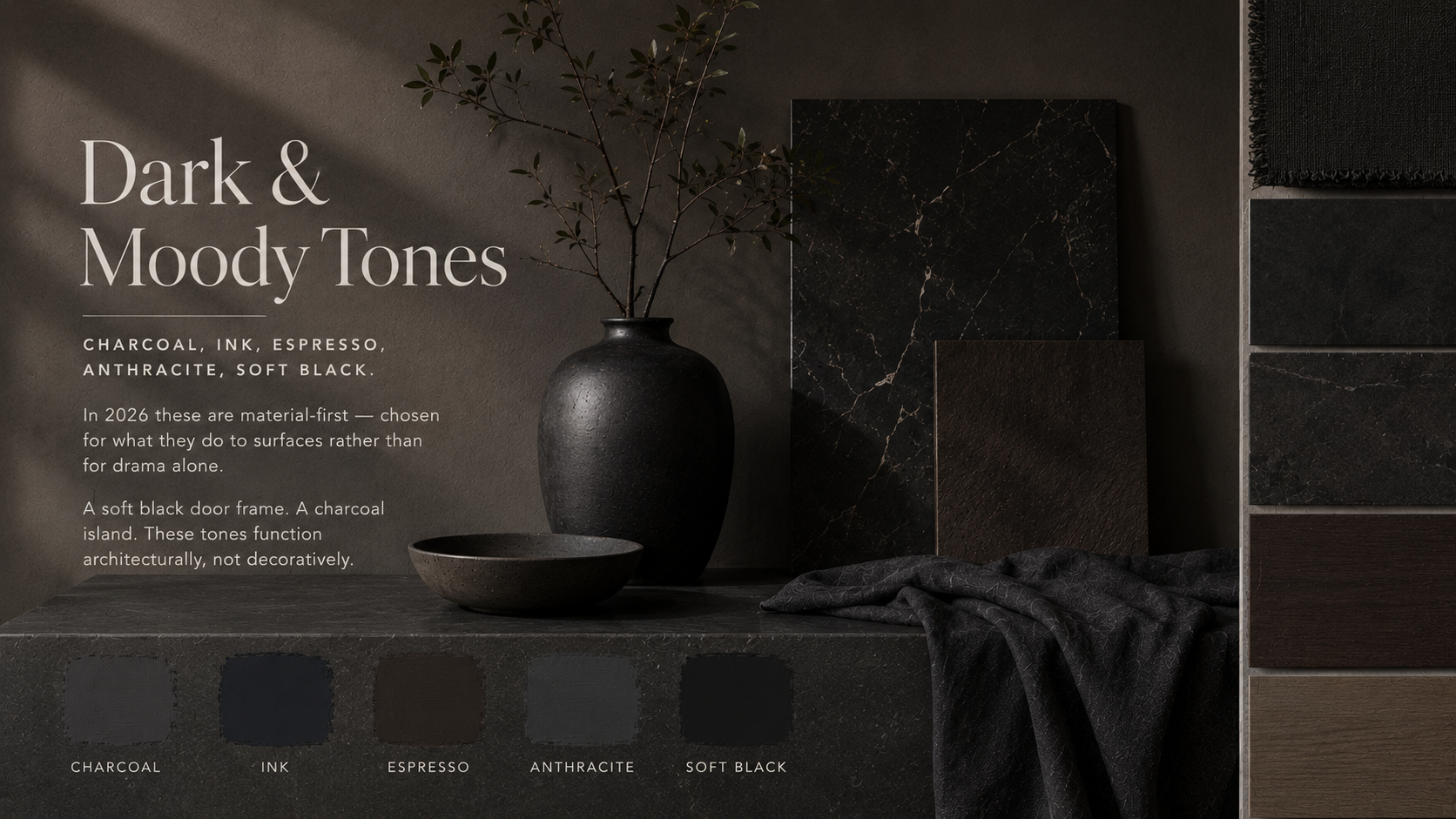
Charcoal · Ink · Obsidian · Anthracite · Soot · Soft Black · Raw Concrete · Smoke
Black in 2026 is not dramatic for its own sake. It is architectural.
The most considered use of dark tones in contemporary residential design is not the statement wall — it is the deliberate use of depth to add weight, definition, and permanence to a space.
A soft black door frame. A charcoal kitchen island. An anthracite concrete floor. These are decisions that give a room structural confidence that lighter tones cannot achieve.
Color psychology
Black conveys confidence, permanence, and visual grounding — it makes everything around it appear more deliberate and considered.
A room with dark architectural elements reads as more resolved than an identical room without them, because the contrast creates hierarchy: the eye knows where to look.
For clients whose brief is “I want it to feel grown-up” or “I want it to feel finished,” a considered use of dark tones is almost always part of the answer.
Key tones and how they behave
- Soft black — the most livable dark tone. Not pure black but a very deep charcoal-grey that retains just enough light reflection to feel warm and habitable. The contemporary default for kitchen cabinetry and architectural joinery.
- Charcoal — the anchor tone of the dark family. Reads as dark without reading as black, and works in almost every design context that calls for depth. The working dark of Minimalist, Contemporary, and Japandi design.
- Smoke — the mid-grey between concrete and charcoal. Introduces weight without the commitment of full charcoal. The most forgiving tone for rooms with limited natural light.
- Soot — a warm black with a very slight brown cast. Its warmth makes it sympathetic to the warm material palette — oak, leather, linen — that dominates 2026.
- Anthracite — the most architectural tone. Associated with stone, concrete, and metal. Belongs in Modern, Industrial, and Contemporary spaces where structure is the design statement.
- Raw concrete — a material color as much as a paint color. Its cool, slightly blue-grey quality introduces concrete’s texture into a scheme. The signature tone of Avant-Garde and Industrial design.
Material pairings — how each surface changes the color
- Microcement — amplifies the architectural quality of dark tones. Its seamless surface makes it the natural partner for anthracite and raw concrete.
- Oak timber — the most important warm counterpart for dark palettes. The contrast between pale oak and charcoal is the foundational visual relationship of Japandi and Contemporary Scandi design.
- Linen — introduces the light, airy quality that keeps dark rooms breathable. Charcoal walls with linen curtains is one of the most reliably successful combinations in residential design.
- Smoked glass — shares the dark palette’s depth and adds translucency. The most architecturally sophisticated partner for the deep-tone family.
- Travertine — the cool mineral material that introduces relief into dark schemes while remaining within the sophisticated register.
Styling tip
Always use dark tones in matte or soft-touch finishes for a contemporary residential context. Gloss black belongs to Art Deco and theatrical spaces; matte black reads as sophisticated and intentional.
The finish distinction is as important as the color choice itself. When presenting a dark palette to a hesitant client, start with architectural elements — door frames, cabinetry, window reveals — rather than full walls.
The same amount of dark tone applied to edges produces more visual impact and more structural authority than it does applied as a wall color, and the reversibility reduces client anxiety.
Design styles this palette connects to
- In Minimalist design, charcoal is the single permissible dark anchor — used precisely to provide the contrast that prevents the palette from reading as merely empty. In
- Modern architecture, black functions as a defining line.
- In Industrial spaces, anthracite and raw concrete are materials as much as colors.
- In Contemporary interiors, soft black has replaced cool grey as the defining architectural accent.
- In Avant-Garde design, the black-white register punctuated by electric blue or digital lavender is the 2025–26 signature palette.
- In Art Deco spaces, pure black is structural — the high-contrast foil against which gold and jewel tones perform.
→ Minimalist Style Guide · Modern Style Guide · Industrial Style Guide · Avant-Garde Style Guide
Build a dramatic dark palette in SampleBoard Studio → Explore Studio membership →
How color palettes differ
These four comparisons are the decisions that most often stall emerging designers — and the most common sources of palette mistakes that only become visible on site.
Warm neutrals vs. cool neutrals
The question is not which is more beautiful — it is which the room needs. In a north or east-facing room, a cool neutral (chalk, stone grey, oyster with blue cast) will read grey and flat by early afternoon. A warm neutral (oat, sand, mushroom) counteracts the light deficit and holds its warmth across the day.
In a south or west-facing room with generous warm afternoon light, the same warm neutral risks tipping into excess — the room goes golden and heavy. A cool neutral brings relief.
The practical test: hold a warm and a cool neutral paint chip in the room at noon and again at 4pm. One will hold; the other will shift in the direction you do not want. The room always tells you the answer. The error is making the decision from a paint chip in a bright shop.
Earth tones vs. pastels
Both are non-primary color registers — neither makes a bold statement in the conventional sense. But they produce entirely different emotional environments.
Earth tones (terracotta, clay, ochre, warm brown) are grounded and material-anchored. They produce the sensation of weight and permanence. Best for clients whose brief is warmth, character, and a sense of belonging to the space.
Pastels (blush, sage, powder blue) are light-anchored and atmospheric. Best for spaces designed for rest, reflection, and emotional ease. Their risk is dissolution: without material anchoring, a pastel room can feel as though it has no edges.
If the brief is comfort and character: earth tones. If the brief is calm and ease: pastels. If it’s both: combine them — terracotta accent within a blush base, or dusty rose within a warm neutral scheme.
Green vs. blue
Both are the color families most associated with calm and rest. But they produce different physiological effects and suit different design registers.
Green produces rest through biological association — the color of plant life and the living world. Its effect is restorative and organic. Green is the better choice where the design goal is nature-connection, wellness, and organic warmth.
Blue produces rest through psychological association — the color of sky, water, and expansive space. Its effect is clarifying and structural. Blue is the better choice where the goal is focus, clarity, and architectural precision.
Does this room need to feel organic or architectural? Green leans organic. Blue leans architectural.
Saturated vs. muted
Saturation is chroma: the intensity of a color relative to its neutral equivalent. High saturation means vivid and specific. Low saturation means muted and atmospheric.
Saturated colors (cobalt, emerald, paprika, antique gold) produce visual energy and identity. Right when the brief is “I want this room to be something.”
Muted tones (dusty blue, sage, clay, mushroom) produce atmosphere and restraint. Right when the brief is “I want this room to feel like somewhere.”
For client presentations, showing a saturated and a muted version of the same color family is often the most efficient way to understand what a client is actually asking for. The one they respond to reveals the emotional register they want — more useful information than any written brief.
How to apply color in real spaces
A palette on paper is an abstraction. A palette on a room is a decision your client will live with every day. The translation between the two is where color education stops and color practice begins.
Start with the base: walls and floors
Walls and floors occupy 60–70% of what the eye registers in a space. The base color determines the room’s fundamental character before any furniture is placed. A decision made at this layer is the most expensive to change and the most impactful to get right.
Hold base color samples in the actual room. Observe them at the time of day the room is most used. Check whether the color reads as intended in artificial evening light as well as natural daytime light. The same warm neutral that glows at noon can go orange under warm incandescent bulbs at 9pm.
Floor material is part of the base layer even when it precedes the project. If the room has existing warm oak floors, the base palette is already warm — and the wall color decision should respond to that warmth rather than fight it.
Build the middle layer: furniture and textiles
Furniture and soft furnishings carry approximately 30% of the visual field. The critical decisions are about value range and temperature consistency.
Value range: the middle layer should introduce at least two different values from the base — either lighter or darker, or both. A middle layer that matches the base in value reads as flat. The eye needs contrast to understand depth.
Temperature consistency: if the base is warm, the secondary tones should reinforce or gently offset that warmth — not contradict it. A warm terracotta wall with a cold blue-grey sofa will produce visual conflict that no amount of styling will resolve.
Introduce accents: objects and art
Accents occupy approximately 10% of the visual field and carry a disproportionate amount of the room’s personality. A room with five accent colors has no accent color — it has five competing focal points. A room with one or two deliberate accent tones has a point of view.
The accent should do one of three things: deepen the palette (a darker version of the base tone in a ceramic or textile), surprise it (a tone from outside the palette’s temperature family), or personalise it (a color with specific meaning to the client). The third option is the most powerful for client loyalty.
Complete the palette: material depth
Return to the fourth step of the Color Framework. Every material decision is a color decision. Before any client presentation, hold your chosen materials together in natural light and examine what happens to the colors you’ve selected.
Does the boucle upholstery warm the wall color toward yellow, or does it hold its neutral? Does the limewash wall shift toward grey or toward warm in the room’s north light? Does the oak floor add warmth that makes the wall color too hot in the afternoon?
The palette is not finished when the colors are chosen. It is finished when the materials have been tested together in the space where they will live.
Every palette has a system behind it.
The palettes in this guide don’t stop at color direction.
Inside SampleBoard Studio, each palette is fully translated into a structured design workflow — including palette structure built on the four-layer Color Framework, a complete mood board system, and a presentation-ready framework you can take directly to a client meeting.
Studio is built for designers who need to move from concept to client-ready presentation efficiently — without starting from scratch every time.
The seven available style guides (Minimalist, Japandi, Organic Modern, Bohemian, Hollywood Glam, Shabby Chic, and Southwestern) each include a style-specific palette with materials, mood boards, and presentation templates.
This palette is fully translated inside SampleBoard Studio — including palette structure, mood board system, and presentation framework.
FAQ
What colors are trending in interior design right now?
The dominant 2026 palette directions are warm earth tones (clay, terracotta, rust), emotional neutrals (mushroom, oat, warm greige), nature-led greens (sage, eucalyptus, olive), deep blues (denim blue, indigo, slate), muted pastels (dusty blush, pale sage), and architectural darks (charcoal, soft black). The overarching direction is toward warmth, material richness, and palettes that feel grounded rather than trend-reactive — reflecting a collective appetite for spaces that feel handmade, settled, and emotionally restorative.
How do I use the SampleBoard Color Framework?
The Color Framework is a four-step palette-building process: Base color (the foundation — your dominant wall or floor tone), Secondary tone (the support — furniture and large textiles), Accent color (the focus — ceramics, art, cushions at 10% coverage), and Material layer (the modifier — the surfaces that change how every other color behaves). Work through these four steps in order. The material layer is the step most often skipped and the one that most often explains why a palette that looked right on paper looks wrong on site.
How do designers predict color trends each year?
Color trend forecasting combines analysis of cultural mood, lifestyle shifts, material innovation, fashion movements, and the outputs of global forecasting agencies. The best color trend work goes deeper than prediction: it explains why a palette direction is rising, what psychological or cultural need it addresses, and how long its relevance is likely to last. This is the context that allows a designer to use a trending color as a considered choice rather than a reactive one.
Which colors work best for small spaces?
The conventional advice — light colors open small spaces — is only partially correct. Light soft neutrals (chalk, oyster, pale sand) do create visual airiness. But dark tones used at high coverage in small rooms can produce the sensation of a more intentional space — a small room in deep charcoal feels like a jewel box when the material quality is right. The real rules: avoid mid-value, medium-saturation tones; choose either light and airy or deep and deliberate; use tonal layering rather than color contrast; keep the floor lighter than the walls to make the room feel taller.
What colors make a home look more modern?
Modernity in 2026 reads through palette restraint, not novelty. Warm mushroom neutrals, soft black architectural accents, denim blue, muted olive, and warm bronze finishes are the current register of contemporary residential design. Mid-grey now reads as a decade past its moment. Clean architectural lines paired with natural materials in a warm-neutral or dark-accent palette is the combination that reads as most current.
Are warm or cool colors more popular in 2026?
Warm colors are leading 2026 — warm earth tones, warm neutrals, amber-gold accents, and the warm end of the green and blue families are all in strong demand. The cool register is not disappearing but is yielding to warmer versions of itself: chalk over pure white, slate over steel blue, eucalyptus over bright sage. The direction of travel is toward warmth, material depth, and the kind of palette that feels grounded in the physical world rather than composed on a screen.
How do I combine color trends without overwhelming a room?
Use the 60-30-10 ratio and commit to a single temperature family. 60% base color, 30% secondary tone, 10% accent. The key is staying within the same temperature family: warm tones together, cool tones together, with only the accent introducing deliberate contrast. The palette that combines three warm tones with one cool accent reads as considered; the palette that mixes warm and cool tones at equal weights reads as unresolved.
What colors pair well with natural wood?
Natural timber introduces a permanent warm undertone to every room it appears in. The colors that work best: sage and eucalyptus green, soft warm neutrals (oat, sand, mushroom), warm charcoal, and clay or terracotta. Cool greys, pure whites, and blue-cast neutrals produce visual tension with most timber species — the cool and warm registers fight for dominance. The exception is very dark timber (smoked oak, wenge) where cool-dark tones can work because the timber reads as architectural rather than warm.
How do I talk to clients about color confidently?
Confidence comes from having a reason for every choice. The most effective framework: explain the mood first (what you want the room to feel like), then the base tone and why it suits the room’s light, then the material layer and how each surface will modify the colors. Show material samples alongside paint colors — never paint chips alone. When a client is nervous about a color, show it at minimum viable coverage first and let the material do the persuading. The color you can explain is always more persuasive than the color that simply looks good on a sample board.
Where can I find designer-approved color palettes?
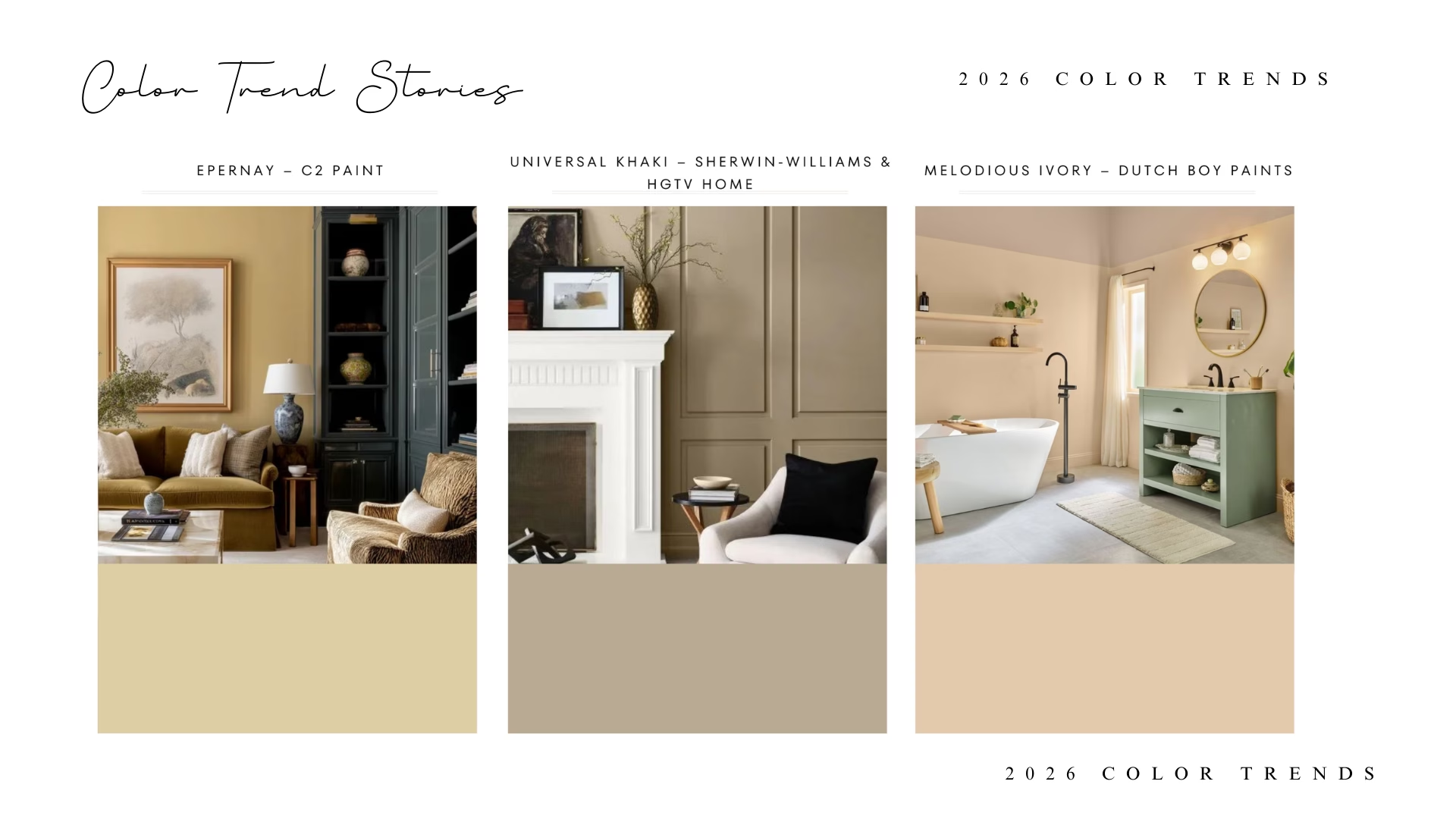
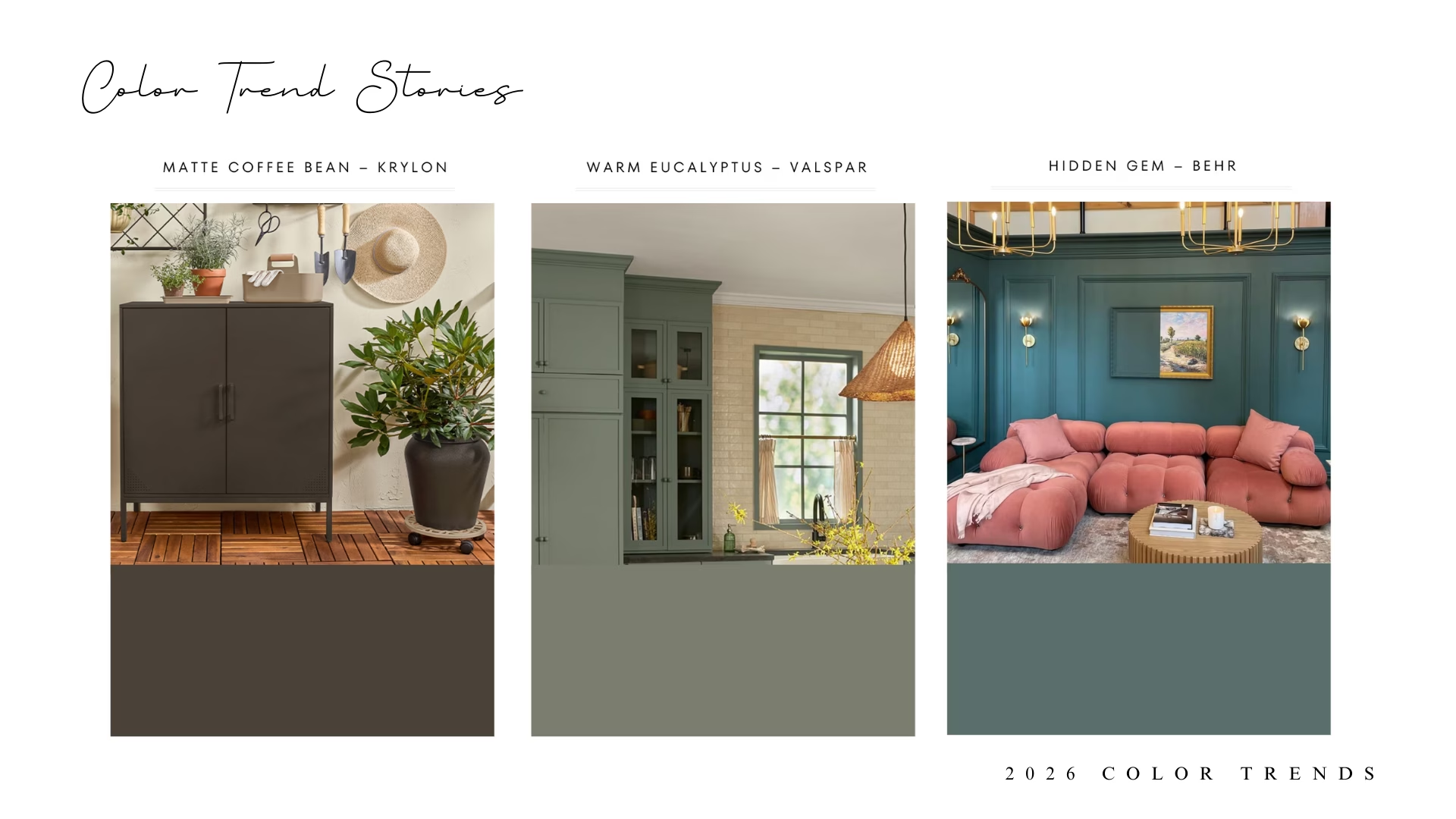
SampleBoard’s color content is curated for interior designers and design students — every palette is mapped to design styles, material contexts, and real space applications. For palettes by family: explore the ten families in this guide. For color stories that decode the cultural context: visit Color Trend Stories. For complete palette systems built for client presentation: SampleBoard Studio includes structured palette frameworks for seven design styles.
Color is not the final layer of a space.
It is the foundation.
The palettes in this guide are not trends to follow. They are tools to think with — frameworks for understanding how color behaves in real spaces, with real materials, in the context of what clients are asking for right now.
Take the framework. Apply it to your next project. The confidence comes from having a reason for every choice you make.
Glossary: Key color terms in interior design
Color theory has a vocabulary. Understanding it precisely makes conversations with clients, contractors, and manufacturers more efficient — and makes your design reasoning more defensible.
Accent color
A contrasting or bold color used sparingly — at approximately 10% of visual field — to add identity, energy, or focal points. The most changeable element of a palette; should be specified as such in client presentations.
Analogous palette
A color scheme using neighboring hues on the color wheel — blue, blue-green, and green — to create harmony and cohesion. The dominant palette logic in most contemporary residential interiors, even when designers don’t name it as such.
Base color
The dominant color in a room’s palette, applied to walls, large furniture, or flooring. Sets the room’s emotional register and should be the first decision in any palette-building process.
Biophilic color palette
Nature-derived hues — greens, browns, moss, stone, sky — chosen to reinforce human connection to the natural world. Grounded in environmental psychology research demonstrating measurable wellbeing benefits.
Chroma
The saturation or intensity of a color — how vivid or muted it is relative to a neutral grey of the same value. Chroma is usually the most important variable in determining whether a color will work in a residential interior.
Color direction
A thematic palette movement driven by cultural, psychological, and material forces — broader than a single color family, narrower than a trend. Each of the six directions in this guide represents a coherent emotional and material register.
Cool tones
Colors with blue, green, or violet undertones that create visual space, clarity, and calm. They amplify natural light in warm rooms and can read as cold in rooms without sufficient natural warmth. Performance is always light-dependent.
Digital softs
Futuristic pastel tones influenced by technology aesthetics — lavender haze, soft lilac, powdery blue, digital lavender. The 2025–26 color language of Avant-Garde and contemporary design. Their quality of being simultaneously nostalgic and futuristic is their current cultural appeal.
Emotional neutrals
Warm, grounding neutrals (mushroom, greige, oat, soft clay, warm sand) chosen for the psychological comfort they produce rather than as a backdrop. The defining palette of the quiet luxury movement.
Greige
A blend of grey and beige. The warm neutral that dominated residential interiors from approximately 2010–2020. Still valid in 2026 but requires stronger material layering to feel considered rather than default.
Hue
The pure form of a color — red, yellow, green, blue — without modification by white, black, or grey. The starting point for all color description, though rarely the most practically important variable in interior design decisions.
Material layer
The fourth step of the SampleBoard Color Framework — the surfaces that carry and modify every color in a palette. Materials are not passive: boucle softens and warms, limewash shifts with light direction, polished stone intensifies, raw timber adds permanent warmth.
Monochromatic scheme
A palette using variations of a single hue — different tints, tones, and shades of the same color — for a cohesive and layered result. Requires strong textural variation to avoid reading as flat. The most sophisticated expression of any color family.
Muted tones
Soft, desaturated colors — low chroma versions of any hue — that create calm, timeless environments. The dominant register of 2026 residential design. Require more material complexity to perform well than saturated tones.
Nature-tech palette
A blend of earthy, biophilic colors with futuristic, digitally-influenced pastels and cool tones. The emerging register bridging biophilic and Avant-Garde directions — warm moss alongside digital lavender, raw concrete alongside eucalyptus.
Pigmented neutrals
Neutral hues subtly infused with color — lavender-grey, mushroom-taupe, blush-beige, sage-white. The palette that allows a room to feel colored without committing to a color. Most of the soft and warm neutral families in this guide are pigmented neutrals.
Saturated color
Pure, vivid color with maximum intensity — cobalt, emerald, paprika, antique gold. High chroma, high identity, high visual demand. Best used at low coverage or in rooms specifically designed to support visual energy.
Shade
A color darkened with black. Forest green is a shade of green; burgundy is a shade of red; navy is a shade of blue. Adding black reduces chroma slightly as well as value, which is why shades often read as richer and more complex than their parent hue.
Tint
A color lightened with white. Blush is a tint of red; powder blue is a tint of blue; pale sage is a tint of green. The pastel register is almost entirely composed of tints. The muted quality of pastels comes from their tint, not from the hue itself.
Tone
A color softened with grey — produced by adding both black and white. Almost all of the colors most used in contemporary residential interiors are tones rather than pure hues, tints, or shades. The muted quality that makes colors liveable comes from the grey in the tone.
Value
The lightness or darkness of a color on a scale from white to black, regardless of hue. Value contrast creates hierarchy and depth; value similarity creates unity and calm. A palette that works in value will work even when the hues themselves are not perfectly matched.
Warm tones
Colors with red, yellow, or brown undertones that bring warmth, intimacy, and physical comfort to a space. They counteract cool light deficits in north-facing rooms and reinforce the material warmth of timber, leather, and natural textiles. The dominant direction in 2026 residential interiors.
Every palette has a style system behind it.
Studio builds each color direction into a complete design workflow — style guide, Canva mood board, and presentation framework — so you can move from palette to client presentation without starting from scratch.
Explore Studio membership →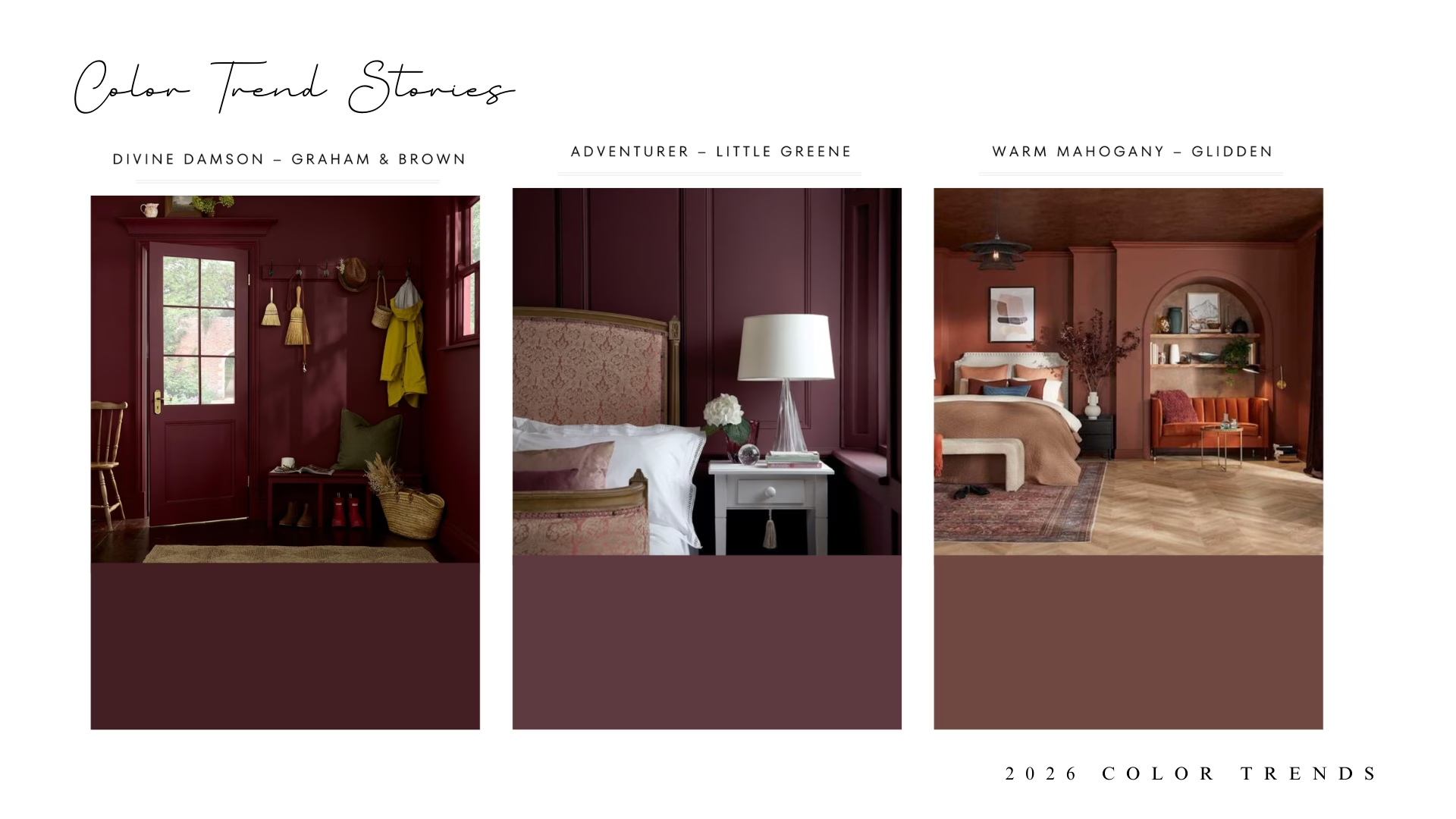
How this fits into the SampleBoard system
Stage 3 of 4 — the application layer, where design becomes real. From here: connect each palette back to its style system → see the trends driving each palette → then build your complete mood board and presentation in SampleBoard Studio →