
Cluster 1 — Calm & Considered
These styles share a commitment to restraint — in colour, in object quantity, and in visual complexity. They are not empty. They are edited.
The design intelligence in a Minimalist or Japandi space is expressed through what has been removed, not what has been added. Spaces in this cluster rely on material quality, proportion, and natural light to do the work that pattern and colour do in other styles.
1. Scandinavian Interior Design
Scandinavian design emerged from a specific cultural and geographic context — long winters, limited daylight, and a design tradition that placed equal value on beauty and function. What resulted is a style that treats comfort as a design principle rather than an afterthought.
The palette is built around light: whitewashed floors, pale walls in warm white or grey, and natural timber in birch, pine, or ash. Colour is introduced carefully — a dusty blue, a sage green, a terracotta accent — never as the dominant force.
Textiles carry warmth: wool, linen, sheepskin, and brushed cotton layer across furniture with slim profiles and tapered legs. Houseplants and hand-thrown ceramics ground the space in the organic without disrupting the calm.
Where Scandinavian differs from Minimalism is in its invitation to linger. This is a sociable, human-scaled aesthetic — designed for hygge, for gathering around a table, for a home that functions as a refuge.
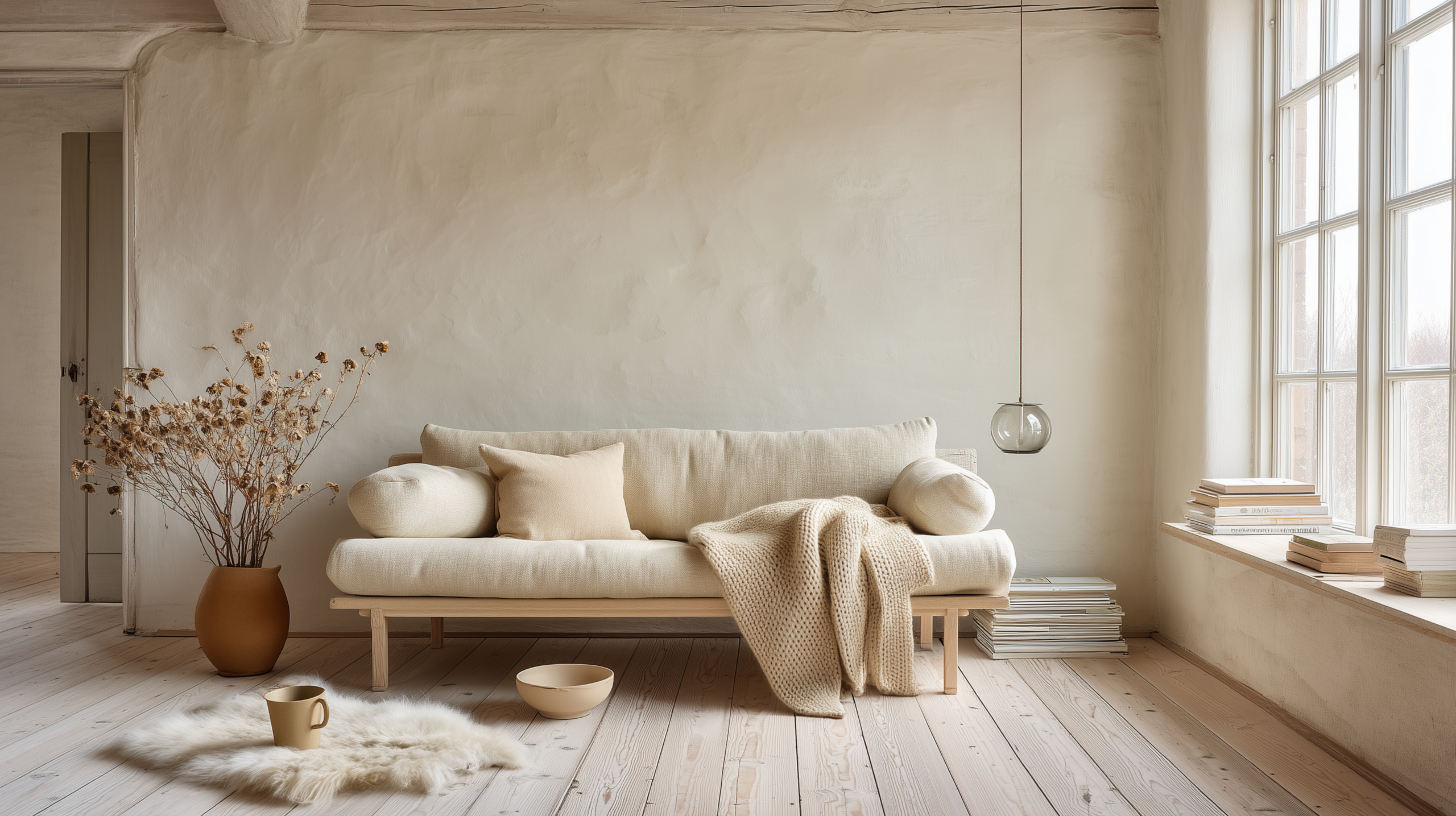
Key materials: Birch and pine, linen, wool, whitewashed oak, hand-thrown stoneware, brushed cotton.
Palette logic: Warm whites and pale greys as base. One or two muted accent tones — never vivid.
Designer’s Note: The most common error in Scandinavian interiors is stripping them too bare. The warmth comes from layering textures within a tight palette — a wool throw over a linen sofa, a ceramic bowl on a pale timber shelf. Without the layering, the space reads as unfinished rather than considered.
Scandinavian Style Guide → | Explore all Scandinavian content →
2. Minimalist Interior Design
Minimalism is frequently misunderstood as an absence of design. It is more accurately described as design with maximum intention — where every object, surface, and spatial decision is deliberate and nothing exists without a clear reason.
The style is rooted in the modernist principle that form follows function, filtered through influences including Japanese spatial philosophy and the De Stijl movement.
In practice, it means concealed storage, furniture chosen for precise geometric proportion, and a palette of neutrals — white, stone, sand, warm grey — that allows architecture and light to become the primary experience.
Texture is the key variable in a Minimalist interior. Without it, the space becomes clinical rather than calm. Smooth plaster against rough linen, polished concrete alongside raw timber — these contrasts create visual interest without introducing pattern or colour complexity.
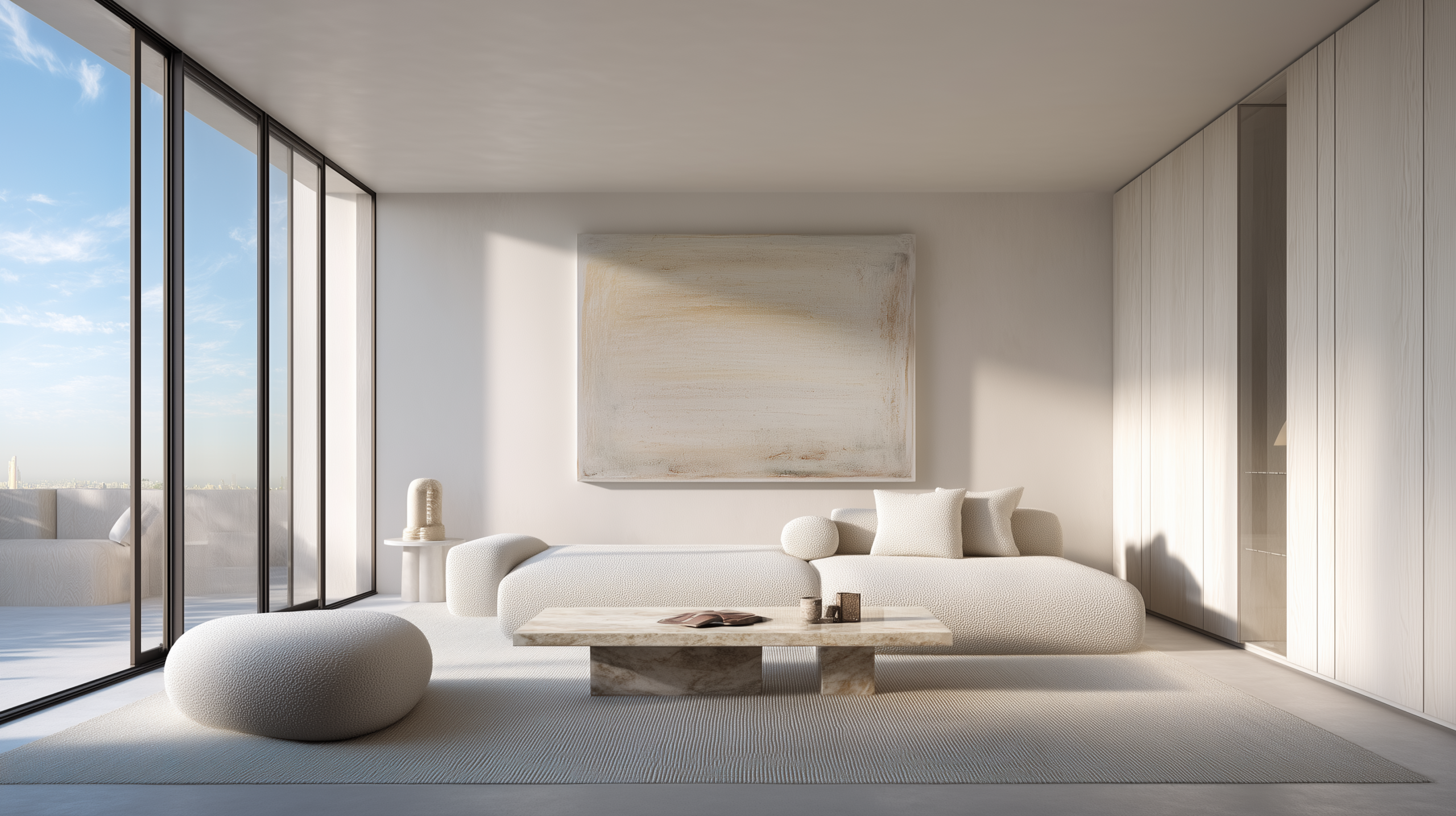
Key materials: Polished concrete, smooth plaster, raw linen, solid timber, tempered glass, architectural hardware in matte finishes.
Palette logic: Monochromatic or near-monochromatic. Warm whites and stone tones are more liveable than pure white.
Designer’s Note: Minimalism requires better quality sourcing than almost any other style. When there is nothing to distract the eye, every material decision is visible. A poorly finished edge or a lightweight fabric reads immediately.
Available in SampleBoard Studio — including the LILLI style guide, mood board framework, and design presentation deck. Explore in Studio →
Minimalist Style Guide → | Explore all Minimalist content →
3. Japandi Interior Design
Japandi is not simply a portmanteau of Japanese and Scandinavian design — it is the point at which both traditions’ deepest values converge.
Both cultures share a reverence for natural materials, an aversion to excess, and a belief that beauty is found in what is necessary. The fusion feels coherent because it is principled, not arbitrary.
In material terms, Japandi spaces work with low-profile furniture in solid timber — oak, walnut, or ash — paired with handmade ceramics, wabi-textured textiles, and a palette of warm neutrals: charcoal, warm beige, muted clay, and off-white.
The Japanese influence introduces asymmetry and a comfort with negative space; the Scandinavian influence brings warmth and domesticity. Together, the result is a space that is quiet without being cold.
Japandi also carries a strong sustainability ethic — pieces are chosen to last, materials are sourced with care, and there is no space for disposable trend objects.
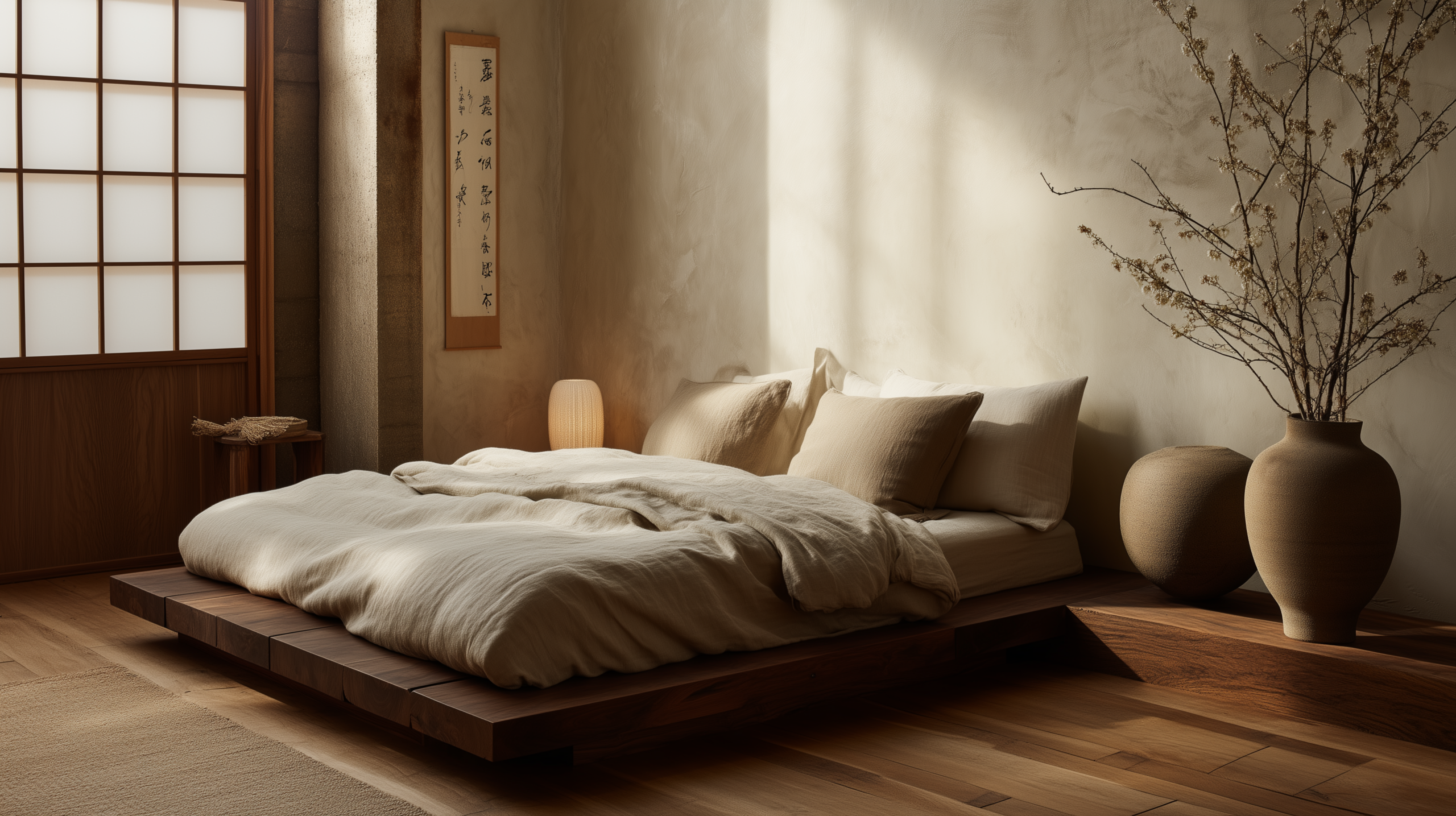
Key materials: Solid oak and walnut, shoji-inspired paper or linen panels, hand-thrown ceramics, rattan, natural beeswax finishes.
Palette logic: Warm charcoals, aged whites, soft clay, and muted sage. The palette should read as aged, not bleached.
Designer’s Note: The most important distinction between Japandi and generic Scandi-Minimal is the presence of imperfection. A hand-thrown bowl with an uneven rim, a timber knot left visible, a linen cushion slightly slubbed — these details give the space its soul.
Available in SampleBoard Studio — including the JUNIPER style guide, mood board framework, and design presentation deck. Explore in Studio →
Janpandi Style Guide → | Japandi Design Trend → | Explore all Japandi content →
4. Wabi-Sabi Interior Design
Wabi-Sabi is a Japanese aesthetic philosophy before it is an interior design style — and understanding that order matters.
The philosophy centres on three principles: nothing is permanent, nothing is finished, and nothing is perfect. Applied to interiors, this produces spaces that are deeply textural, intentionally imperfect, and quietly resistant to trend.
Materials are the language of Wabi-Sabi: weathered timber, unglazed ceramics, rough linen, aged brass, textured plaster walls that show the mark of the maker’s hand.
The palette is drawn from nature at its most subdued — slate grey, worn ochre, pale ash, earthy terracotta. Nothing is polished to perfection. The beauty is in the surface that shows its history.
Where Minimalism removes, Wabi-Sabi accepts. It is a more forgiving and arguably more human aesthetic — one that honours the worn, the repaired, and the impermanent.
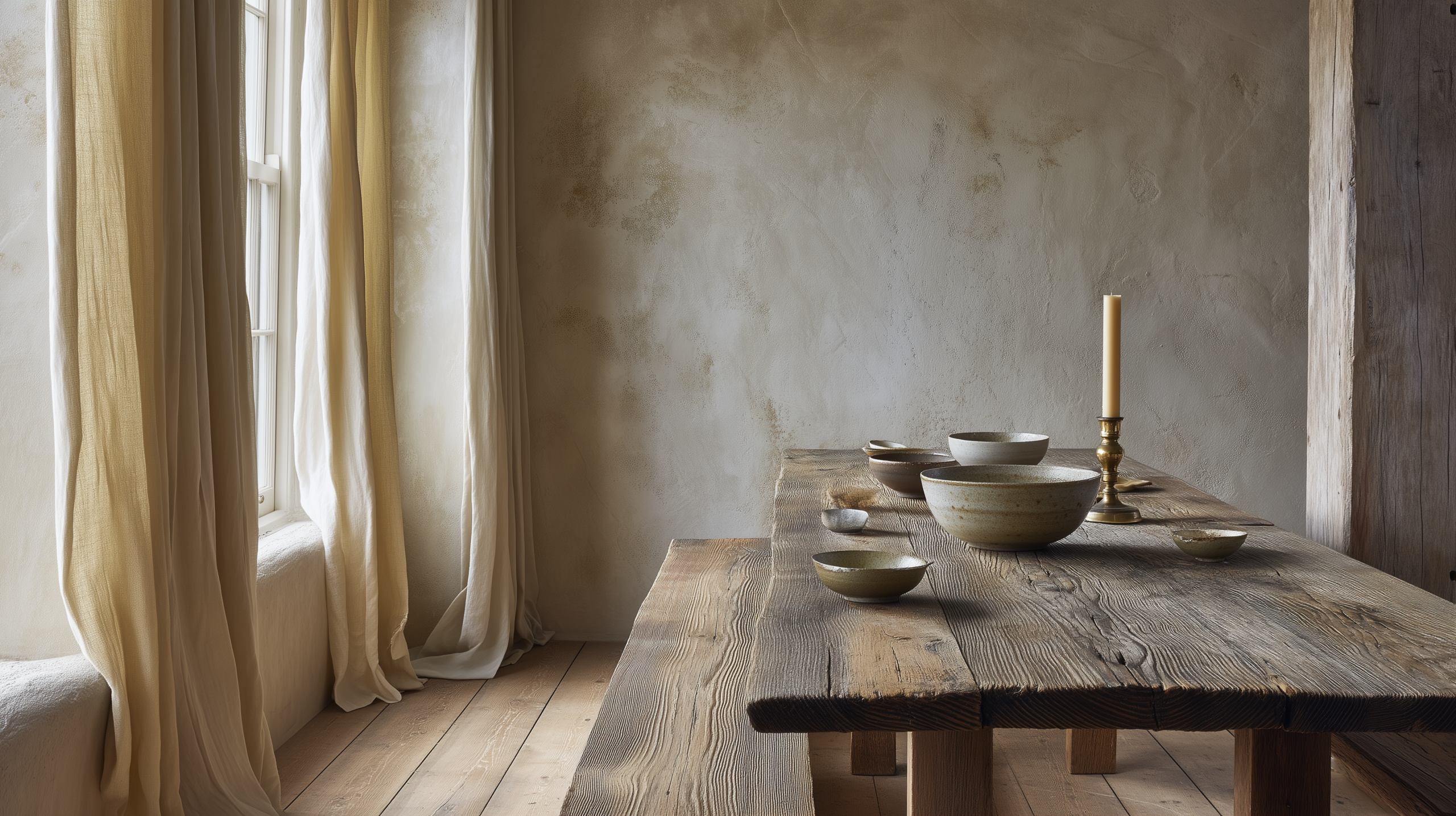
Key materials: Weathered timber, unglazed or crackle-glaze ceramics, rough-textured linen, aged brass, lime wash plaster.
Palette logic: Muted, desaturated, and nature-derived. No pure whites, no high-gloss finishes.
Designer’s Note: Wabi-Sabi is frequently reduced to “rustic with better PR.” The distinction is intentionality — every aged or imperfect element should be chosen, not defaulted to. A deliberately cracked vessel is Wabi-Sabi; a damaged surface that was never addressed is not.
Wabi-Sabi Style Guide → | Explore all Wabi-Sabi content →
5. Asian Zen Interior Design
Zen design is rooted in Buddhist philosophy and traditional Japanese spatial thinking — specifically the concept of ma, or meaningful empty space.
In a Zen interior, what is absent is as deliberately considered as what is present. Negative space is not wasted; it is where the eye and the mind rest.
Structurally, Zen spaces favour low horizontality — floor-level seating, platform beds, long low consoles. Sliding panels in paper or translucent linen modulate light and divide space without the permanence of walls.
The palette is sand, stone, warm white, and the muted greens of living plants. Natural light is the primary decorative element.
This is a profoundly functional aesthetic — every object serves a clear purpose, storage is concealed, and surfaces are kept clear. The intention is that the space itself produces a physical and psychological sensation of calm.
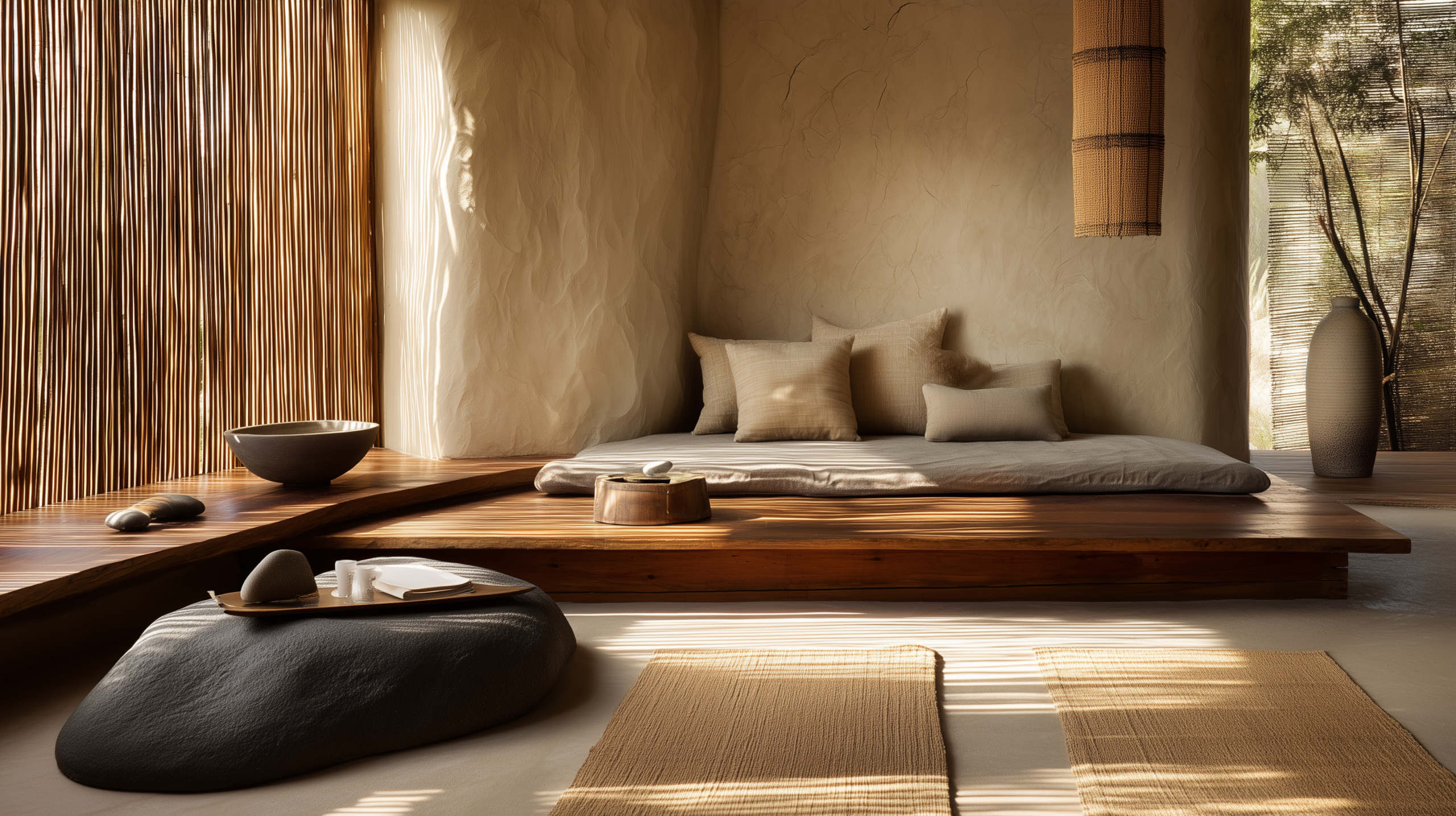
Key materials: Bamboo, shoji screen panels, natural stone, low-grain timber, hand-woven rattan, live plants.
Palette logic: Sand, stone, warm white, moss green. Nature-sourced, never vivid.
Designer’s Note: The temptation in Zen interiors is to over-accessorise with Eastern motifs — lanterns, bonsai, decorative calligraphy. The style is not decorative; it is spatial. Focus on proportion, light, and the quality of emptiness rather than the addition of cultural props.
Asian Zen Style Guide → | Explore all Asian Zen content →
6. Modern Interior Design
Modern interior design is one of the most misapplied terms in the discipline — frequently used to mean “contemporary” or simply “current,” when it refers to a specific movement rooted in early 20th-century architecture and design theory.
True modernism rejected historical ornament and embraced the idea that architecture and interior design should honestly express their structure and materials.
In practice, this translates to open-plan layouts, flat-plane furniture without decorative moulding, structural elements left visible — concrete beams, steel columns, large undivided windows.
The palette is typically restrained: whites, warm greys, and black as a defining line, with natural timber introducing warmth. The geometry is rectilinear and deliberate.
Modern design is highly adaptable as a base aesthetic — it blends naturally with Industrial, Mid-Century, and Minimalist directions without losing its structural integrity.
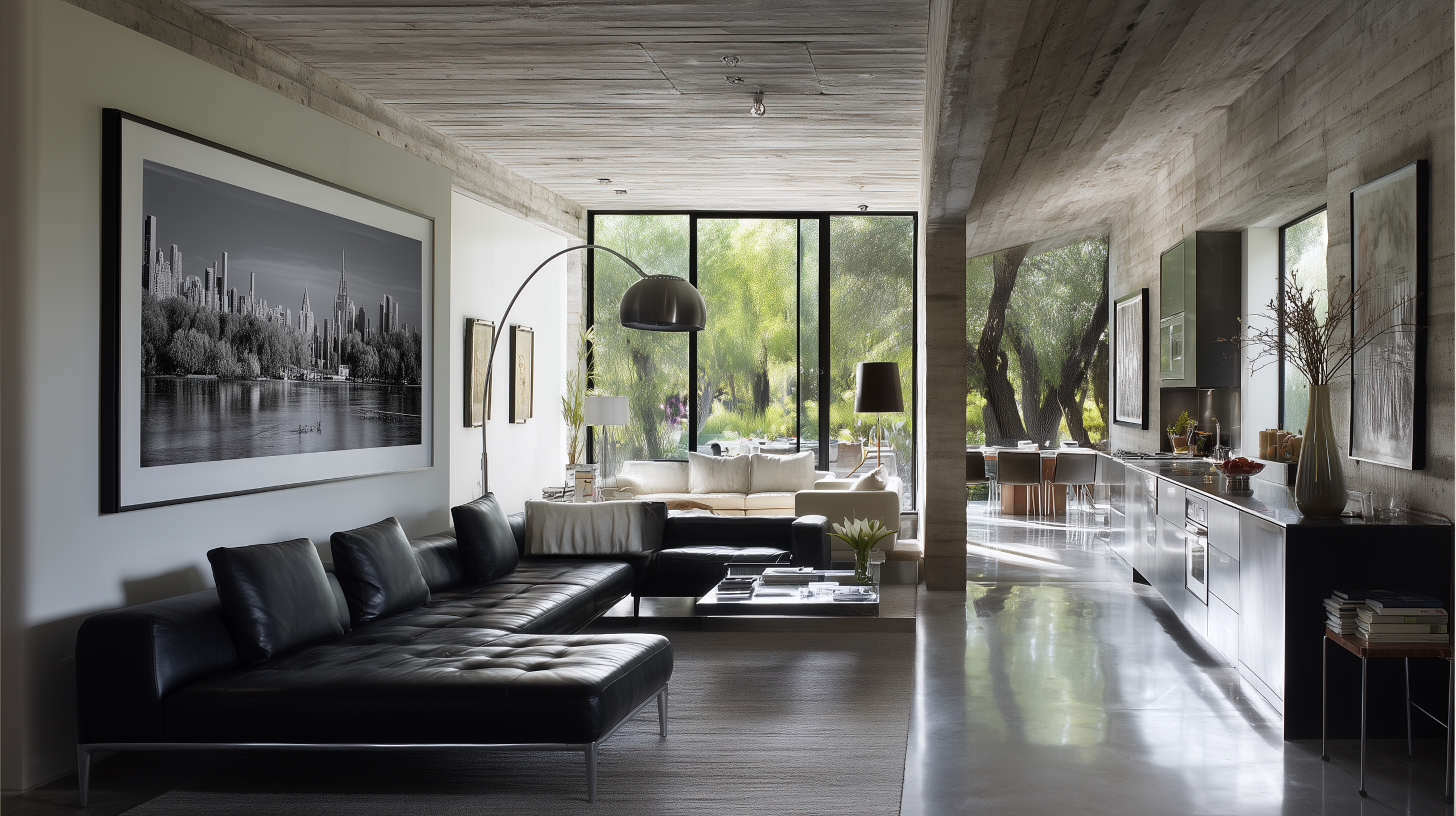
Key materials: Reinforced concrete, structural steel, plate glass, solid timber in flat planes, leather in primary colours or black.
Palette logic: Neutral base with high-contrast accents — black against white, warm timber against cool grey.
Designer’s Note: The hardest thing to maintain in a Modern interior is discipline. The style invites editing rather than addition. When in doubt, remove rather than add.
Modern Style Guide → | Explore all Modern content →
Cluster 2 — Natural & Grounded
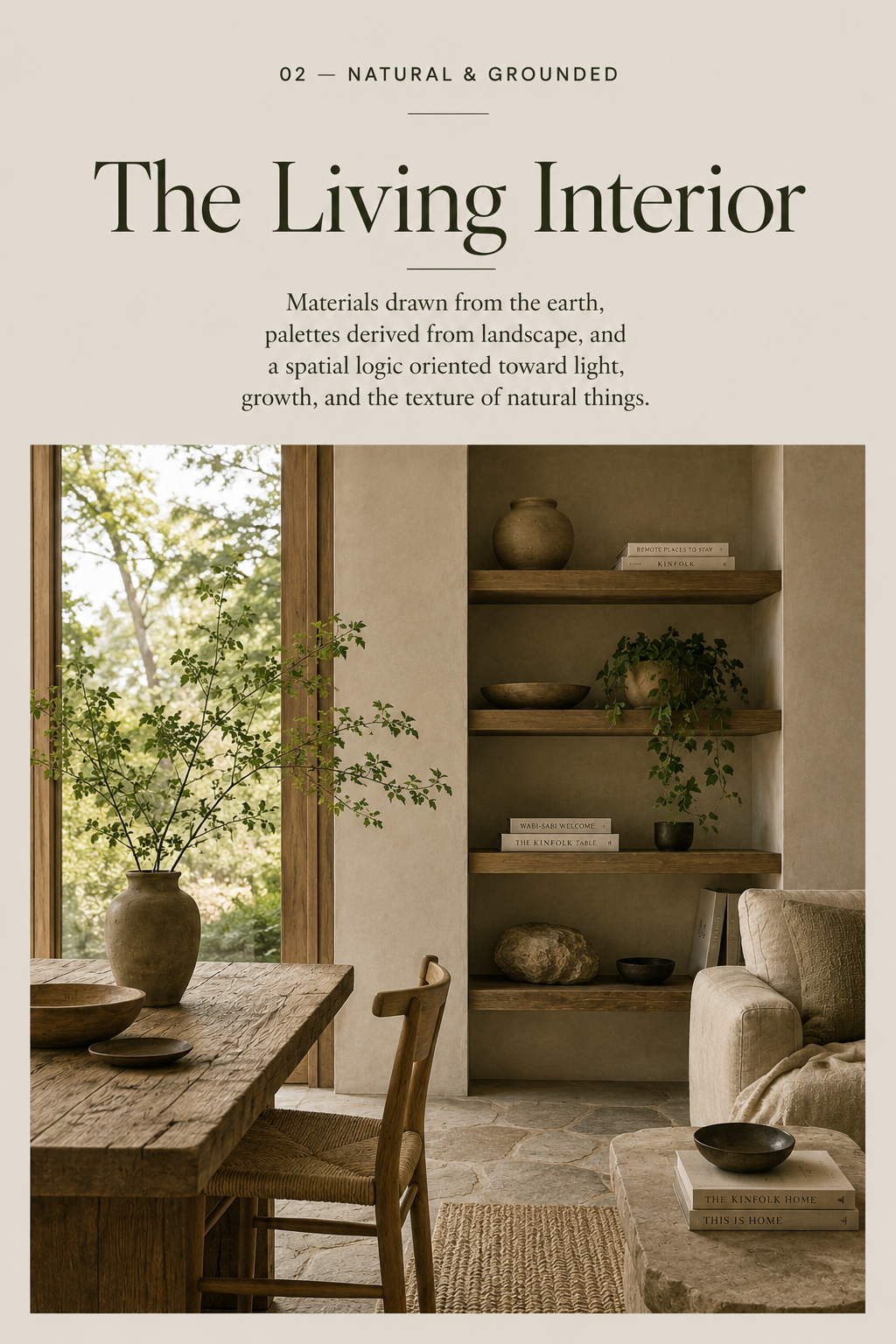
These styles share a material vocabulary rooted in the natural world — stone, timber, clay, linen, terracotta, and living plants.
They differ in their cultural origin and spatial character: Mediterranean is open and sun-bleached; Rustic is dense and lodge-like; Organic Modern is refined and gallery-calm. What connects them is an orientation toward the earth and a preference for materials that age gracefully.
7. Organic Modern Interior Design
Organic Modern occupies a precise position in the design landscape: it has the spatial discipline of contemporary design and the material warmth of nature-forward interiors.
It resolves the tension between sleek and soulful by insisting that both can coexist when the material selection is rigorous and the palette is genuinely grounded in the natural world.
The furniture profile is clean and sculptural — curved sofas in boucle or textured linen, coffee tables in live-edge timber or honed stone, pendants in rattan or spun ceramic.
The palette moves through warm whites, sand, taupe, dusty terracotta, and aged oak — tones that read as neutral but carry heat. No primary colours, no high-gloss lacquer, no chrome.
Organic Modern is currently one of the most practised styles in residential interior design globally, and its endurance suggests it will outlast the trend cycle. Its principles — quality materials, muted warmth, honest craft — have no expiry date.
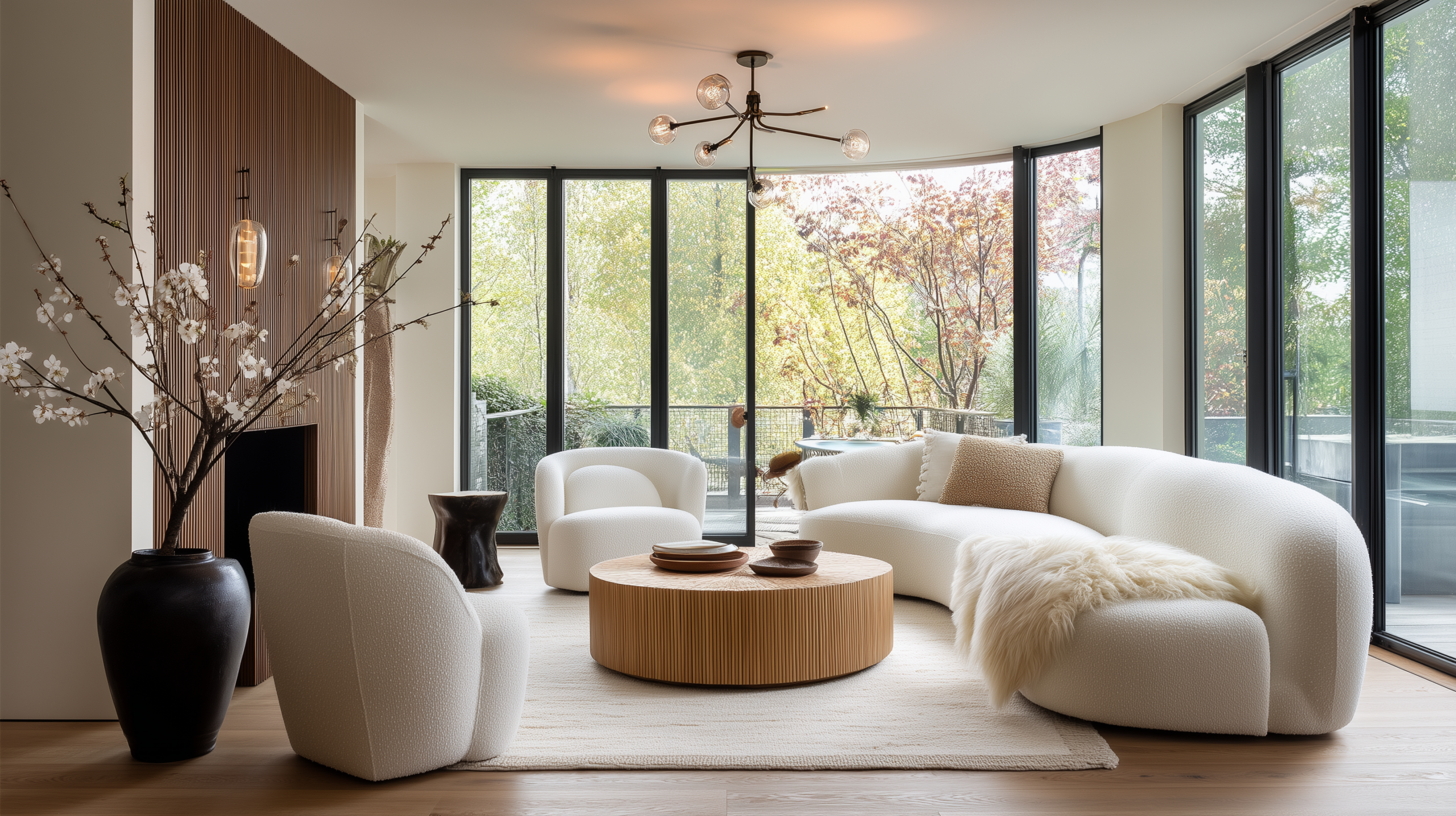
Key materials: Boucle, linen, live-edge and solid timber, honed stone, hand-thrown ceramics, rattan, undyed natural fibre rugs.
Palette logic: Warm neutrals across the full tonal range — from near-white through sand to deep walnut. The palette should feel cohesive across materials, not just paint.
Designer’s Note: The risk in Organic Modern is that it collapses into generic beige. The differentiator is sculptural confidence — a curved sofa with real presence, a stone coffee table that anchors the room, a pendant that reads as an object not just a light source. Without strong form, the warmth becomes monotony.
Available in SampleBoard Studio — including the JUNO style guide, mood board framework, and design presentation deck. Explore in Studio →
Organic Modern Style Guide → | Explore all Organic Modern content →
8. Biophilic Interior Design
Biophilic design is grounded in a body of research demonstrating that human beings have an innate physiological and psychological response to connection with the natural world.
This makes it one of the few design philosophies that can claim a measurable wellness outcome — reduced cortisol, improved cognitive function, lower resting heart rate.
In design terms, this means more than houseplants.
True biophilic design integrates natural light through orientation and window placement, introduces natural materials at every surface, incorporates water features where possible, and uses pattern and form drawn from natural geometry — fractals, organic curves, irregular edges.
Living walls, interior courtyards, and planted ceilings represent the style at its most ambitious.
At a more accessible scale, biophilic principles apply through generous planting, natural ventilation, timber and stone at tactile contact points, and views to the outside from every occupied zone.
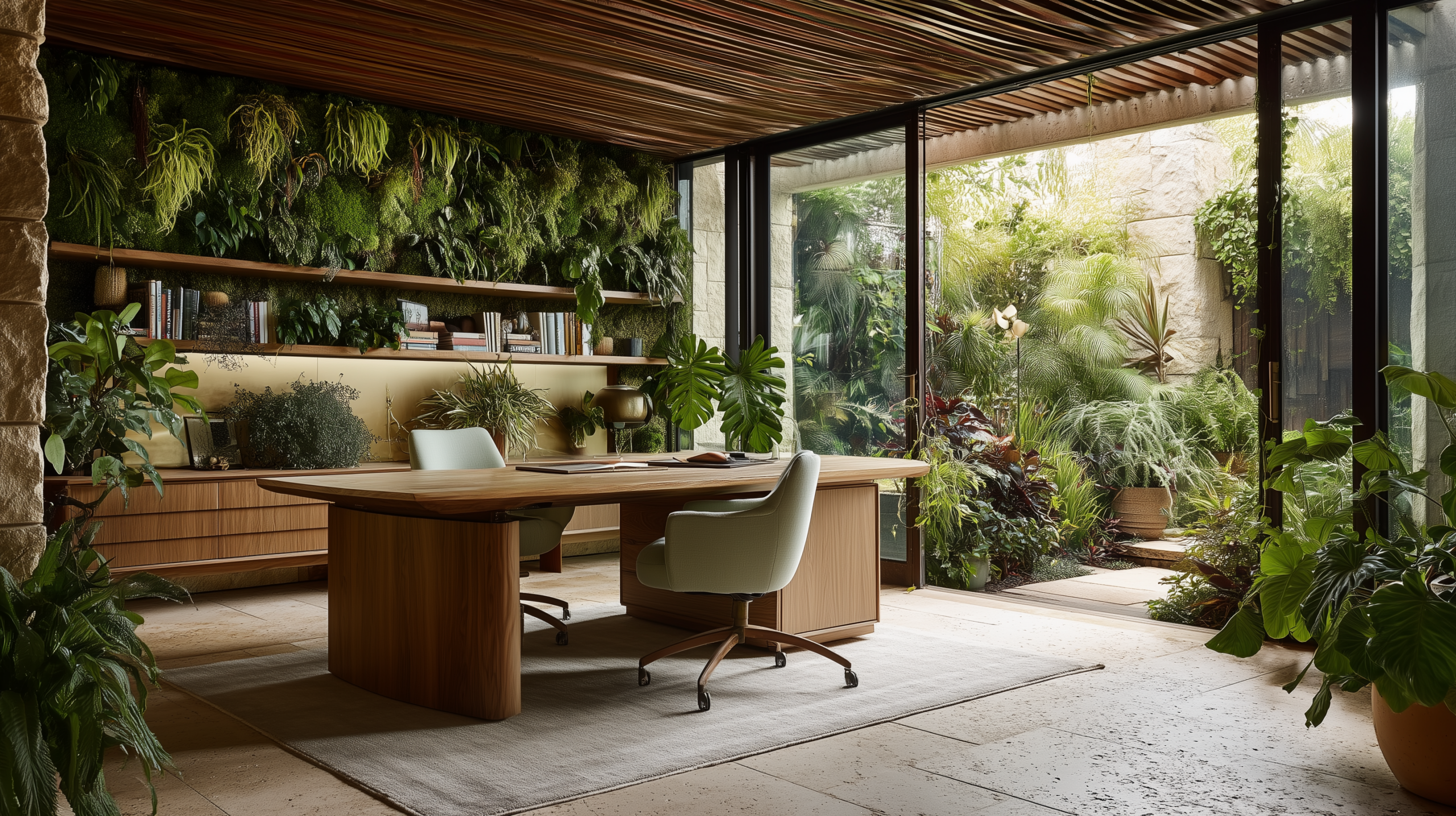
Key materials: Living plants and moss walls, unfinished timber, natural stone, water features, linen and jute, cork.
Palette logic: Derived from the immediate landscape — greens, earthy ochres, sky blues, and stone greys. The palette should feel site-specific.
Designer’s Note: Biophilic design is not a decorative layer applied to a finished interior. It must be considered at the planning stage — light orientation, material specification, plant placement relative to light sources. A single fiddle-leaf fig in a dark corner is not biophilic design.
Biophilic Style Guide → | Explore all Biophilic content →
9. Rustic Interior Design
Rustic design draws its authority from materials rather than aesthetics — reclaimed timber, rough-hewn stone, hand-forged iron, and hand-woven textiles that carry the evidence of how they were made.
The style is rooted in pre-industrial craft traditions and celebrates the density and permanence of natural materials used without concealment.
Structurally, Rustic interiors favour exposed ceiling beams, stone or brick fireplaces as focal points, wide-plank timber floors in aged or hand-scraped finishes, and furniture built for durability rather than elegance.
The palette is drawn from the landscape: bark brown, moss green, slate grey, deep burgundy, cream, and rust. Textiles are thick and tactile — wool blankets, leather upholstery, jute rugs.
Where Rustic diverges from Farmhouse is in its relationship to finishing. Farmhouse is tidier, more domestic in its organisation. Rustic is less concerned with polish and more interested in authenticity of material.
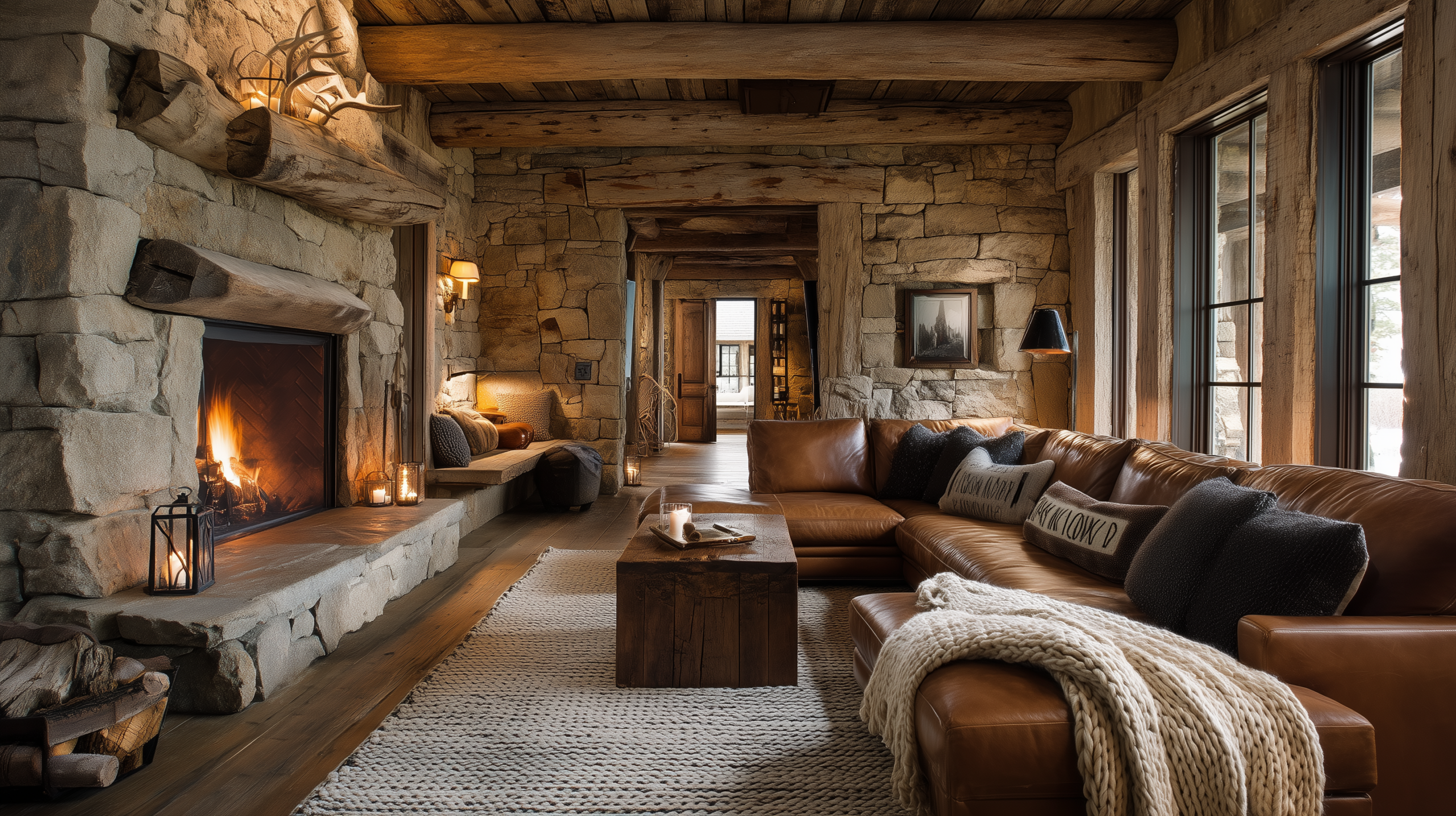
Key materials: Reclaimed timber, rough-cut stone, hand-forged iron, thick wool and leather, wide-plank flooring.
Palette logic: Deep, grounded earth tones — bark, slate, rust, forest green — balanced by cream or off-white.
Designer’s Note: Rustic spaces risk becoming heavy and cavernous if the material density is not counterbalanced with light, either architectural or through a lighter textile layer. Sheepskin throws, linen curtains, and generous window openings prevent the style from feeling oppressive.
Rustic Style Guide → | Explore all Rustic content →
10. Mediterranean Interior Design
Mediterranean interior design is shaped by climate as much as culture — it is an aesthetic born of necessity as much as taste.
In the coastal homes of southern Spain, Italy, Greece, and Morocco, architecture responded to heat and light with thick plaster walls, terracotta tile floors that stay cool underfoot, and shaded courtyards open to airflow. The interior design tradition grew from these functional foundations.
The palette is sun-bleached and sea-referenced: aged white plaster, terracotta, cobalt blue, olive green, and warm ochre. Wrought iron appears in furniture, light fixtures, and architectural detail.
Ceramic tiles — patterned, glazed, and deeply coloured — are used on floors, stairs, and kitchen surfaces. Textiles are warm but lightweight: linen, loosely woven cotton, and embroidered cushions.
The spatial character is open and layered — rooms flow into each other and toward the outside, arched openings frame views, and greenery is used both architecturally and decoratively.
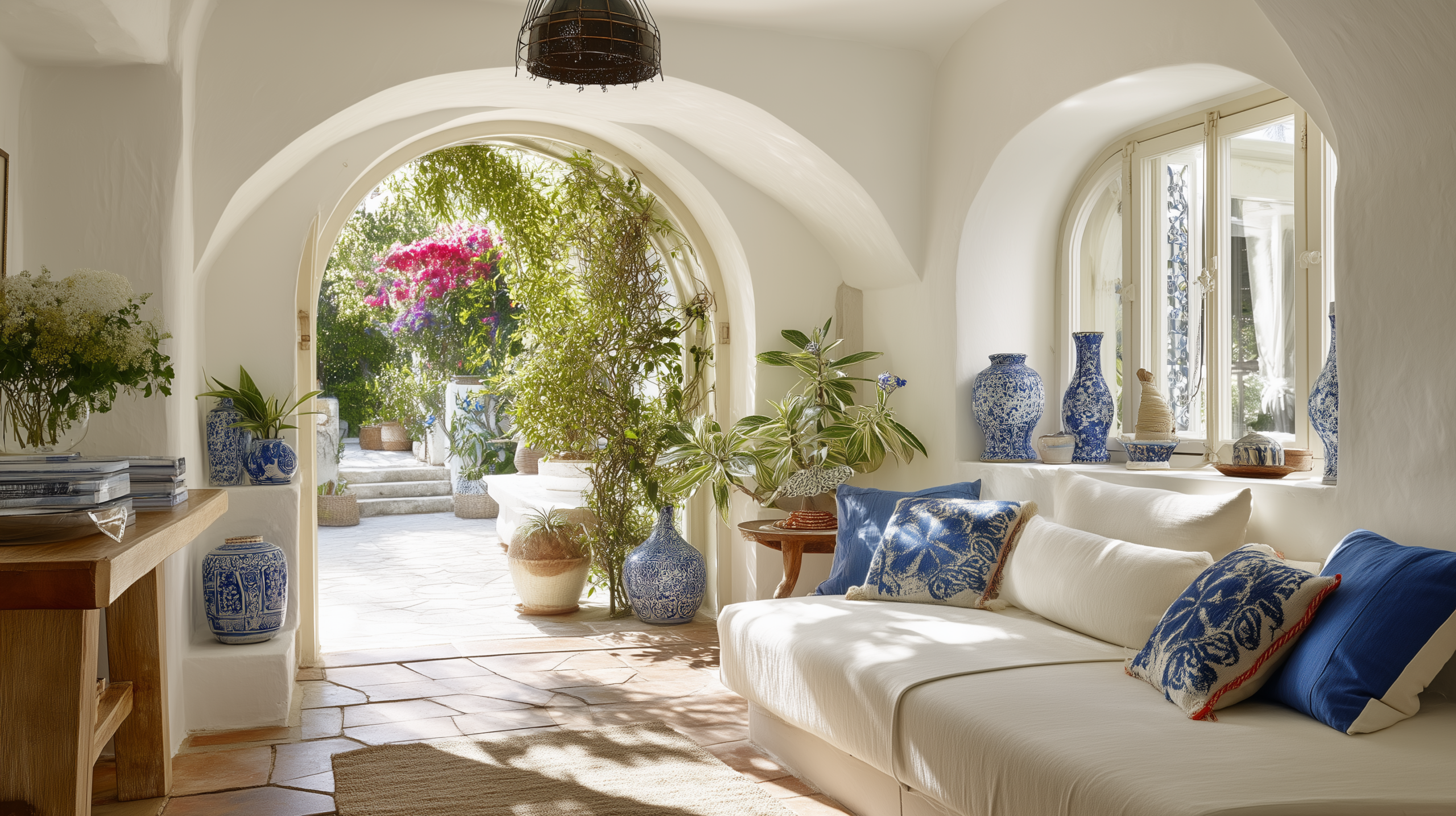
Key materials: Plaster walls, terracotta and glazed ceramic tile, wrought iron, solid timber in painted or distressed finishes, embroidered linen.
Palette logic: Warm whites, terracotta, and cobalt as the core trio. Olive, ochre, and sea green as supporting tones.
Designer’s Note: The Mediterranean style is frequently confused with its coastal sub-variants — Hampton’s Coastal, Greek Island white, or Tuscan country. Each has its own material logic. Specifying which regional tradition you are drawing from will produce a more coherent result than blending all Mediterranean references into one.
Mediterranean Style Guide → | Explore all Mediterranean content →
11. French Country Interior Design
French Country design occupies a precise cultural location — the farmhouses and manor houses of Provence, Burgundy, and the Loire Valley — and its visual language is inseparable from that geography.
Sun-bleached limestone, lavender fields, market ceramics, and the particular quality of southern French light all appear in the material and colour choices of the style.
Furniture is characterised by cabriole legs, carved detailing, and distressed painted finishes in soft blues, greys, and creams. Caned chair backs, toile de Jouy fabric, and hand-painted faïence pottery are recurring elements.
Linen — rough, washed, and slightly crumpled — is the dominant textile. The palette ranges from sun-washed cream and dusty lavender to warm ochre and faded sage.
The distinction from Shabby Chic is important: French Country has a more structured and architecturally rooted quality. The distress is in the finish, not the form.
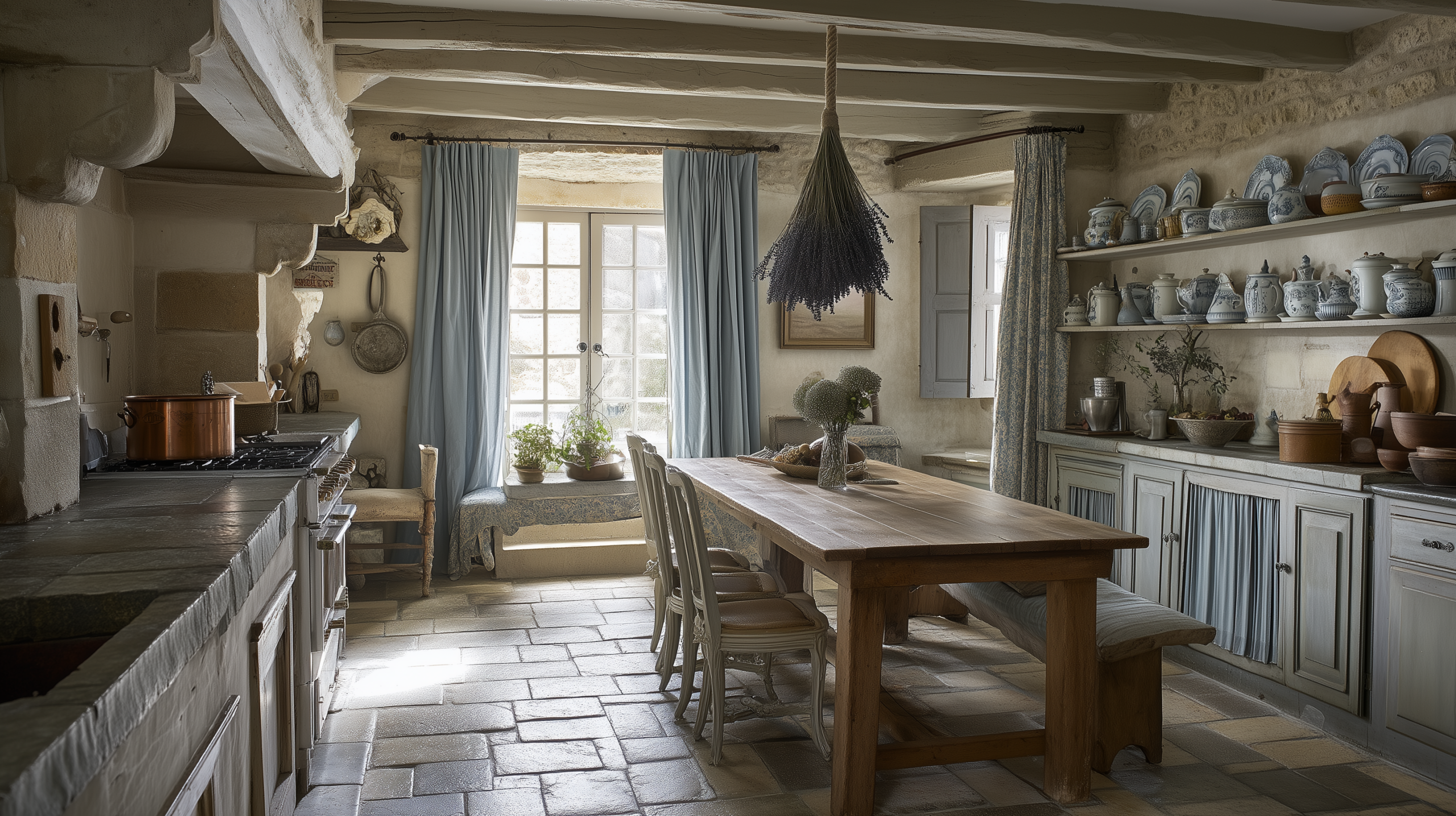
Key materials: Limestone flooring, painted and distressed timber furniture, toile fabric, hand-painted faïence, rough linen, wrought iron.
Palette logic: Cream, dusty lavender, soft blue-grey, warm ochre, faded sage.
Designer’s Note: Authentic French Country sits at the intersection of elegance and function. The kitchen table is used daily; the armoire is worn from generations of use. The design works when it feels genuinely inhabited rather than styled for a photoshoot.
French Country Style Guide → | Explore all French Country content →
12. Tropical Interior Design
Tropical interior design is not a holiday aesthetic — it is a climate-responsive design tradition rooted in the architecture of equatorial and sub-tropical regions.
Open-plan layouts, high ceilings, cross-ventilation, and the blurring of indoor and outdoor boundaries are structural features of tropical architecture that inform the interior design tradition.
Materials are natural, moisture-tolerant, and locally sourced in the traditions that inform the style: rattan, bamboo, teak, coconut shell, woven grass, and raw linen.
The palette is derived from the surrounding landscape — the dense green of jungle canopy, the warm gold of sand, the saturated blue of tropical water. Pattern appears in woven textiles and botanical prints rather than wallpaper or upholstery.
The Balinese resort aesthetic — which is one expression of Tropical design — has globalised the style and introduced some clichés (the ubiquitous hanging rattan chair, the palm-print cushion) that should be handled with care.
The more durable version of the style is less decorative and more architectural.
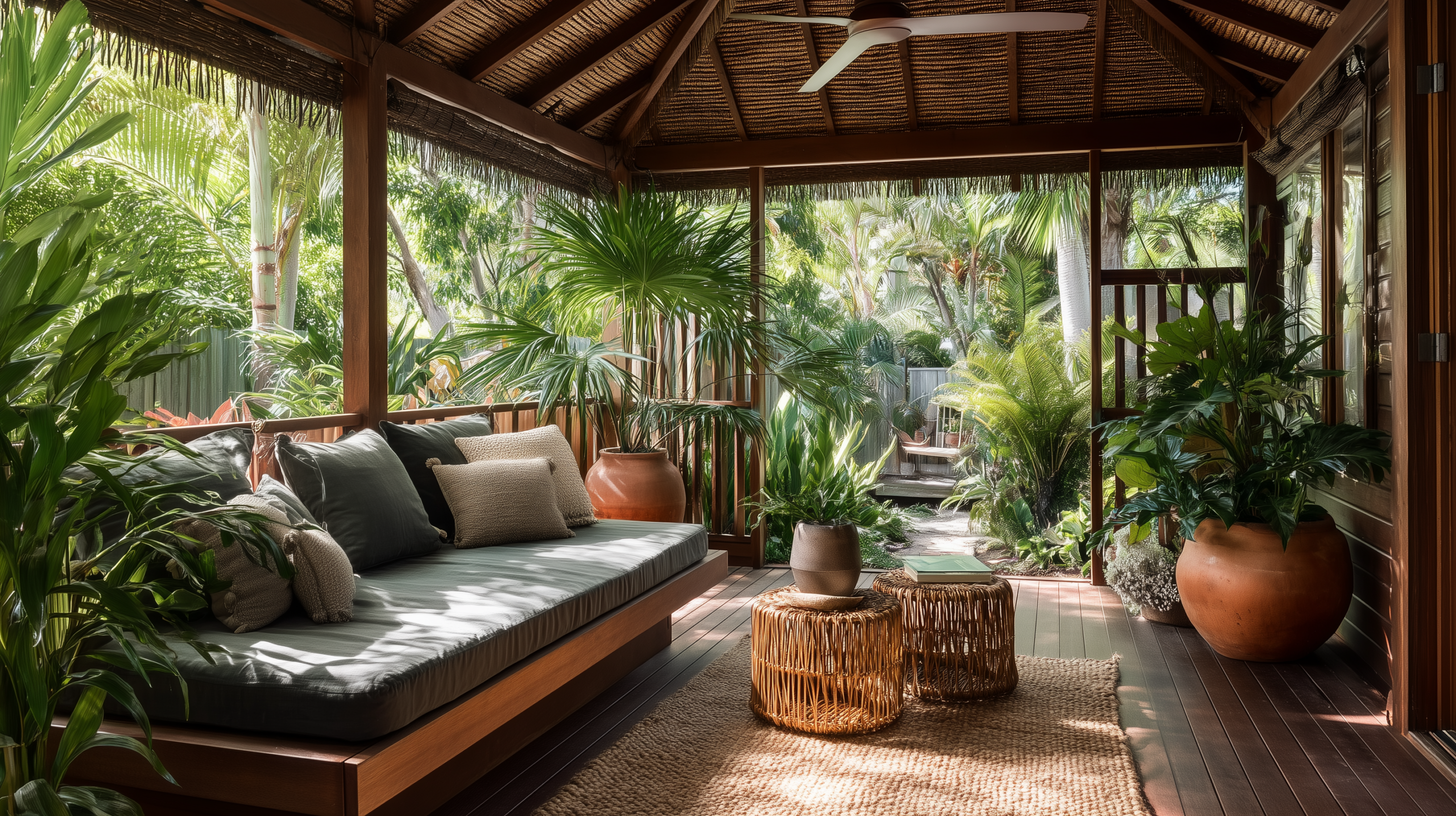
Key materials: Rattan, bamboo, teak, hand-woven grass matting, raw linen, terracotta, live tropical plants.
Palette logic: Deep botanical greens, warm sand, terracotta, and ocean blue. The palette should feel lush rather than pastel.
Designer’s Note: The relationship between indoor and outdoor space is the defining design decision in a Tropical interior. If the architecture does not support genuine indoor-outdoor flow, the style is better referenced through material and plant choices than through overt decorative motifs.
Tropical Style Guide → | Explore all Tropical content →
Cluster 3 — Bold & Expressive
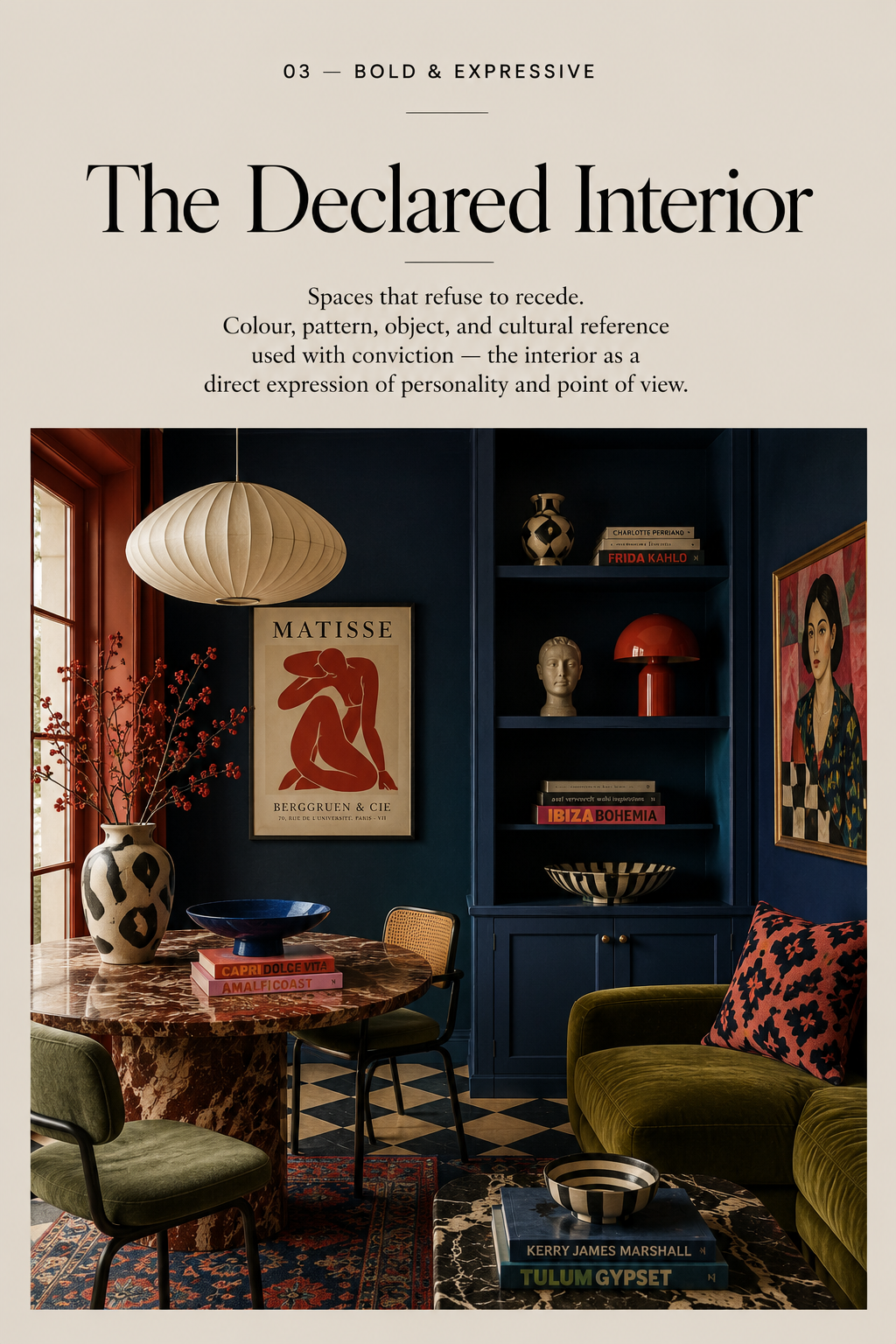
These styles reject the primacy of restraint.
They are built on accumulation, contrast, cultural layering, and the conviction that a space should express personality as clearly as clothing does.
The design intelligence in this cluster is not in subtraction but in curation — knowing which combination of patterns, objects, and references creates tension that reads as exciting rather than chaotic.
13. Bohemian Interior Design
Bohemian design is rooted in a specific counter-cultural history — the artistic communities of 19th-century Paris, the beat generation, the 1960s and 70s global travel movement — and it carries that history in its material preferences.
The style is defined by the accumulated objects of a well-travelled, culturally curious life: textiles from Rajasthan, ceramics from Oaxaca, rugs from Anatolia, furniture from a dozen different eras and origins.
This is not a style for those who prefer coordination. It thrives on apparent contradiction — jewel-toned velvet against raw jute, antique gilded frames around contemporary photography, macramé beside mid-century furniture.
The palette is rich and layered: saffron, deep teal, burgundy, terracotta, and forest green held together by a warm neutral base. Natural materials — rattan, bamboo, jute, raw linen — provide the structural language that prevents the layering from collapsing into chaos.
The critical skill in Bohemian design is density management — knowing how much is too much and using the neutral base and material consistency to create a container for the eclecticism.

Key materials: Kilim and Persian rugs, rattan, macramé, raw linen, hand-block-printed textiles, patterned ceramic, vintage and secondhand furniture.
Palette logic: Rich jewel tones — saffron, teal, burgundy, terracotta — over a warm neutral base. Pattern mixing is central; coordinate through colour family rather than motif.
Designer’s Note: The most common Bohemian failure is confusing the style with generic “boho” — a Pinterest aesthetic characterised by white walls, pampas grass, and rattan mirrors. Authentic Bohemian design is culturally referential, materially diverse, and personal. It cannot be purchased as a complete kit.
Available in SampleBoard Studio — including the LIV style guide, mood board framework, and design presentation deck. Explore in Studio →
Bohemian Style Guide → | Explore all Bohemian content →
14. Maximalist Interior Design
Maximalism is a considered design philosophy, not the absence of editing.
The distinction matters enormously — a well-executed Maximalist interior is as rigorously controlled as a Minimalist one, but the control operates through colour rhythm, pattern repetition, and object curation rather than through removal.
The style welcomes abundance: walls covered in art, shelves dense with objects, pattern layered on pattern, and multiple competing colour families held in productive tension.
Jewel tones — emerald, sapphire, amethyst, burnt orange — are typical, often paired with rich dark grounds: deep navy, forest green, charcoal, or black. Furniture is often antique or vintage, chosen for character over coordination.
The structural principle that makes Maximalism work rather than overwhelm is repetition — a colour, a material, or a motif that recurs throughout the space and gives the eye a thread to follow through the complexity.
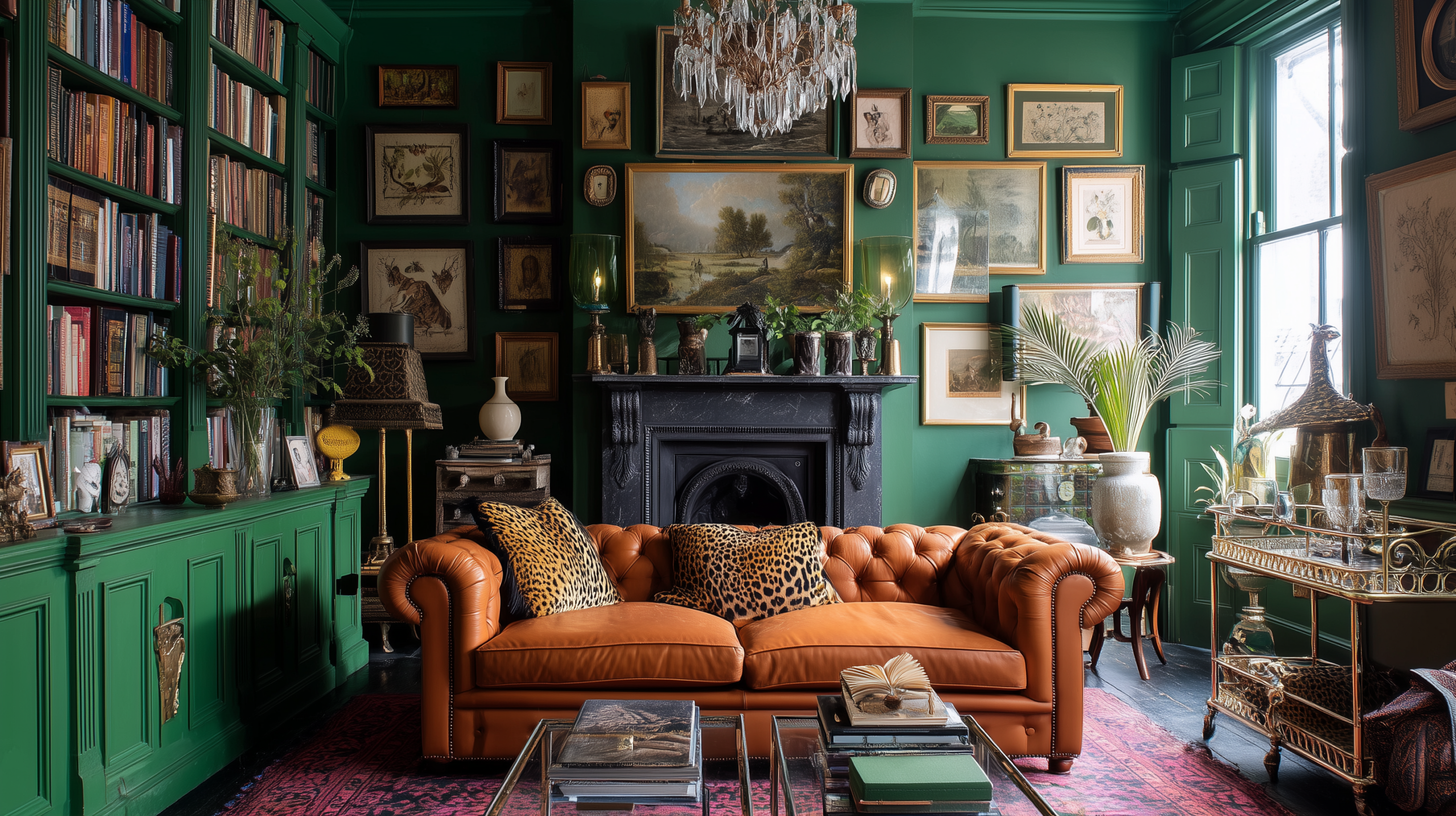
Key materials: Velvet, silk, patterned upholstery, antique and vintage furniture, layered rugs, gallery-wall art, decorative objects with visual weight.
Palette logic: Commit to a dominant colour family and use it as the recurring thread. Secondary and tertiary tones should be chosen to complement, not compete.
Designer’s Note: Start the colour decision from the rug or the largest textile in the space. Build the palette from what already exists rather than designing from a mood board down. Maximalist spaces that feel curated are almost always built from the floor up.
Maximalist Style Guide → | Explore all Maximalist content →
15. Eclectic Interior Design
Eclectic design is the most technically demanding style on this list — because it has no rules beyond coherence, and coherence without shared rules requires a strong designer’s eye.
The style combines elements from different periods, cultures, and aesthetic traditions and asks them to function as a unified whole.
What makes an Eclectic interior work is not the diversity of its sources but the discipline of its editing — the recurring colour that appears in both the antique rug and the contemporary art, the material — brass, for example — that bridges the Victorian side table and the mid-century lamp.
Without these through-lines, the space reads as unresolved rather than intentionally layered.
This is a style that rewards confidence and punishes hesitation. The most successful Eclectic interiors are made by designers who understand the rules of other styles well enough to know which rules they are breaking.

Key materials: Mixed — the defining characteristic is variety held in tension. The skill is in identifying the unifying element across disparate pieces.
Palette logic: Identify one dominant colour that recurs across objects and surfaces. Allow secondary tones to vary but return to the dominant as the visual anchor.
Designer’s Note: Before specifying any Eclectic interior, identify your through-lines: one colour, one material, one motif that will recur. Without at least two of these three, the space will read as unstyled rather than eclectic.
Eclectic Style Guide → | Explore all Eclectic content →
16. Moroccan Interior Design
Moroccan interior design is one of the world’s most distinctive and internally coherent design traditions, shaped by centuries of craftsmanship, trade routes, and the particular demands of a North African climate.
It is a style that rewards study — the pattern systems in zellige tilework, the geometry of carved plaster, and the construction of a traditional Marrakchi riad all follow rigorous design logic that has very little to do with contemporary trend cycles.
The visual language includes hand-cut ceramic zellige tile in complex geometric patterns, carved plaster (stucco) walls with arabesque detailing, cedar wood cabinetry with inlaid marquetry, hand-knotted Berber and Beni Ourain rugs, and brass lanterns that cast patterned light.
The palette moves between warm terracotta, deep saffron, cobalt, and aged metals — always grounded in the earthy tones of the North African landscape.
Low seating — banquette platforms, floor cushions, and pouf ottomans — creates an intimacy and horizontality distinct from European furniture traditions.
Arched openings, internal fountains, and courtyard gardens are architectural elements that the style references even when they cannot be physically reproduced.
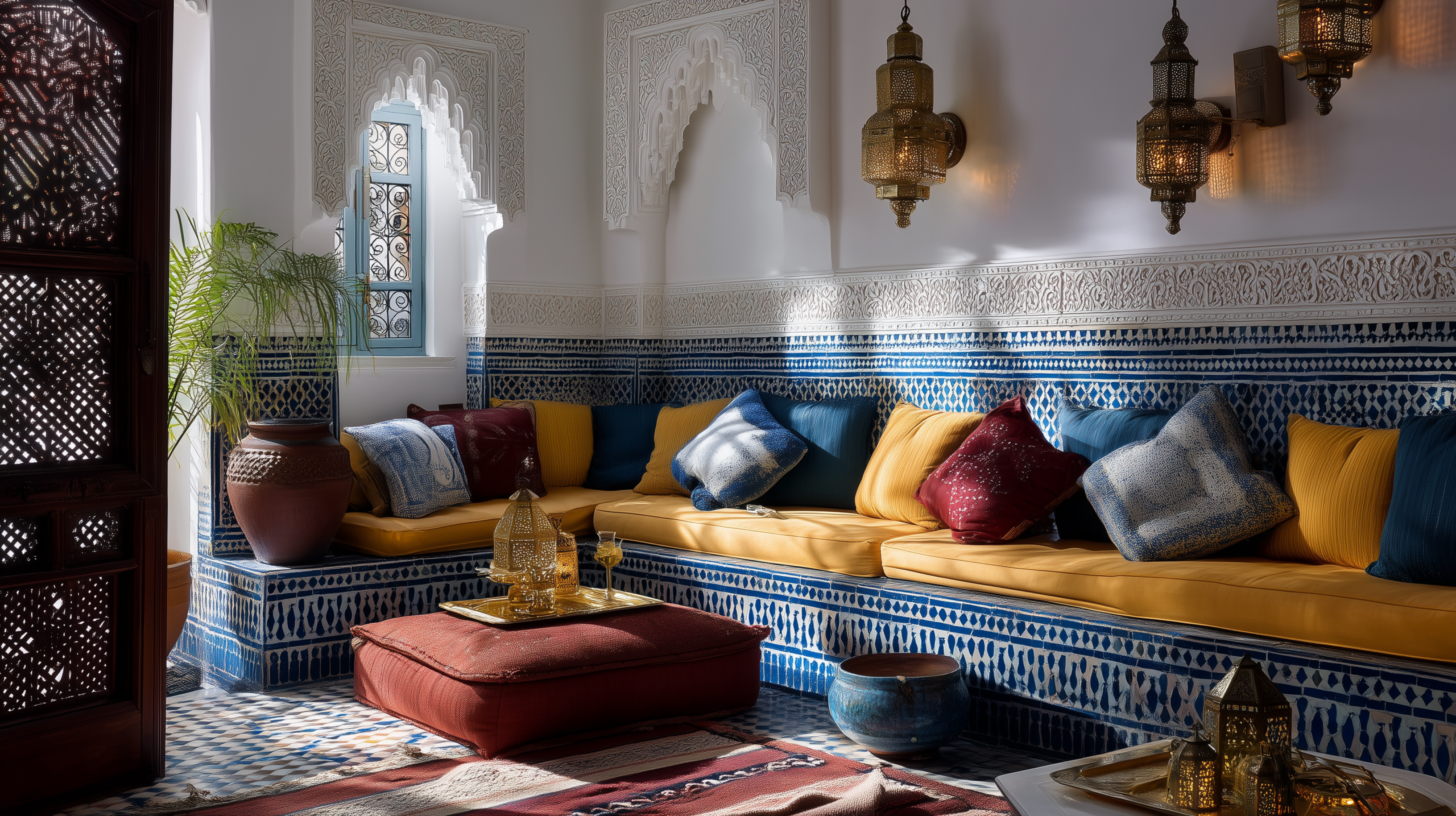
Key materials: Zellige tile, carved plaster, cedar wood, hand-knotted Berber rugs, brass metalwork, hand-blown glass lanterns.
Palette logic: Terracotta, saffron, cobalt, aged brass, and deep burgundy against creamy lime-washed walls.
Designer’s Note: The distinction between authentic Moroccan design and Moroccan-adjacent bohemian décor is material specificity. Zellige tile is handmade and deliberately imperfect; machine-made ceramic substitutes read differently. Beni Ourain rugs are hand-knotted and undyed; mass-produced replicas have a uniformity that undermines the aesthetic. The investment in genuine craft materials is what gives the style its authority.
Moroccan Style Guide → | Explore all Moroccan content →
17. Retro Interior Design
Retro design draws specifically from the 1950s through the 1980s — three decades of rapid material and cultural change that produced some of the most formally inventive furniture and colour thinking in design history.
Each decade has its own visual logic: the optimistic organics of the 1950s, the psychedelic boldness of the 1960s, the warm earth tones of the 1970s, and the high-contrast graphic energy of the 1980s.
The style is characterised by bold hues — mustard, burnt orange, avocado green, harvest gold, candy red — used in combination rather than as accents.
Furniture profiles favour curves, pod shapes, and low seating. Materials include moulded plastic, chrome, terrazzo, and textured fabrics in geometric or abstract patterns. Pop art and graphic print appear on walls.
The most durable version of Retro design tends to draw from a single decade rather than blending all three — the visual logic of each period is distinct enough that mixing them without great care produces confusion rather than nostalgia.
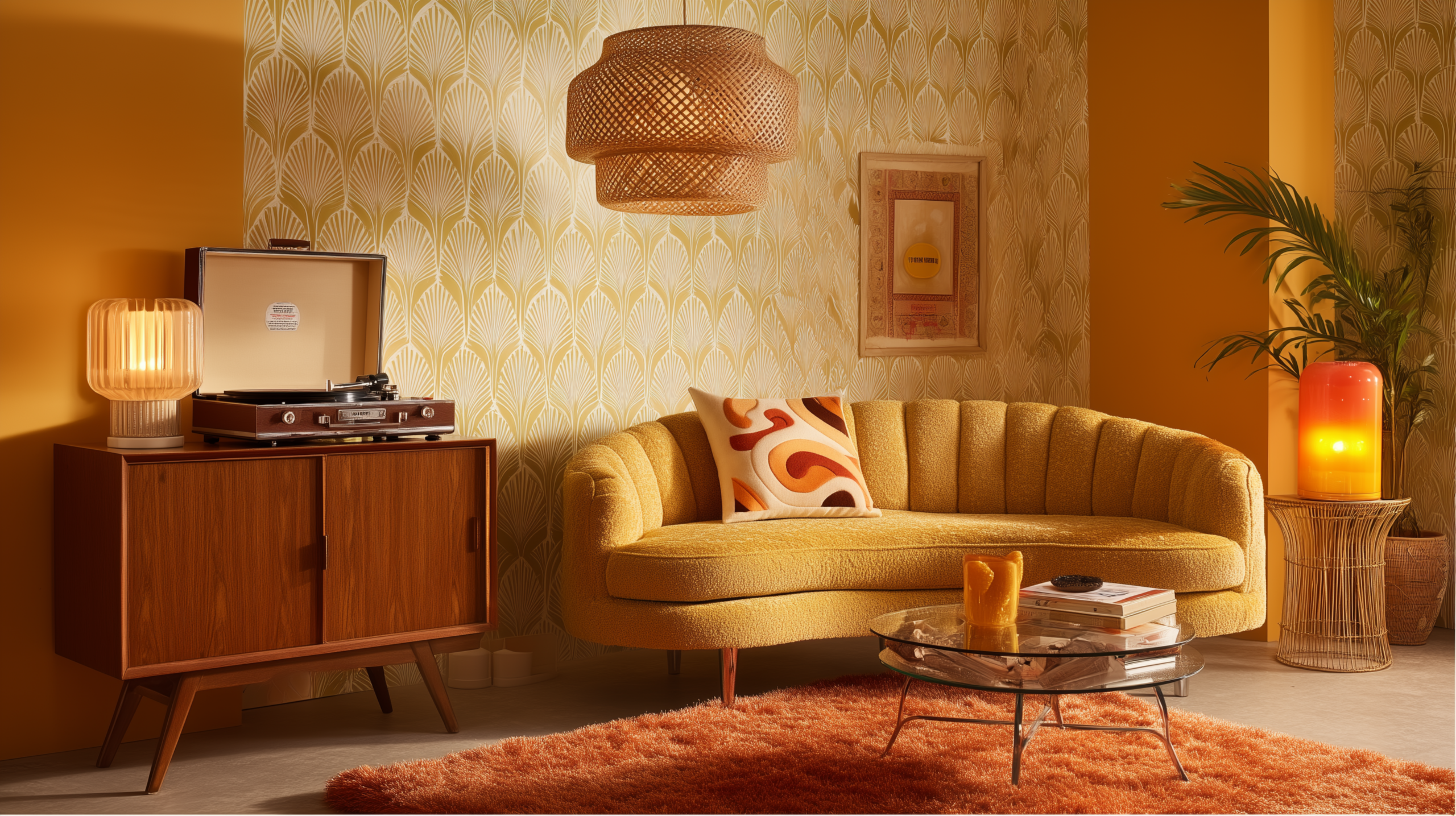
Key materials: Moulded plastic and fibreglass, chrome, terrazzo, bouclé and textured upholstery in period colours, vinyl flooring.
Palette logic: Period-specific and unapologetic — mustard and avocado, burnt orange and cream, black and primary red. The palette is the statement.
Designer’s Note: The most sophisticated Retro interiors balance one or two period-specific statement pieces — a Tulip table, an Egg chair, a terrazzo floor — against a more restrained contemporary backdrop. Full immersion works in commercial or hospitality contexts; in residential spaces it requires a committed client.
Retro Interior Style → | Explore all Retro content →
18. Avant-Garde Interior Design
Avant-Garde interior design sits at the intersection of art and architecture — and like avant-garde art, its primary interest is in questioning assumptions rather than fulfilling them.
Furniture may be non-functional or sculptural in intent. Spatial division may be achieved through unexpected means — a colour boundary, a material change, a structural object. The hierarchy between art, furniture, and architecture is deliberately blurred.
This is a style for spaces that are intended to be experienced rather than merely inhabited. It is the design language of gallery spaces, design studios, hospitality environments conceived as cultural statements, and the homes of clients with a strong conceptual design appetite.
Materials are chosen for their expressive qualities — raw concrete alongside highly polished resin, industrial steel paired with delicate hand-blown glass, unexpected colour in a structural application. The palette is often high-contrast or highly specific to a concept.

Key materials: Concept-led — raw concrete, resin, structural steel, unexpected combinations chosen for expressive rather than conventional reasons.
Palette logic: Concept-driven. May be monochromatic, maximally contrasted, or tied to a single saturated colour used as a spatial statement.
Designer’s Note: Avant-Garde design is less a style to apply and more an attitude to design thinking. The question to ask before each decision is: what assumption does this challenge? Without that interrogation, the result is unconventional-looking rather than genuinely avant-garde.
Avant-Garde Style Guide → | Explore all Avant-Garde content →
Cluster 4 — Heritage & Structure
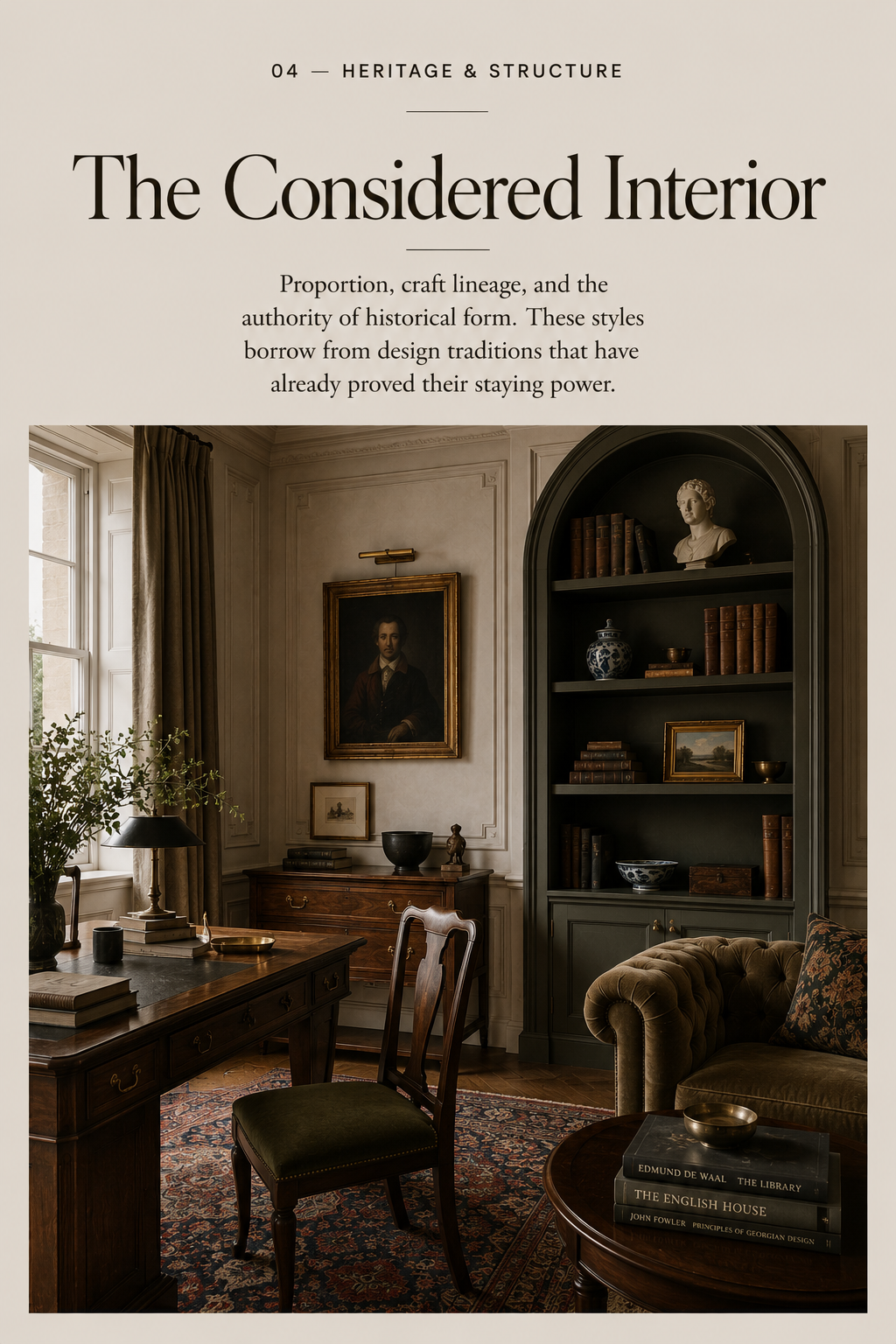
These styles draw their authority from design history — from the craft traditions, architectural movements, and cultural moments that produced some of the most enduring interiors ever made.
The best work in this cluster is not nostalgic; it is genuinely informed by historical precedent and applies that knowledge with contemporary skill. The difference between Traditional and pastiche is always craft knowledge and material integrity.
19. Traditional Interior Design
Traditional interior design draws from 18th- and 19th-century European domestic interiors — primarily English Georgian and Regency, French Empire, and American Federal styles.
It is characterised by architectural formality (symmetry, proportion, and moulding), fine craftsmanship in furniture and upholstery, and rich material selection across every surface.
Crown moulding, panelled walls, dado rails, and coffered ceilings create the architectural framework. Within it, furniture in mahogany, walnut, or cherry with carved detailing and cabriole legs is upholstered in velvet, damask, silk, or wool tapestry.
The palette is rich and deliberate — navy, claret, forest green, and gold against warm cream or off-white.
Symmetry governs composition: matching lamps, paired armchairs, balanced art arrangements. Pattern is used confidently — florals, damask, stripes, and toile — but coordinated through colour family rather than motif.
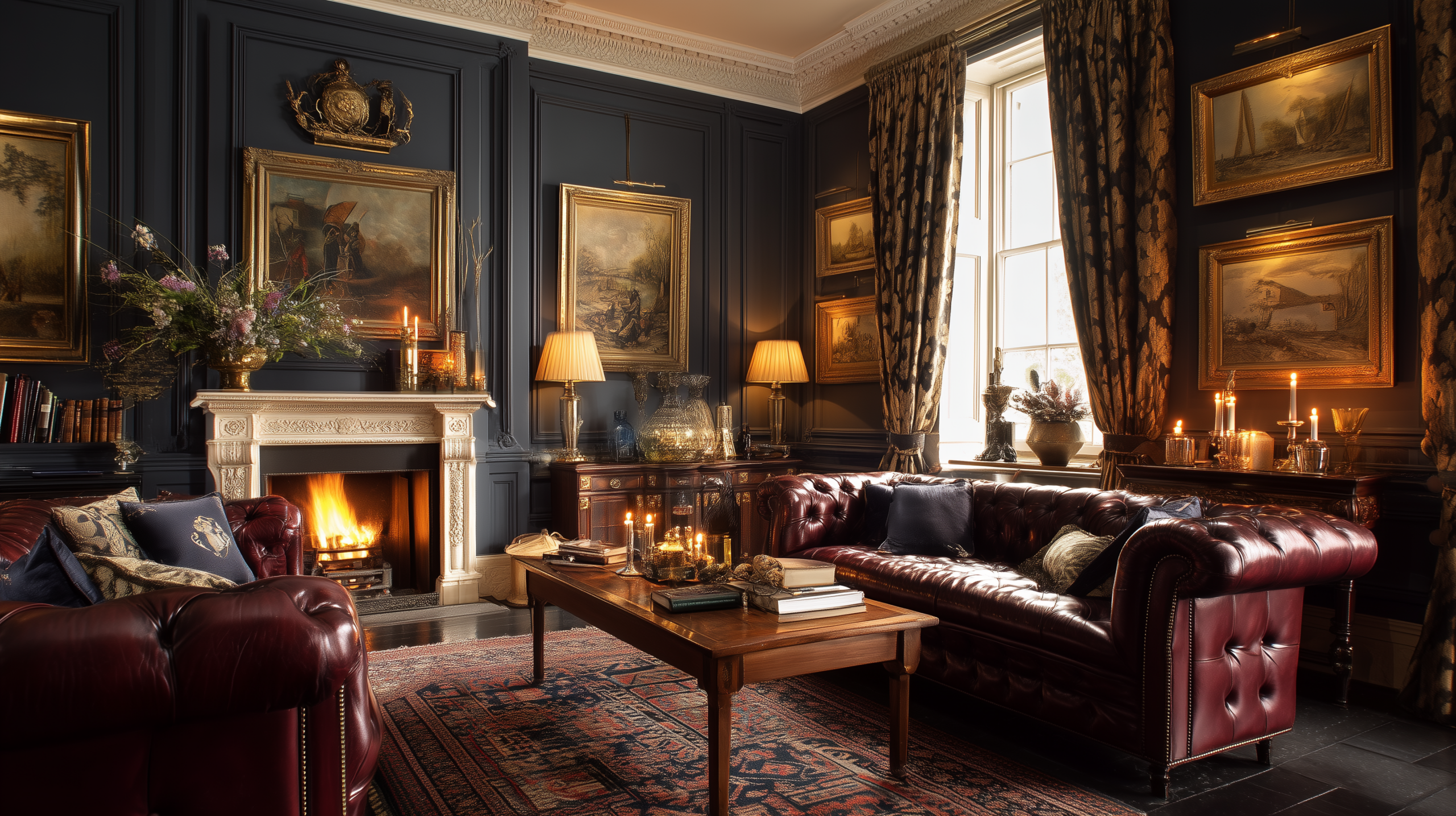
Key materials: Mahogany, walnut, and cherry furniture; velvet, damask, and silk upholstery; oil paintings; antique rugs; polished brass hardware.
Palette logic: Rich, saturated, and historically referenced — navy, claret, forest green, gold, deep teal. Balanced by warm neutral grounds.
Designer’s Note: Traditional design is exceptionally sensitive to proportion. Rooms that are too small for the furniture scale, or ceilings that are too low for formal curtain treatments, will read as cramped rather than grand. Always assess the architectural envelope before specifying furniture scale and window treatments.
Traditional Style Guide → | Explore all Traditional content →
20. Transitional Interior Design
Transitional design is the most commercially prevalent style in professional interior design practice — and for good reason.
It resolves the tension between clients who want “timeless” and clients who want “current” by operating precisely in the space between traditional form and contemporary restraint.
The signature move of Transitional design is pairing a traditional silhouette with a contemporary material — a rolled-arm sofa in a clean linen rather than a patterned fabric, a classic console in a matte finish rather than a high-gloss lacquer, an antique mirror over a streamlined fireplace.
The result is a space that reads as polished and resolved without committing to either pole.
The palette is typically neutral and warm: ivory, greige, taupe, warm white, with wood tones and stone finishes providing material interest. Metallics appear in brushed rather than polished finishes. Pattern is used selectively — one hero textile, echoed quietly elsewhere.
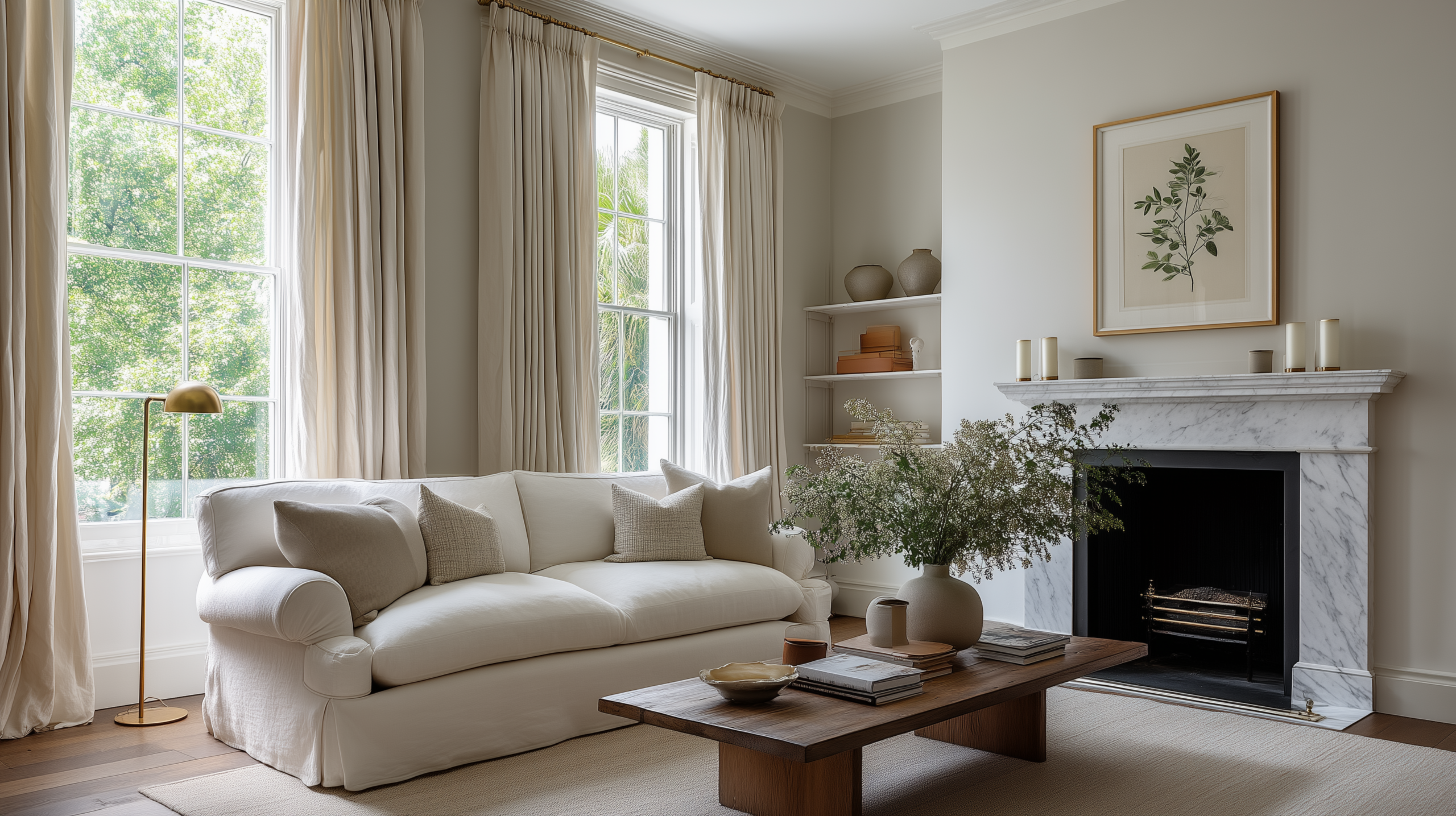
Key materials: Linen and wool upholstery, brushed nickel and brass hardware, honed stone, solid timber in mid-tones, glass.
Palette logic: Warm neutrals throughout — ivory, greige, taupe — with wood tone and stone as the material anchors.
Designer’s Note: The risk in Transitional design is that it becomes safe to the point of being forgettable. The antidote is a single moment of genuine character — an unexpected artwork, an heirloom piece, a tile selection with real presence. Without one, the space can read as a showroom floor rather than a home.
Transitional Style Guide → | Explore all Transitional content →
21. Victorian Interior Design
Victorian interior design reflects the material ambitions and cultural values of 19th-century Britain at the height of its industrial and imperial reach.
It is a style of abundance, accumulation, and craft — a demonstration of the extraordinary range of materials, textiles, and manufacturing techniques that became available during that period.
Architecturally, Victorian interiors are characterised by high ceilings with elaborate plaster cornicing, timber floors with encaustic tile borders in entrance halls, marble fireplaces as room centrepieces, and heavily draped windows.
Furniture is dark, carved, and upholstered in deep jewel tones — claret velvet, forest green leather, teal damask. Decorative objects are numerous and deliberate: figurines, framed prints, pressed botanical collections, and display cabinets full of curiosities.
The contemporary application of Victorian design tends toward selective curation — drawing from its material richness and formal confidence without reproducing the density of a fully period-accurate interior.
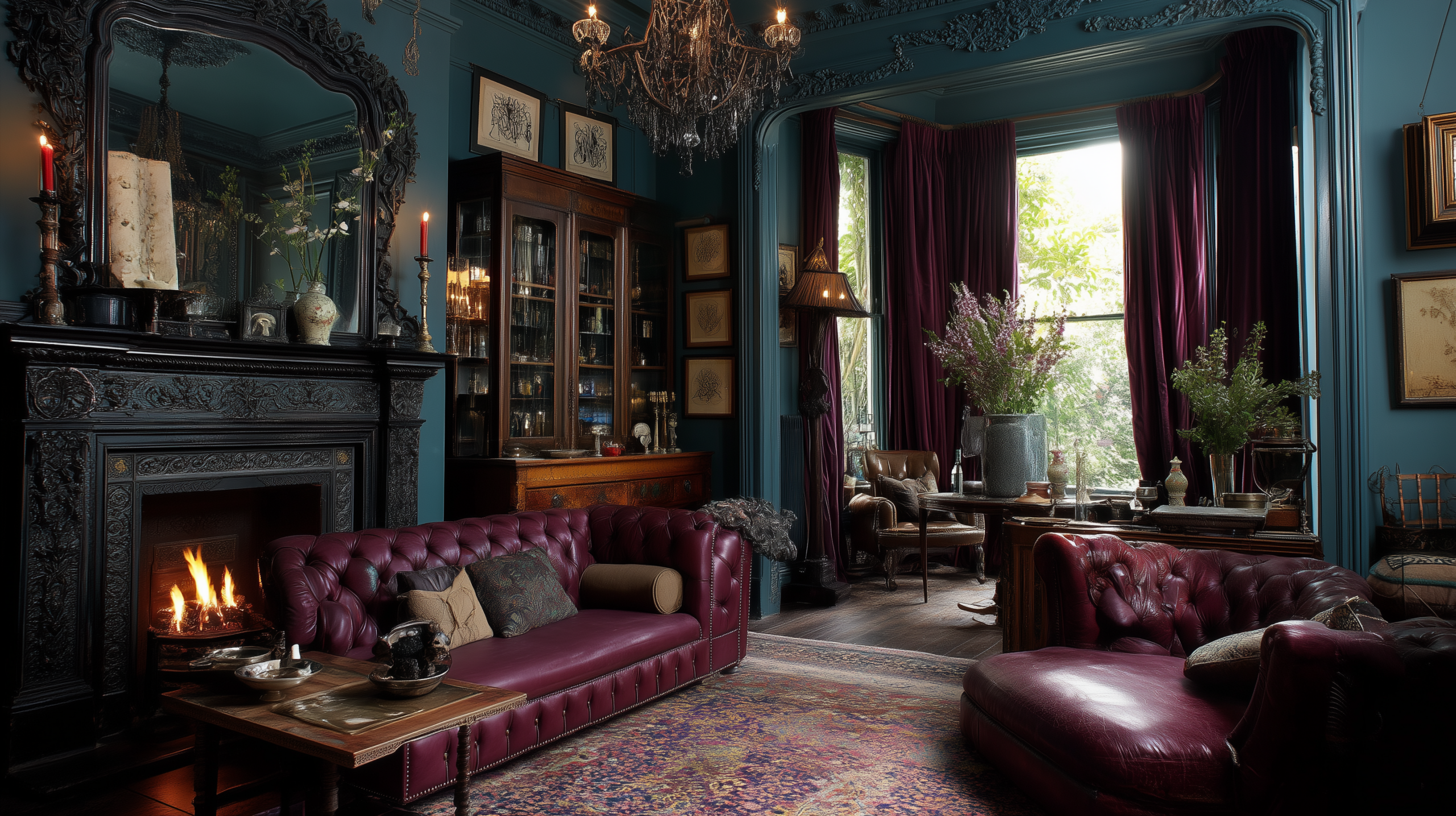
Key materials: Dark carved timber (mahogany, ebonised wood), velvet and damask upholstery, encaustic tile, marble, ornate brass and bronze hardware.
Palette logic: Deep jewel tones — claret, forest green, navy, plum — against dark grounds or rich cream. Gold as a metallic accent throughout.
Designer’s Note: Victorian design applied selectively is far more effective than a full period recreation in most contemporary contexts. Choose your references deliberately: the fireplace, the cornicing, the upholstery colour — and let those carry the character without reproducing every Victorian material layer.
Victorian Style Guide → | Explore all Victorian content →
22. Art Deco Interior Design
Art Deco emerged in France in the 1920s as a deliberate rejection of Art Nouveau’s organic curves and a celebration of the machine age — its geometry, its new materials, and its speed.
The style spread rapidly across Europe and America, reaching its fullest expression in the architecture and interiors of New York, Miami, and Paris between the wars.
The visual language is precise and confident: sunburst motifs, stepped forms, chevron and fan patterns, and the strict geometry of rectilinear furniture silhouettes.
Materials are luxurious and modern simultaneously — lacquered wood, chrome, brass, mirrored glass, shagreen, and Bakelite. The palette balances drama with sophistication: black and gold, emerald and blush, navy and chrome.
Art Deco is a style that requires commitment to its formal precision. The geometry must be exact, the materials must have quality, and the palette must be bold enough to hold the ornament. Timid Art Deco reads as decorative pastiche.
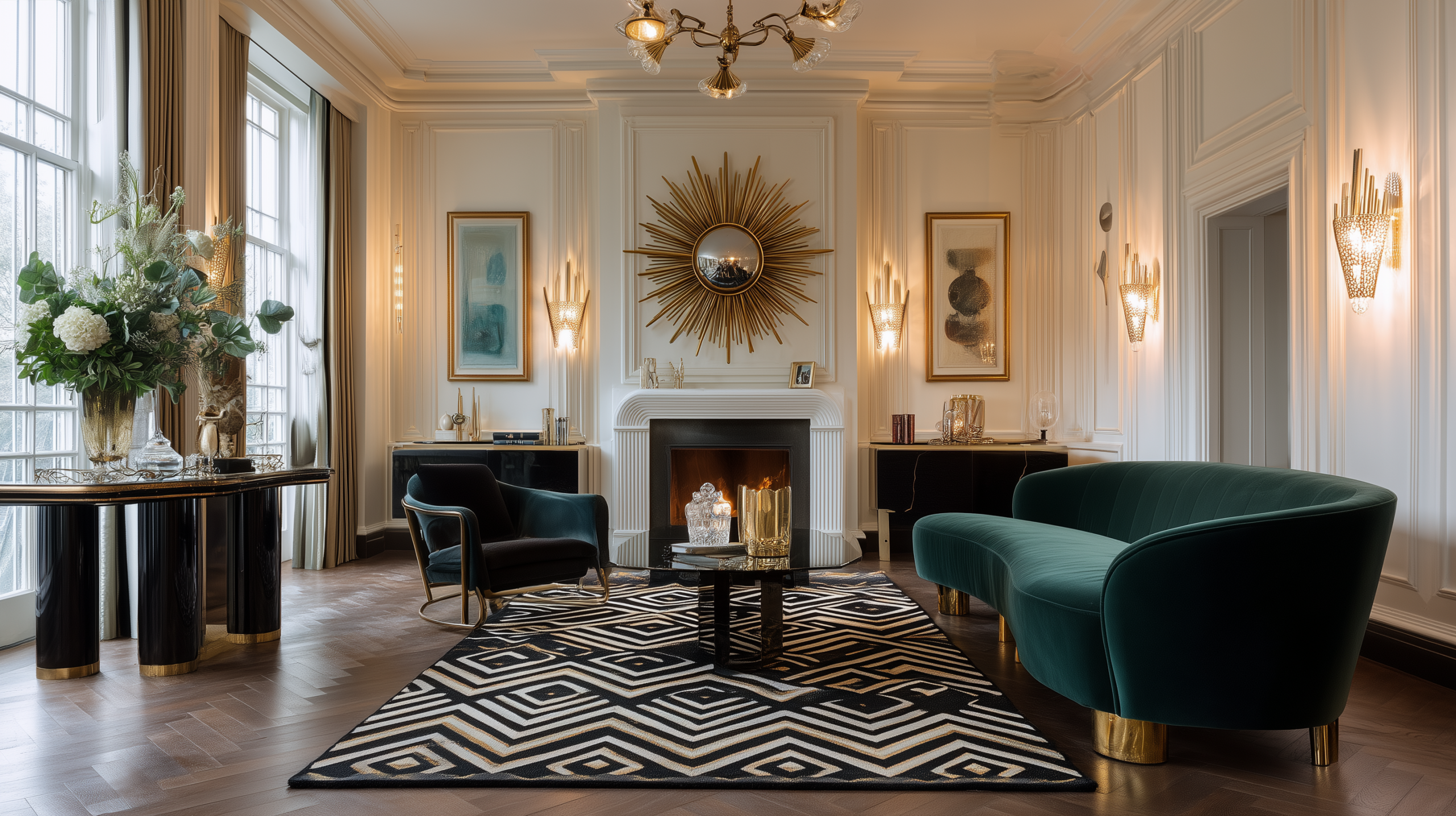
Key materials: Lacquered furniture, chrome and brass detailing, mirrored glass, marble, velvet upholstery, geometric patterned rugs.
Palette logic: Black and gold as the primary pairing. Emerald, sapphire, or deep teal as the colour statement. Chrome and mirror as the light-distributing metals.
Designer’s Note: The lighting specification is the single most important decision in an Art Deco interior. The style depends on the interplay of surface and light — the way chrome reflects, mirrored glass multiplies, and lacquer shimmers. Lighting that is too diffuse or too even will flatten the effect entirely.
Art Deco Style Guide → | Explore all Art Deco content →
23. Hollywood Glam Interior Design
Hollywood Glam — also referred to as Hollywood Regency — is an American design tradition with a specific origin: the interiors created for and by the entertainment industry in Los Angeles between the 1930s and 1960s.
Designers including Dorothy Draper, Billy Haines, and Kelly Wearstler (its contemporary inheritor) developed a style of unapologetic luxury, high contrast, and performative confidence.
The style is distinguished from Art Deco by its theatricality and its comfort with the playful. Where Art Deco is precise and serious, Hollywood Glam is dramatic and witty.
Black and white floors, lacquered walls in jewel tones, tufted velvet seating, crystal and brass lighting, chinoiserie accents, and mirrored surfaces coexist with leopard print, oversized florals, and sculptural decorative objects.
The palette is high contrast: black and white as the structural pairing, with one or two vivid colour statements — blush, emerald, cobalt, or gold — used with confidence. The overall effect should read as curated excess rather than undisciplined accumulation.
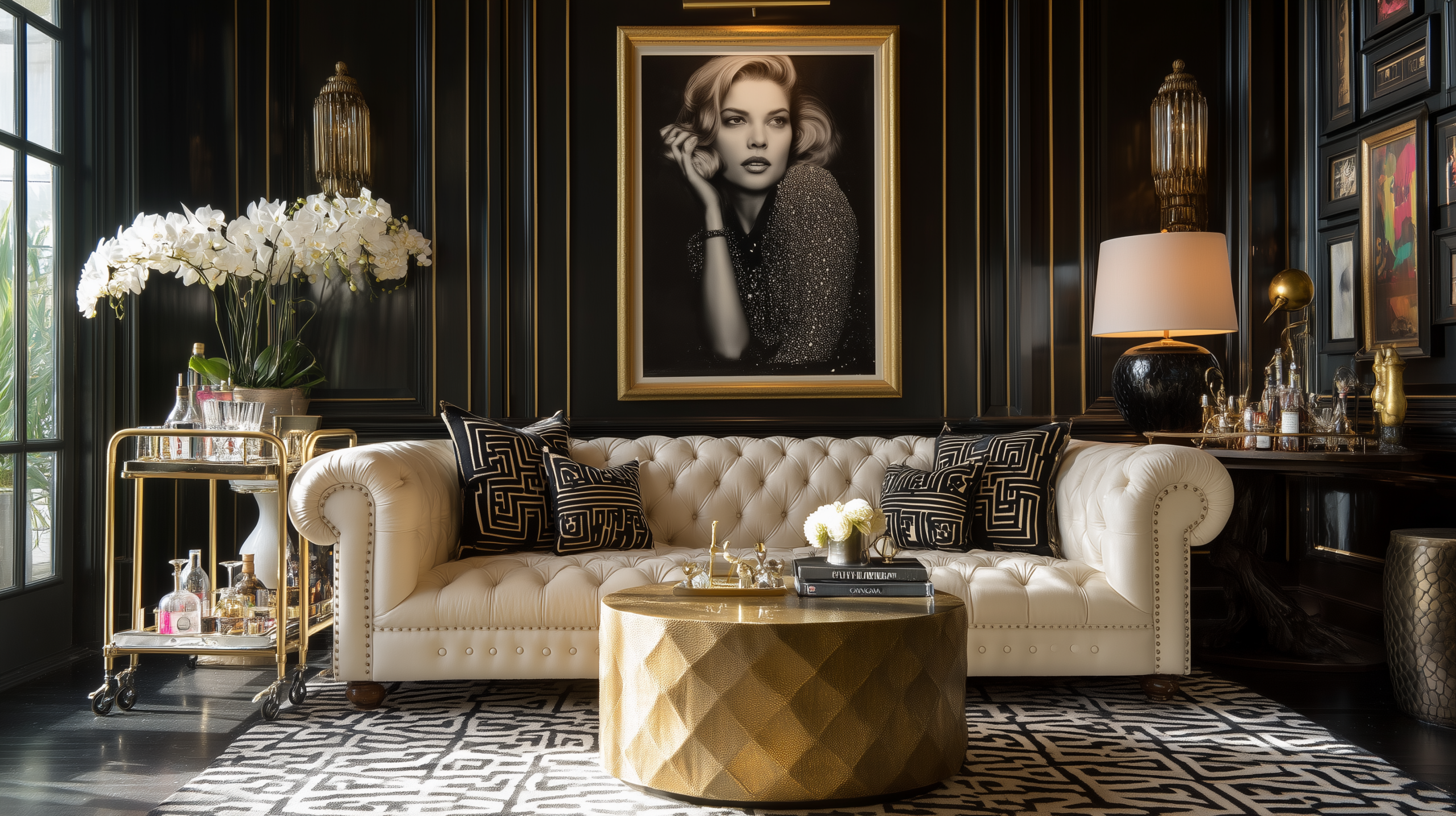
Key materials: Velvet upholstery in jewel tones, lacquered furniture, crystal chandeliers, brass and chrome, mirrored glass, chinoiserie decorative objects.
Palette logic: High contrast as the structural logic — black and white — with one vivid colour statement. Metallics are everywhere but must be coordinated (all brass, or all chrome; never mixed carelessly).
Designer’s Note: The bar cart, the crystal decanter, the sculptural table lamp — the accessories in a Hollywood Glam interior are not afterthoughts. They are the punctuation of the design. Source them with the same rigour as the furniture and they will elevate the space; treat them as secondary and the style reads as costume rather than design.
Available in SampleBoard Studio — including the ALBA style guide, mood board framework, and design presentation deck. Explore in Studio →
Hollywood Glam Style Guide → | Explore all Hollywood Glam content →
24. Shabby Chic Interior Design
Shabby Chic was codified by designer Rachel Ashwell in the 1980s as an aesthetic that found beauty in the gently worn, the softly faded, and the imperfectly preserved.
It is a style rooted in the romance of the secondhand — furniture with its paint gently lifting at the corners, linen slipcovers washed to a satisfying softness, pressed flower prints in ornate frames bought at a market rather than a shop.
The palette is deliberately pale and femininely weighted: chalk white, blush pink, soft sage, and powder blue are the dominant tones. Distressed painted furniture — typically in white, cream, or soft grey — is the furniture signature.
Textiles layer generously: lace, broderie anglaise, ruffled cotton, and loosely woven linen all coexist. Decorative objects are vintage or antique, chosen for sentiment as much as style.
The critical distinction between Shabby Chic and merely aged is intentionality. In a well-executed Shabby Chic interior, the distress is deliberate and the softness is carefully maintained. It is a romantic aesthetic, but it is not an accidental one.
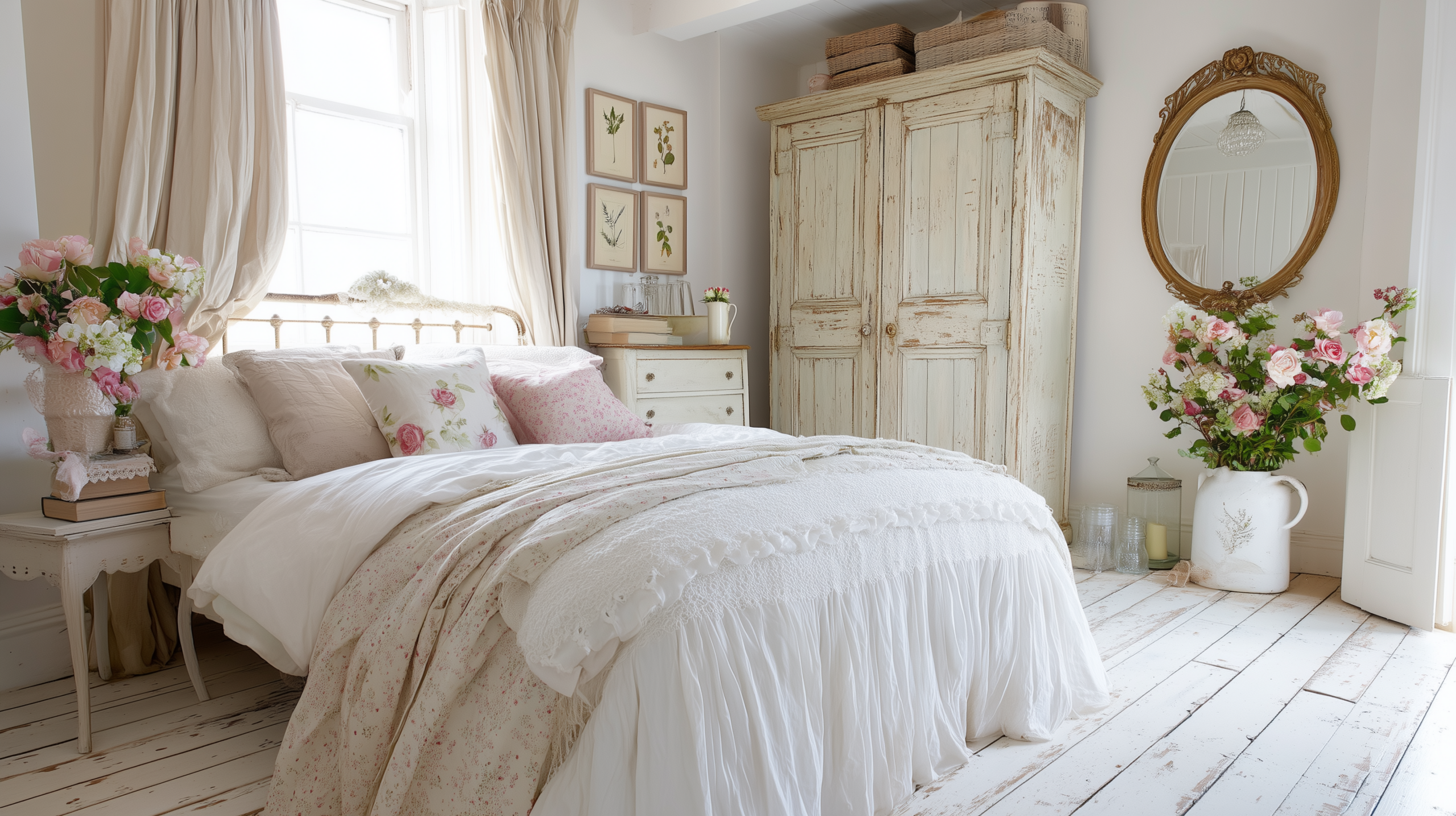
Key materials: Distressed painted timber furniture, lace and cotton textiles, botanical prints, pressed flowers, vintage and antique decorative objects, whitewashed or limewash walls.
Palette logic: Pale throughout — chalk white, blush, soft sage, powder blue. No dark tones; the lightness of the palette is integral to the style.
Designer’s Note: The strength of Shabby Chic is its emotional warmth; its risk is that it reads as decoratively dated in the wrong application. The contemporary version of the style works best when grounded by one or two more architecturally confident elements — a limestone floor, a simple plaster wall — that prevent it from becoming purely nostalgic.
Available in SampleBoard Studio — style guide, mood board framework, and design presentation deck coming soon. Explore in Studio →
Shabby Chic Style Guide → | Explore all Shabby Chic content →
25. Vintage Interior Design
Vintage design is distinguished from Retro by its relationship to authenticity. Retro recreates the aesthetic of a particular decade; Vintage works with objects that actually come from it.
The distinction matters because Vintage interiors carry a different kind of authority — the patina of age is real, the provenance is traceable, and the objects have a history that reproduction cannot replicate.
The style draws from a range of periods — typically anything from the early 20th century through the 1970s — and layers pieces from different decades within a single space.
A 1920s dresser, a 1950s armchair, a 1960s pendant light, and a 1970s ceramic — these can coexist in a Vintage interior when unified by palette and material harmony.
The palette tends toward the soft and faded: dusty rose, muted teal, warm mustard, aged cream, and soft rust — tones that reflect the way colour fades with time rather than the saturation of new production.
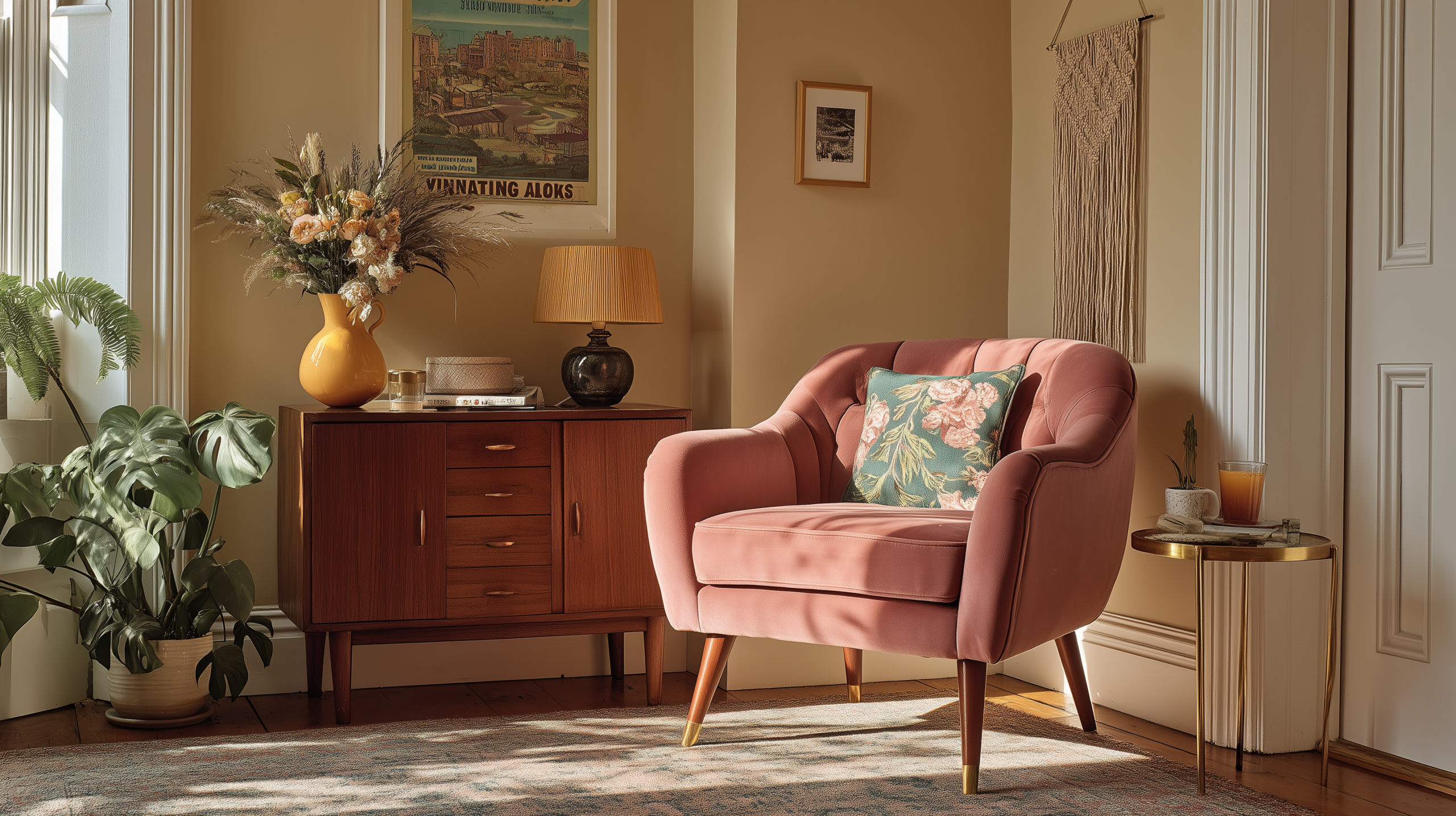
Key materials: Genuine vintage and secondhand furniture, aged brass, patinated timber, faded textiles, hand-painted ceramics, period lighting fixtures.
Palette logic: Desaturated and time-worn — dusty rose, faded teal, aged cream, warm mustard. Colour that reads as having mellowed rather than been chosen.
Designer’s Note: The sourcing practice is central to Vintage design. The most successful Vintage interiors are built over time, not assembled in one purchasing session. Encourage clients to develop a sourcing habit — markets, estate sales, and online vintage platforms — rather than expecting the look to be achieved immediately.
Cluster 5 — Regional & Material-Led
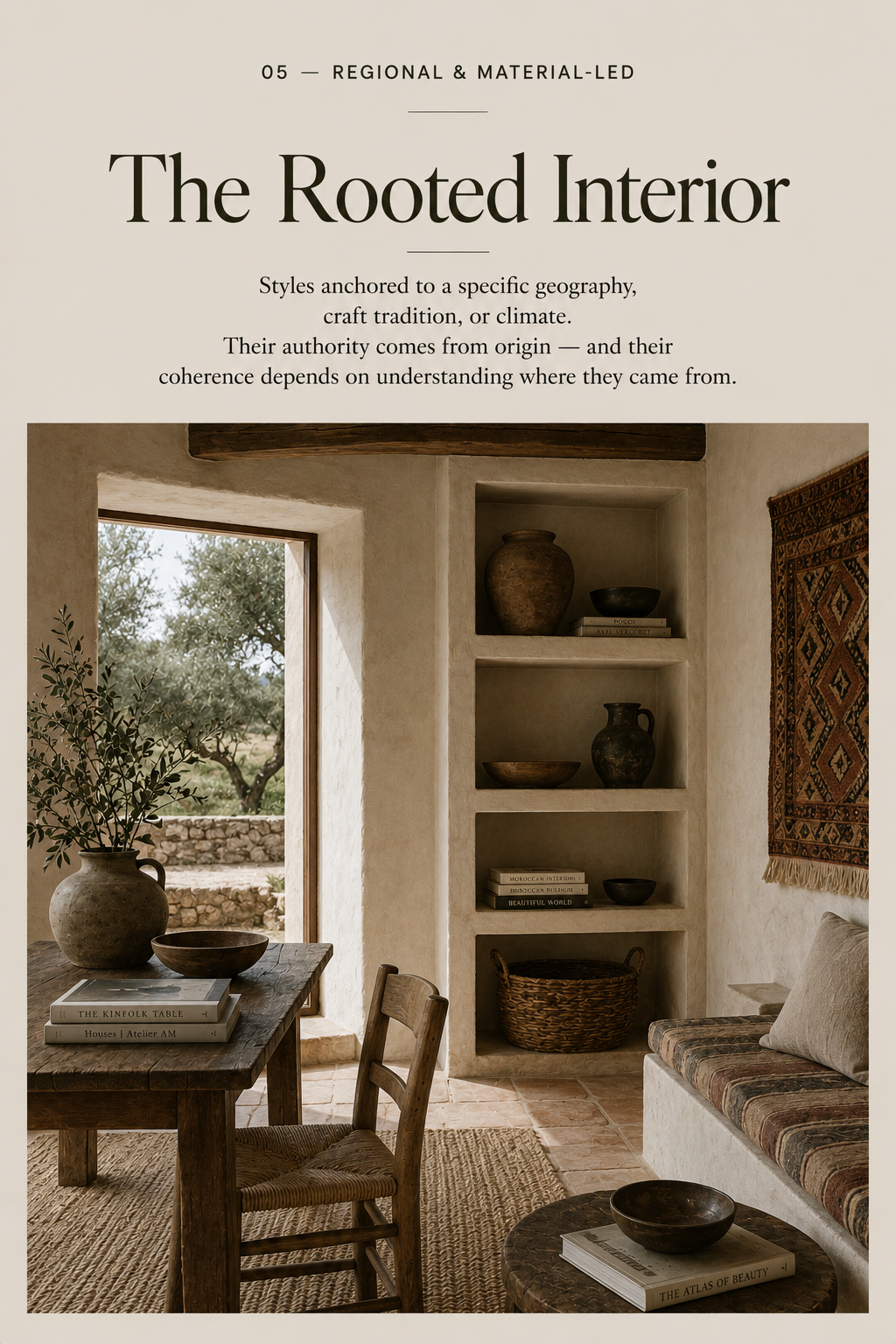
These styles are defined by a specific cultural context, material tradition, or geographic origin — and their integrity depends on how faithfully those roots are understood and applied.
Southwestern design draws from the living craft traditions of the American Southwest. Coastal design is shaped by the materials and light conditions of specific coastlines.
Industrial design grew from the conversion of specific building typologies. Understanding the origin of each style is what separates authentic application from surface-level appropriation.
26. Southwestern Interior Design
Southwestern interior design draws from three distinct and layered cultural traditions — Native American, Spanish Colonial, and Mexican — that have coexisted and influenced each other in the American Southwest for centuries.
Understanding this layering is essential, because the style is not a single coherent tradition but a fusion of several, and conflating them produces a generalised “desert aesthetic” that does a disservice to all three sources.
Native American craft traditions contribute the Navajo woven textile — geometric, bold, and produced in a specific set of regional colour systems — as well as turquoise jewellery-inspired colour usage, hand-coiled pottery, and the kiva fireplace as an architectural form.
Spanish Colonial influence introduces thick adobe walls, terracotta tile floors, carved timber vigas on ceilings, wrought iron light fixtures and hardware, and arched doorways. Mexican craft traditions add hand-painted Talavera ceramics, hammered copper, and embroidered textiles in saturated colour.
The palette is desert-derived and specific: terracotta, ochre, turquoise, clay red, and cactus green against the warm cream of adobe plaster. It is a warm palette, grounded in the particular quality of light in the high desert landscape of New Mexico, Arizona, and Colorado.
The most important editorial principle in Southwestern design is the distinction between the authentic and the themed. A Navajo-style rug purchased from a Native artist is culturally connected; a mass-produced “Aztec print” blanket is not, and the difference is visible in the design.
Similarly, the style is not interchangeable with generic “boho” or “desert” aesthetics — its material and cultural specificity is what gives it depth.
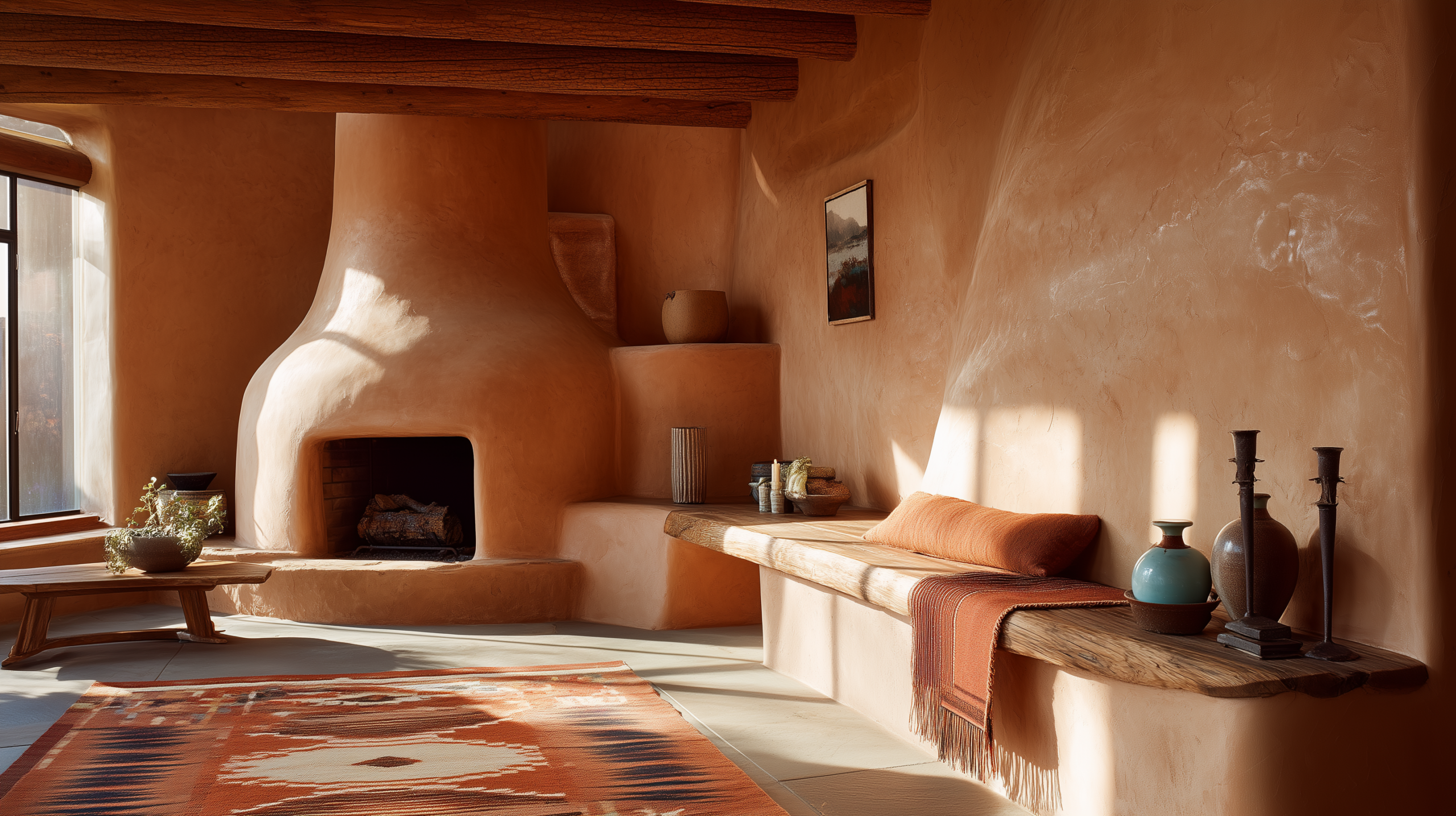
Key materials: Adobe plaster walls, terracotta tile, carved timber vigas, hand-woven Navajo-style textiles, turquoise, hammered copper, hand-painted Talavera ceramics, wrought iron.
Palette logic: Terracotta, ochre, turquoise, clay red, and cactus green against warm adobe cream. The palette should feel sun-baked and mineral rather than earthy-neutral.
Designer’s Note: Southwestern is one of the few styles where the sourcing of craft objects carries ethical weight. The distinction between authentic Native-made work and commercial appropriation matters — both culturally and aesthetically. Objects sourced from regional artisans carry a specificity and quality that mass-market equivalents cannot replicate, and this is visible in the finished space.
Available in SampleBoard Studio — including the SIENNA style guide, mood board framework, and design presentation deck. Explore in Studio →
Southwestern Style Guide → | Explore all Southwestern content →
27. Coastal Interior Design
Coastal interior design is not a single aesthetic but a family of related traditions — each shaped by a specific coastline, light condition, and cultural context. The Hamptons coastal style is architecturally formal, white-painted, and preppy.
Californian Coastal is relaxed, bleached, and influenced by surf culture. Australian Coastal is open-plan and material-forward with rattan and raw timber.
Mediterranean Coastal is terracotta and sun-bleached plaster. Understanding which coastal tradition you are working within is the first design decision.
What connects all coastal traditions is their relationship to light and air — pale palettes that maximise reflected light, natural fibres that respond to humidity, furniture profiles that feel casual and reconfigurable, and a preference for materials that age gracefully in proximity to salt and moisture.
The palette moves from crisp white through sand, bleached oak, and driftwood grey, with accent tones drawn from the specific body of water the tradition references — ocean blue for the Atlantic, deeper navy for the Pacific, cobalt for the Mediterranean.
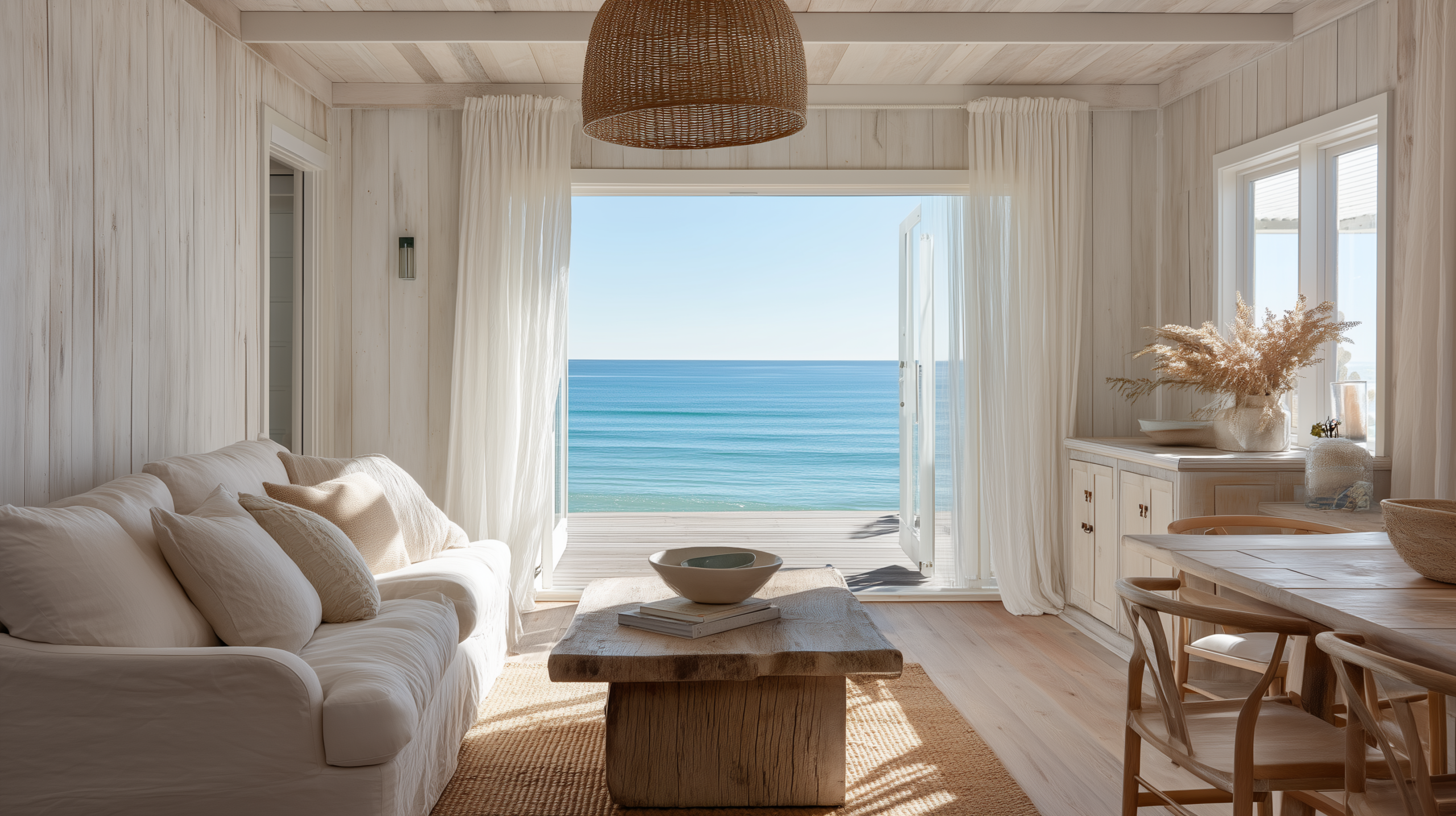
Key materials: Bleached or whitewashed timber, rattan, seagrass and jute, linen slipcovers, natural shell and driftwood accents, honed or tumbled stone.
Palette logic: White and sand as the base, with blue-tone accents calibrated to the specific coastal reference — from pale sky to deep ocean.
Designer’s Note: The most common coastal failure is the nautical motif — the rope detail, the anchor, the fish print. These are decorative shortcuts that signal the style rather than embody it. Authentic coastal interiors communicate through material — the texture of seagrass, the weight of a linen slipcover, the grain of bleached timber — not through motif.
Coastal Style Guide → | Explore all Coastal content →
28. Modern Farmhouse Interior Design
Modern Farmhouse is an American residential tradition that combines the material warmth and domestic functionality of agricultural buildings with the spatial openness and material restraint of contemporary design.
Its popularisation through the early 2010s television renovation culture has made it the most widely practised residential interior style in the United States, which has also produced a significant volume of generic or formulaic execution.
The authentic version of the style draws from actual farmhouse architecture: wide-plank timber floors, shiplap cladding as an interior wall treatment, exposed timber beams, functional galvanised metal details, and furniture built for daily family use rather than display.
The palette is warm and liveable: creamy whites, warm greys, natural timber tones, and soft blues or sage greens as accent.
What distinguishes Modern Farmhouse from Rustic is its contemporary spatial organisation — open-plan layouts, clean window proportions, and a restraint in decorative detail that keeps the space from becoming cluttered despite the warmth of its material palette.
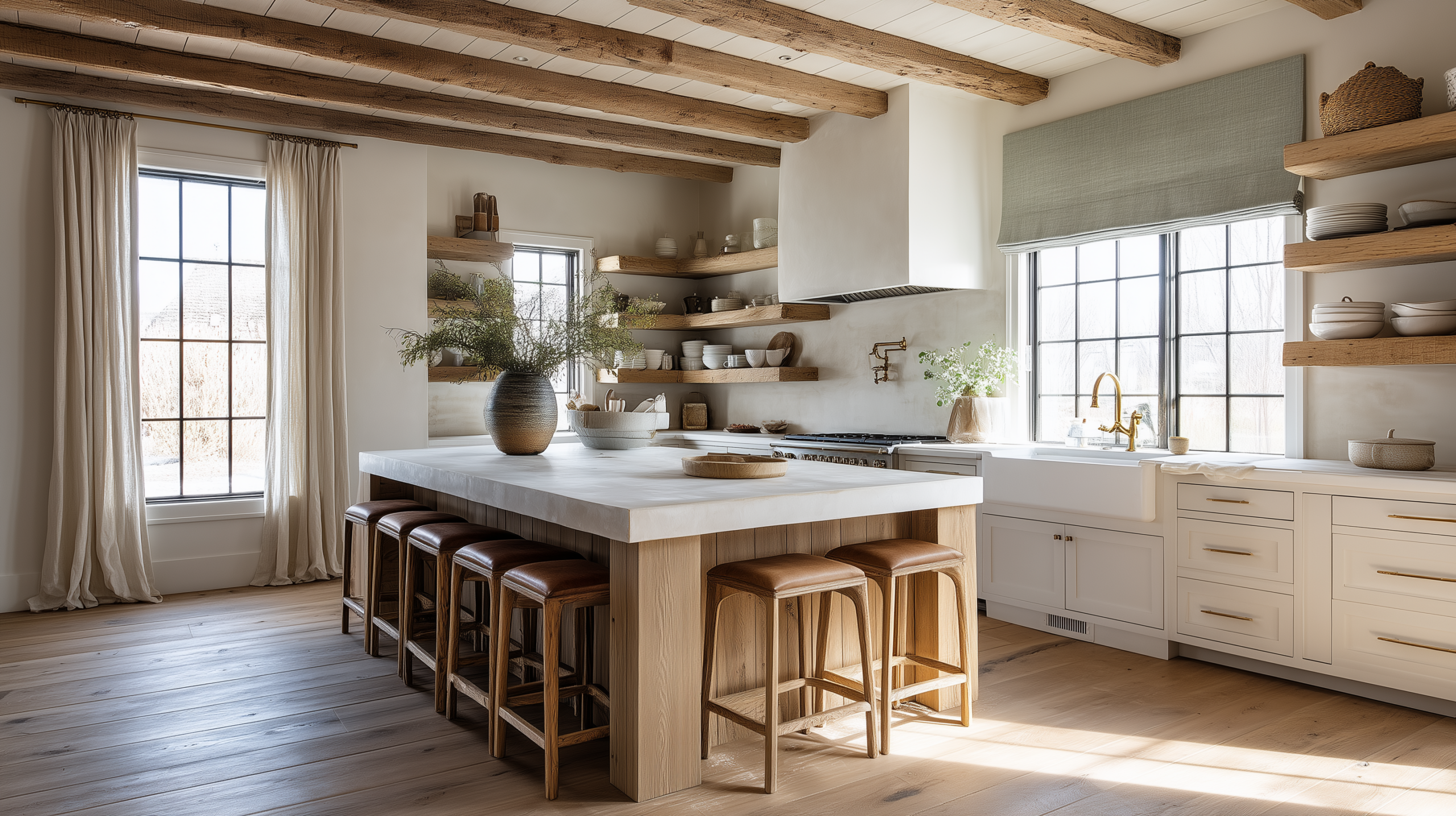
Key materials: Wide-plank timber flooring, shiplap timber cladding, exposed beams, galvanised metal, linen and cotton textiles, enamelware and functional ceramics.
Palette logic: Creamy white as the base with warm grey, natural timber, and one soft accent colour — sage, soft blue, or muted terracotta.
Designer’s Note: The shiplap wall has become shorthand for Modern Farmhouse to the point of cliché. It works when it is architecturally integrated and structurally honest; it fails when applied as a single-wall decorative feature without context. Apply farmhouse material references throughout the spatial logic of the room, not just at the most photographed surface.
Modern Farmhouse Style Guide → | Explore all Modern Farmhouse content →
29. Industrial and Brutalist Interior Design
Industrial interior design grew from a specific urban phenomenon: the conversion of 19th- and early 20th-century manufacturing buildings — warehouses, factories, print works, and engine rooms — into residential and commercial spaces.
The aesthetic is a consequence of architectural honesty: when you remove the dropped ceilings, carpeted floors, and plasterboard walls from an old factory, what you find is exposed brick, structural steel, polished concrete, and ductwork. Industrial design makes these elements the material language of the interior rather than concealing them.
The style is characterised by high volumes, raw material surfaces, and a palette of industrial tones: raw concrete grey, brick red, warm black, weathered steel, and the warm amber of aged timber.
Furniture references workshop and factory aesthetics — steel-framed pieces, reclaimed timber tabletops, factory stools, and Edison-bulb lighting. Leather, used heavily and honestly, adds warmth and patina.
Brutalism in interior design extends these principles with a greater emphasis on raw concrete as a finish — concrete ceilings, board-formed concrete walls, and exposed structural pours.
Where Industrial leans toward warmth through its reclaimed timber and leather, Brutalist interiors are cooler and more architecturally severe.
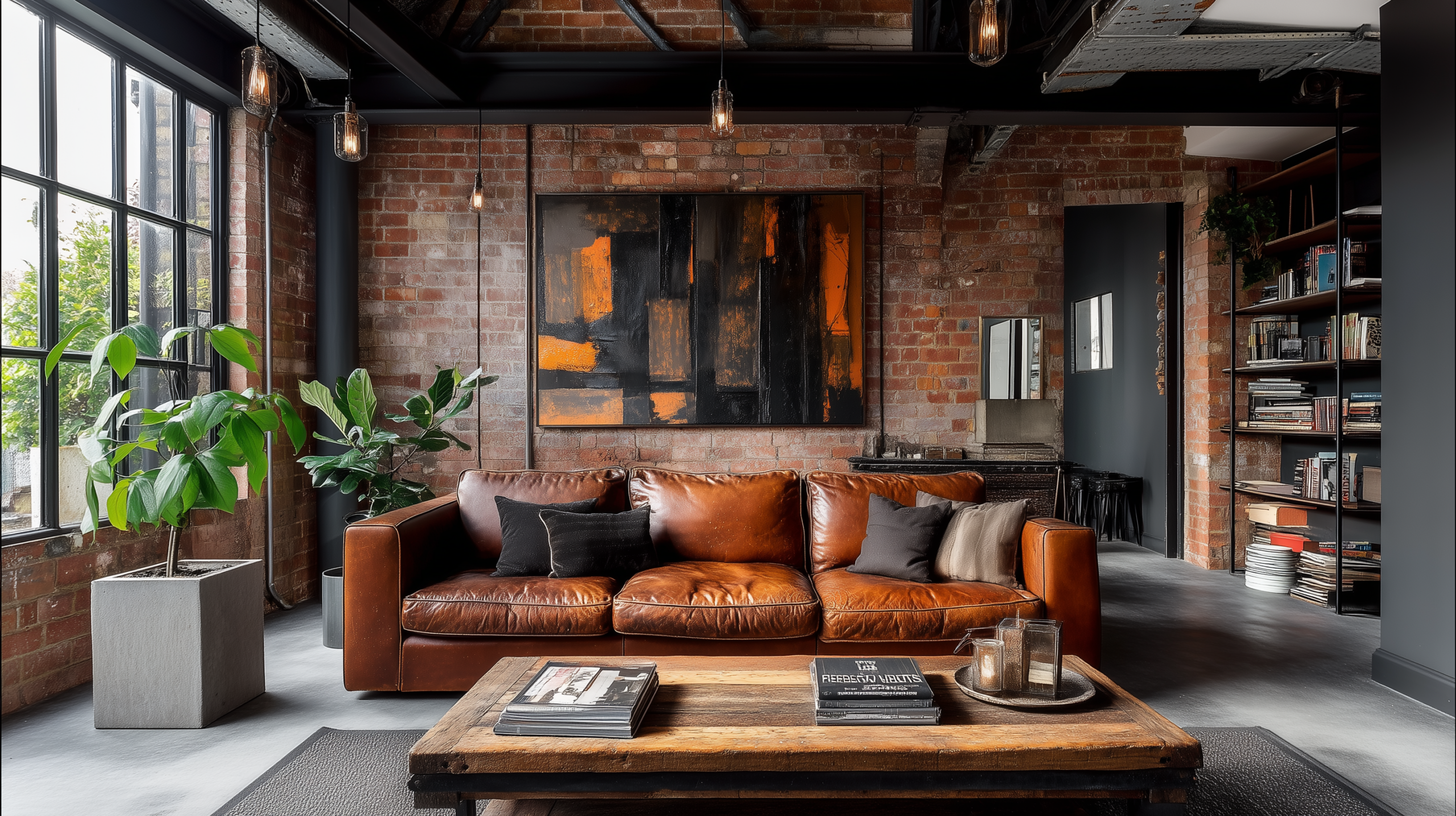
Key materials: Raw or polished concrete, exposed brick, structural steel, reclaimed timber, aged leather, Edison-bulb and industrial-grade lighting.
Palette logic: Concrete grey, warm black, brick red, and raw timber. The palette is derived from the materials rather than applied over them.
Designer’s Note: The warmth challenge in Industrial design is real and must be addressed deliberately. Greenery in large-scale planters, generous leather upholstery, and layered wool or cotton textiles prevent the space from reading as a building site. The goal is not to soften the rawness but to balance it.
Industrial Style Guide → | Explore all Industrial content →
30. Contemporary Interior Design
Contemporary design is, by definition, what is being made now — which means it is in constant motion and cannot be pinned to a fixed set of visual characteristics.
In professional practice, the term refers to a design approach that draws on current ideas in architecture, material science, and cultural production without committing to the rules of any historical style.
What contemporary design tends to share across its many expressions is an openness to new materials and technologies alongside a continued preference for clean spatial organisation, considered natural light, and a palette that builds from neutral to expressive rather than the reverse.
Plush upholstery and layered lighting distinguish it from Minimalism; the absence of period references distinguishes it from Traditional or Art Deco.
The most coherent Contemporary interiors are defined by a clear material hierarchy — one or two dominant materials used with discipline, supported by a restrained palette, with one or two expressive moments of art or form that give the space its character.
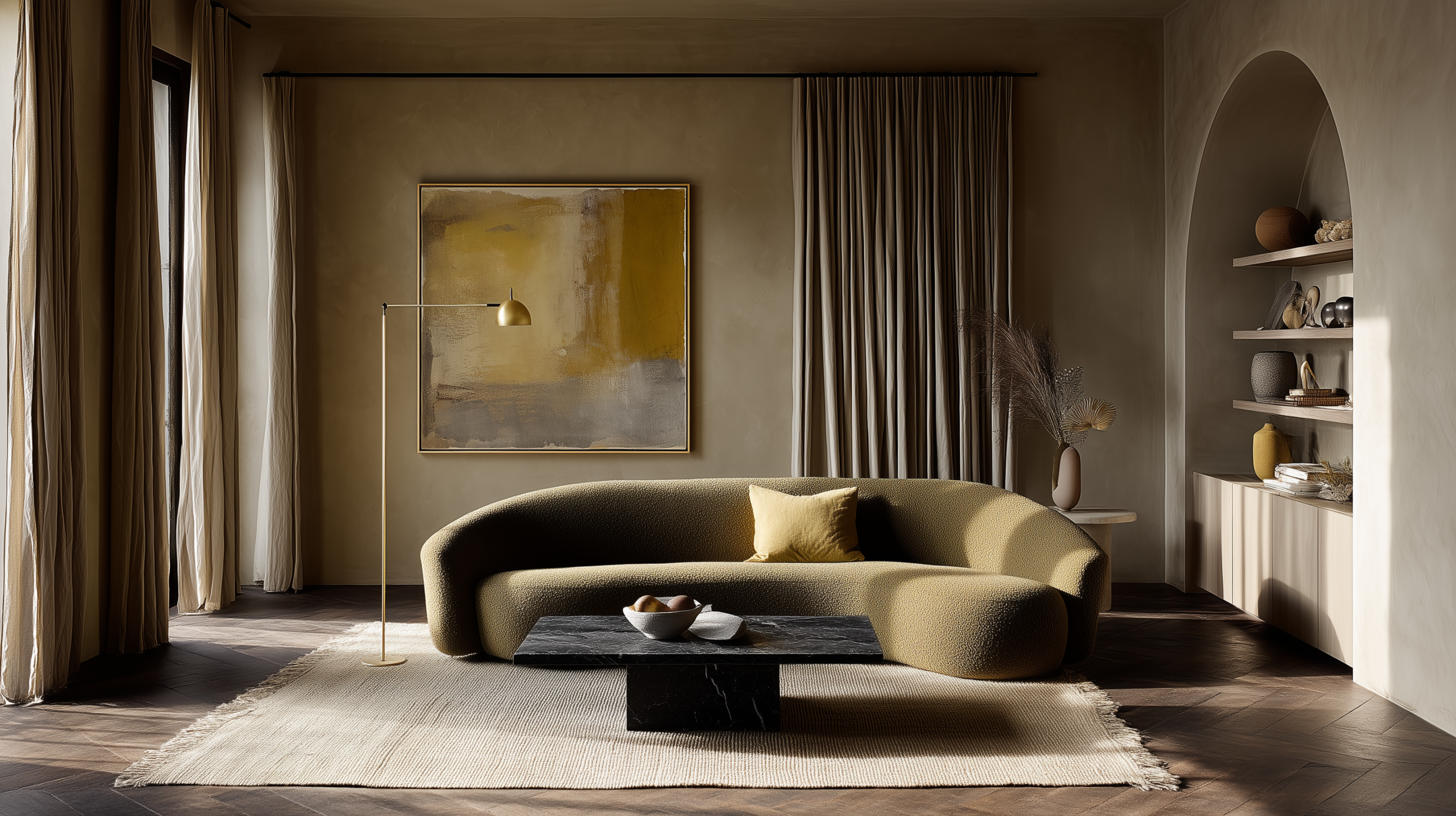
Key materials: Current — natural stone, engineered timber, tactile upholstery, glass and metal in refined finishes. Material selection should reflect what is available and well-made at the time of specification.
Palette logic: Neutral base with one expressive colour decision. The palette should feel current without following a trend — this requires knowledge of what is overused at any given moment.
Designer’s Note: Contemporary design dates faster than any other style precisely because it is tied to the present. Build the foundational material decisions — flooring, fixed joinery, major furniture — for longevity, and allow the expressive moments to be refreshed as the space evolves.
Contemporary Style Guide → | Explore all Contemporary content →
31. Mid-Century Modern Interior Design
Mid-Century Modern is one of the most precisely defined styles on this list — because it refers to a documented design movement with a specific geographic and temporal origin: the postwar design culture of the United States, Scandinavia, and Italy between approximately 1945 and 1969.
The designers who defined it — Charles and Ray Eames, Eero Saarinen, Arne Jacobsen, Hans Wegner, George Nelson, and Gio Ponti among them — were designing with a genuine formal program: to use new industrial materials and manufacturing processes to make beautiful, functional, affordable furniture for a generation beginning again after the war.
The formal language is unmistakable: organic shapes drawn from natural forms, tapered legs, low horizontal profiles, and the expressive use of moulded plywood, fibreglass, and aluminium alongside warm teak and walnut.
The palette combines warm neutrals with period-specific accent colours: mustard, burnt orange, teal, olive green, and the particular avocado and harvest gold of the late 1960s American moment.
The style has proven extraordinarily durable because its underlying formal logic — the honest expression of material, the integration of form and function, the preference for quality craft over decoration — is timeless even as specific pieces become period markers.
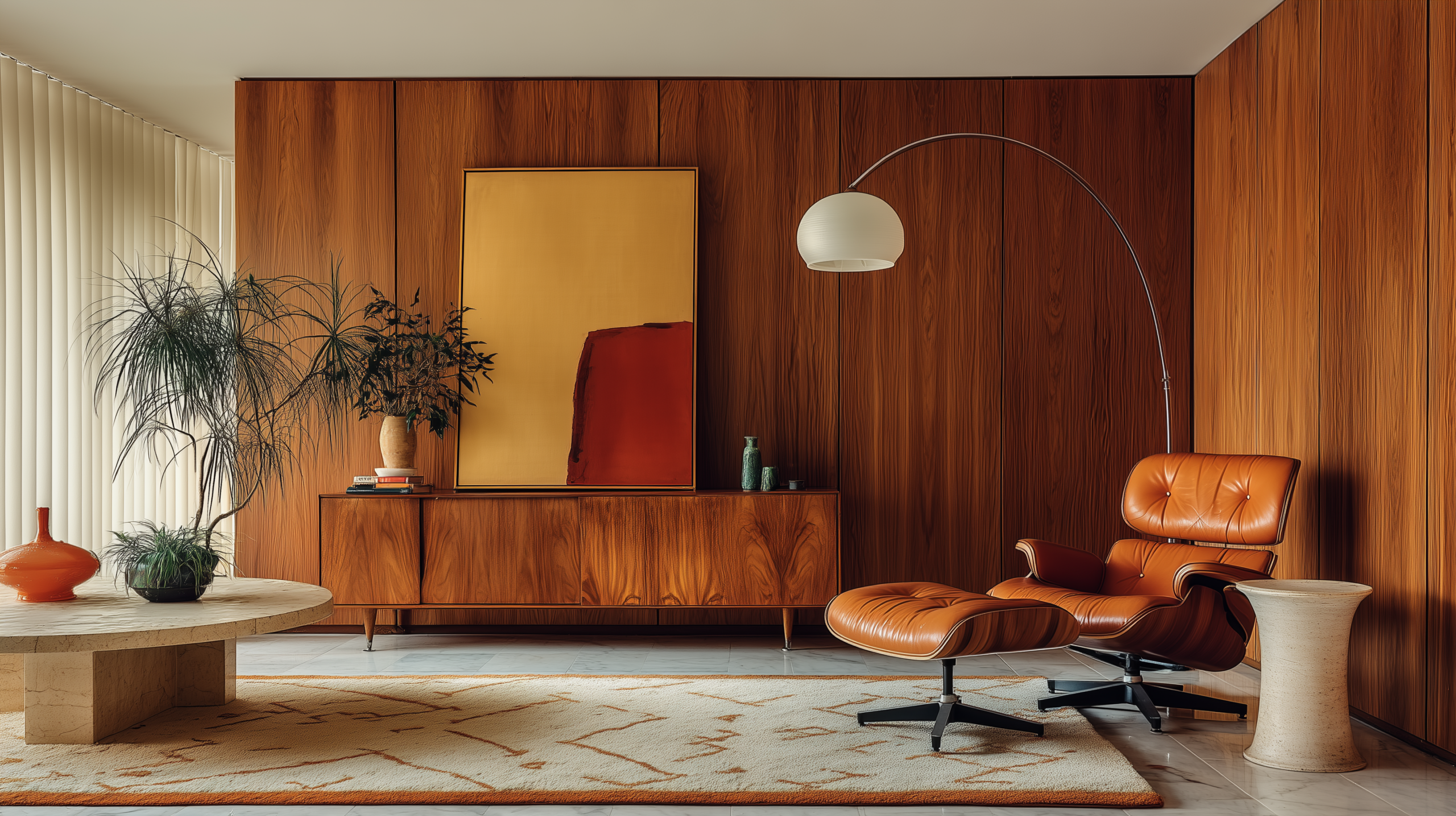
Key materials: Teak and walnut in thin profiles, moulded plywood, fibreglass shell furniture, aluminium and chrome, wool upholstery in period colours.
Palette logic: Warm neutrals as the base with period accent colours — mustard, burnt orange, teal, olive. The palette should feel warm and optimistic rather than cool and minimal.
Designer’s Note: The most important distinction in sourcing Mid-Century Modern is between original period pieces, licensed reproductions from the original manufacturers (Herman Miller, Fritz Hansen, Vitra), and unlicensed copies. This distinction matters aesthetically as well as ethically — the material quality and dimensional accuracy of licensed pieces is meaningfully different from reproduction furniture, and it shows in the finished space.
Mid-Century Modern Style Guide → | Explore all Mid-Century Modern content →
From Understanding to Application — SampleBoard Studio
Knowing a style is the first layer of design education. Applying it with enough precision to present it to a client — in a mood board, a design concept, or a professional presentation — is a separate and learnable skill.
SampleBoard Studio is built for that second layer.
Seven of the styles in this guide are available as full structured resources: a foundational style guide that covers principles, material logic, colour systems, and cultural context; a mood board framework for the creative exploration phase; and a design presentation deck formatted for client delivery.
The seven styles currently in Studio are: Minimalist (LILLI), Bohemian (LIV), Hollywood Glam (ALBA), Organic Modern (JUNO), Southwestern (SIENNA), Japandi (JUNIPER), and Shabby Chic (ROSE)
Take any style from understanding to execution.
Seven styles from this guide are available in Studio now — each with a foundational style guide, a structured Canva mood board system, and a client-ready presentation framework. A new style releases every month.
Explore Studio membership →Frequently Asked Questions
What are the main interior design styles?
The most significant interior design styles include Scandinavian, Minimalist, Japandi, Organic Modern, Coastal, Industrial, Mediterranean, Rustic, Modern Farmhouse, Bohemian, Mid-Century Modern, Traditional, Transitional, Art Deco, Hollywood Glam, Moroccan, and Southwestern. Each has a distinct material palette, spatial logic, and cultural origin. A complete guide to all 31 styles is above.
How do I choose an interior design style?
Start with the spatial and architectural reality of the project — the ceiling height, floor material, window proportions, and building typology. Many styles have material prerequisites that either work with or against the existing architecture. Then consider the client’s daily patterns, their relationship to maintenance, and the emotional register they want the space to produce. Style selection is a brief process, not just an aesthetic preference.
Can interior design styles be mixed?
Yes — and most successful residential interiors blend two styles, one dominant and one complementary. The five cluster groupings in this guide identify which styles share enough material and spatial logic to blend naturally. Styles from the same cluster are the safest starting point. Styles from different clusters require a clear unifying material or colour decision to prevent the space from reading as unresolved.
What is the most timeless interior design style?
Styles that are least dependent on trend cycles tend to be the most enduring. Scandinavian, Organic Modern, Transitional, and Mid-Century Modern all have this quality — their underlying principles (material honesty, functional clarity, natural warmth) do not date the way decorative choices do. Traditional and Victorian are also deeply durable but are more sensitive to the quality of execution.
Which style works best for small spaces?
Styles that favour visual simplicity and furniture with a light spatial footprint perform best in smaller rooms — Minimalist, Scandinavian, Japandi, and Asian Zen are well suited. The key variables are furniture scale (pieces proportioned to the room), visual complexity (fewer patterns and objects), and the palette’s relationship to light (pale tones make walls recede; dark tones advance them).
What styles are best for a warm and welcoming space?
Warmth in interior design is produced by a combination of material weight (heavier, denser materials read as warmer), colour temperature (warm-toned neutrals read warmer than cool greys), and textile layering. Rustic, Modern Farmhouse, Bohemian, Mediterranean, French Country, and Organic Modern are all strong choices for spaces intended to feel genuinely welcoming rather than formally impressive.
Which styles are most relevant for interior design students to study?
A working knowledge of Scandinavian, Minimalist, Organic Modern, Transitional, and Mid-Century Modern is essential for professional practice — these styles appear most frequently in residential briefs. Supplementary knowledge of Japandi, Bohemian, Coastal, and Southwestern covers the majority of remaining residential requests. Traditional and Art Deco are important for luxury and heritage projects. The seven SampleBoard Studio styles are a strong starting framework — they cover the range from minimal to expressive and include both mainstream and culturally specific references.
Are there student pricing options for Studio?
| SampleBoard Studio offers 75% off for Interior Design Institute students. Membership gives you immediate access to seven complete style systems — Minimalist, Japandi, Organic Modern, Bohemian, Hollywood Glam, Southwestern, and Shabby Chic — each including a foundational style guide, a structured Canva mood board template, and a professional presentation framework. A new style is released monthly. Explore Studio Membership → |
Where can I explore interior design styles in depth?
Each style above links to a dedicated style guide on SampleBoard. Seven styles — Minimalist, Bohemian, Hollywood Glam, Organic Modern, Southwestern, Japandi, and Shabby Chic — are available as complete structured resources inside SampleBoard Studio, including foundational guides, mood board frameworks, and design presentation templates.
How this fits into the SampleBoard system
Stage 2 of 4 — building the vocabulary of design. From here: apply the palette through the Color Direction pillar → see which trends are shaping each style → then take any style from concept to client presentation in SampleBoard Studio →